Thank you for visiting SNEWPapers!
Sign up free
Editorial
February 14, 1875
Nashville Union And American
Nashville, Davidson County, Tennessee
What is this article about?
Editorial from Chattanooga Commercial argues Tennessee's poverty stems from over-reliance on agriculture and trade, with high unemployment and lack of industrial diversification. Urges shift to manufacturing and production to boost prosperity for the state and South.
Clipping
OCR Quality
98%
Excellent
Full Text
THOSE OLD GROOVES. No Hope for Tennessee Until She Gets Out of Them, Chattanooga Commercial.
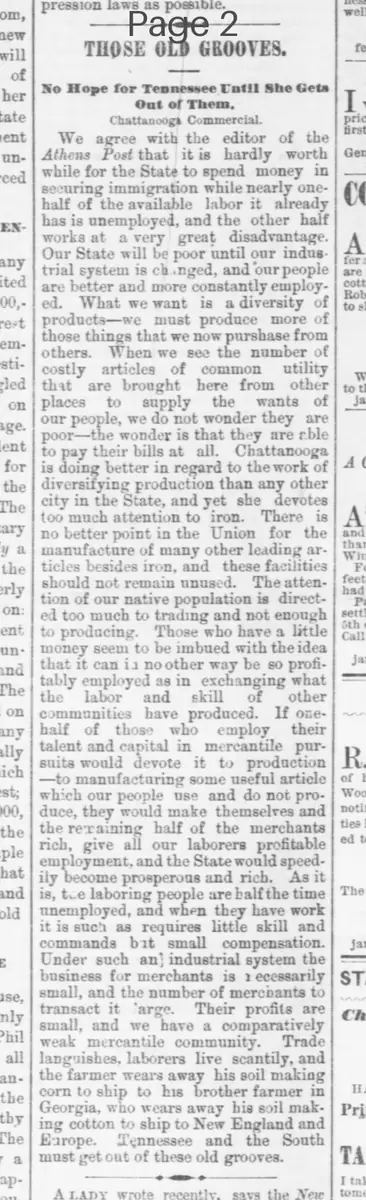
We agree with the editor of the Athens Post that it is hardly worth while for the State to spend money in securing immigration while nearly one-half of the available labor it already has is unemployed, and the other half works at a very great disadvantage. Our State will be poor until our industrial system is changed, and our people are better and more constantly employed. What we want is a diversity of products—we must produce more of those things that we now purchase from others. When we see the number of costly articles of common utility that are brought here from other places to supply the wants of our people, we do not wonder they are poor—the wonder is that they are able to pay their bills at all. Chattanooga is doing better in regard to the work of diversifying production than any other city in the State, and yet she devotes too much attention to iron. There is no better point in the Union for the manufacture of many other leading articles besides iron, and these facilities should not remain unused. The attention of our native population is directed too much to trading and not enough to producing. Those who have a little money seem to be imbued with the idea that it can in no other way be so profitably employed as in exchanging what the labor and skill of other communities have produced. If one-half of those who employ their talent and capital in mercantile pursuits would devote it to production—to manufacturing some useful article which our people use and do not produce, they would make themselves and the remaining half of the merchants rich, give all our laborers profitable employment, and the State would speedily become prosperous and rich. As it is, the laboring people are half the time unemployed, and when they have work it is such as requires little skill and commands but small compensation. Under such an industrial system the business for merchants is necessarily small, and the number of merchants to transact it large. Their profits are small, and we have a comparatively weak mercantile community. Trade languishes, laborers live scantily, and the farmer wears away his soil making corn to ship to his brother farmer in Georgia, who wears away his soil making cotton to ship to New England and Europe. Tennessee and the South must get out of these old grooves.
We agree with the editor of the Athens Post that it is hardly worth while for the State to spend money in securing immigration while nearly one-half of the available labor it already has is unemployed, and the other half works at a very great disadvantage. Our State will be poor until our industrial system is changed, and our people are better and more constantly employed. What we want is a diversity of products—we must produce more of those things that we now purchase from others. When we see the number of costly articles of common utility that are brought here from other places to supply the wants of our people, we do not wonder they are poor—the wonder is that they are able to pay their bills at all. Chattanooga is doing better in regard to the work of diversifying production than any other city in the State, and yet she devotes too much attention to iron. There is no better point in the Union for the manufacture of many other leading articles besides iron, and these facilities should not remain unused. The attention of our native population is directed too much to trading and not enough to producing. Those who have a little money seem to be imbued with the idea that it can in no other way be so profitably employed as in exchanging what the labor and skill of other communities have produced. If one-half of those who employ their talent and capital in mercantile pursuits would devote it to production—to manufacturing some useful article which our people use and do not produce, they would make themselves and the remaining half of the merchants rich, give all our laborers profitable employment, and the State would speedily become prosperous and rich. As it is, the laboring people are half the time unemployed, and when they have work it is such as requires little skill and commands but small compensation. Under such an industrial system the business for merchants is necessarily small, and the number of merchants to transact it large. Their profits are small, and we have a comparatively weak mercantile community. Trade languishes, laborers live scantily, and the farmer wears away his soil making corn to ship to his brother farmer in Georgia, who wears away his soil making cotton to ship to New England and Europe. Tennessee and the South must get out of these old grooves.
What sub-type of article is it?
Economic Policy
Trade Or Commerce
Labor
What keywords are associated?
Industrial Diversification
Unemployment
Production Over Trade
Tennessee Economy
Southern Prosperity
Manufacturing
Agricultural Depletion
What entities or persons were involved?
Chattanooga Commercial
Athens Post
Tennessee
Chattanooga
South
Editorial Details
Primary Topic
Industrial Diversification And Economic Reform In Tennessee
Stance / Tone
Advocacy For Shifting From Trade And Agriculture To Manufacturing And Production
Key Figures
Chattanooga Commercial
Athens Post
Tennessee
Chattanooga
South
Key Arguments
State Should Not Invest In Immigration While Existing Labor Is Unemployed
Industrial System Must Change For Better Employment And Prosperity
Need Diversity Of Products To Reduce Imports
Chattanooga Over Focuses On Iron Despite Potential For Other Manufacturing
Population Too Focused On Trading Rather Than Producing
Redirecting Capital To Production Would Enrich Merchants, Employ Laborers, And Prosper The State
Current System Leads To Unemployment, Low Wages, Weak Trade, And Soil Depletion In Agriculture