Thank you for visiting SNEWPapers!
Sign up free
Editorial
August 1, 1792
Gazette Of The United States
New York, New York County, New York
What is this article about?
Editorial warns against enemies of the Union using fabricated letters in newspapers and extralegal clubs to subvert the U.S. government, praises the Constitution as a safeguard against despotism and anarchy, references American Revolution and French experiences, and cites letters from St. Lucia and M. Andre Chenier as examples of misinformation.
Clipping
OCR Quality
98%
Excellent
Full Text
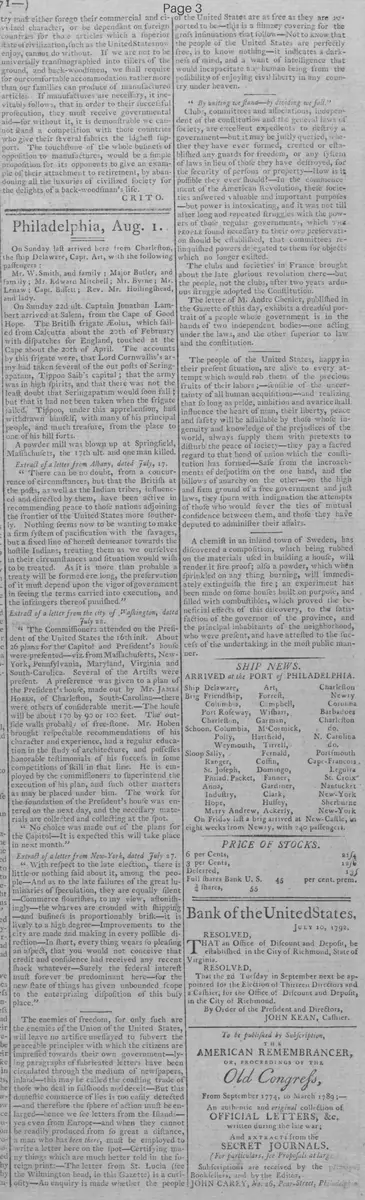
The enemies of freedom, for only such are the enemies of the Union of the United States, will leave no artifice unessayed to subvert the peaceable principles with which the citizens are impressed towards their own government—lying paragraphs of fabricated letters have been circulated through the medium of newspapers, inland—this may be called the coasting trade of those who deal in falsehoods and deceit—But this domestic commerce of lies is too easily detected—and therefore the sphere of action must be enlarged—hence we see letters from the Islands—yea even from Europe—and when they cannot be readily produced from so great a distance, a man who has been there, must be employed to write a letter here on the spot—Certifying many things which are much better told in the foreign prints—The letter from St. Lucia (see the Wilmington head, in this Gazette) is a curiosity—An enquiry is made whether the people of the United States are as free as they are reported to be—this is a flimsy covering for the gross insinuations that follow—Not to know that the people of the United States are perfectly free, is to know nothing—it indicates a darkness of mind, and a want of intelligence that would incapacitate a human being from the possibility of enjoying civil liberty in any country under heaven.
"By uniting we stand—by dividing we fall."
Clubs, committees and associations, independent of the constitution and the general laws of society, are excellent expedients to destroy a government—but it may be justly queried, whether they have ever formed, created or established any guards for freedom, or any system of laws in lieu of those they have destroyed, for the security of persons or property—how is it possible they ever should?—In the commencement of the American Revolution, these societies answered valuable and important purposes—but power is intoxicating, and it was not till after long and repeated struggles with the powers of those regular governments, which THE PEOPLE found necessary to their own preservation should be established, that committees relinquished powers delegated to them for objects which no longer existed.
The clubs and societies' in France brought about the late glorious revolution there—but the people, not the clubs, after two years arduous struggle adopted the Constitution.
The letter of M. Andre Chenier, published in the Gazette of this day, exhibits a dreadful portrait of a people whose government is in the hands of two independent bodies—one acting under the laws, and the other superior to law and the constitution.
The people of the United States, happy in their present situation, are alive to every attempt which would rob them of the precious fruits of their labors;—sensible of the uncertainty of all human acquisitions—and realizing that so long as pride, ambition and avarice shall influence the heart of man, their liberty, peace and safety will be assailable by those whose ingenuity and knowledge of the prejudices of the world, always supply them with pretexts to disturb the peace of society—they pay a sacred regard to that bond of union which the constitution has formed—Safe from the encroachments of despotism on the one hand, and the billows of anarchy on the other—on the high and firm ground of a free government and just laws, they spurn with indignation the attempts of those who would sever the ties of mutual confidence between them, and those they have deputed to administer their affairs.
"By uniting we stand—by dividing we fall."
Clubs, committees and associations, independent of the constitution and the general laws of society, are excellent expedients to destroy a government—but it may be justly queried, whether they have ever formed, created or established any guards for freedom, or any system of laws in lieu of those they have destroyed, for the security of persons or property—how is it possible they ever should?—In the commencement of the American Revolution, these societies answered valuable and important purposes—but power is intoxicating, and it was not till after long and repeated struggles with the powers of those regular governments, which THE PEOPLE found necessary to their own preservation should be established, that committees relinquished powers delegated to them for objects which no longer existed.
The clubs and societies' in France brought about the late glorious revolution there—but the people, not the clubs, after two years arduous struggle adopted the Constitution.
The letter of M. Andre Chenier, published in the Gazette of this day, exhibits a dreadful portrait of a people whose government is in the hands of two independent bodies—one acting under the laws, and the other superior to law and the constitution.
The people of the United States, happy in their present situation, are alive to every attempt which would rob them of the precious fruits of their labors;—sensible of the uncertainty of all human acquisitions—and realizing that so long as pride, ambition and avarice shall influence the heart of man, their liberty, peace and safety will be assailable by those whose ingenuity and knowledge of the prejudices of the world, always supply them with pretexts to disturb the peace of society—they pay a sacred regard to that bond of union which the constitution has formed—Safe from the encroachments of despotism on the one hand, and the billows of anarchy on the other—on the high and firm ground of a free government and just laws, they spurn with indignation the attempts of those who would sever the ties of mutual confidence between them, and those they have deputed to administer their affairs.
What sub-type of article is it?
Constitutional
Partisan Politics
What keywords are associated?
Union
Constitution
Freedom
Fabricated Letters
Newspapers
Clubs
Committees
American Revolution
French Revolution
Anarchy
Despotism
What entities or persons were involved?
Enemies Of Freedom
M. Andre Chenier
Clubs And Committees
People Of The United States
Editorial Details
Primary Topic
Defense Of The Union Against Subversion By Propaganda And Extralegal Societies
Stance / Tone
Strongly Pro Union And Pro Constitution, Warning Against Anarchy And Despotism
Key Figures
Enemies Of Freedom
M. Andre Chenier
Clubs And Committees
People Of The United States
Key Arguments
Fabricated Letters In Newspapers Are Tools To Subvert Peaceable Government Principles.
Domestic Lies Are Easily Detected, So Fabrications From Distant Places Like St. Lucia And Europe Are Used.
The People Of The United States Are Perfectly Free, And Ignorance Of This Indicates Incapacity For Liberty.
"By Uniting We Stand—By Dividing We Fall."
Clubs And Associations Destroy Governments But Fail To Establish Lasting Guards For Freedom Or Laws.
In The American Revolution, Committees Served Purposes But Eventually Relinquished Power To Regular Governments.
In France, Clubs Sparked Revolution, But The People Adopted The Constitution After Struggle.
M. Andre Chenier's Letter Shows Dangers Of Governments With Bodies Superior To Law And Constitution.
The People Safeguard Their Liberty Through Sacred Regard For The Constitutional Bond Of Union.
They Reject Attempts To Sever Ties Of Mutual Confidence With Deputed Administrators.