Thank you for visiting SNEWPapers!
Sign up free
Daily National Intelligencer
Washington, District Of Columbia
What is this article about?
Article from Niles' Weekly Register discusses the promising cultivation of sugar cane on Louisiana's Red River lands near Natchitoches, highlighting high yields, economic advantages over cotton, and certificates from planters T. Bossie and S. Davenport dated 1813 and 1816, emphasizing the region's potential to become a major sugar producer.
Clipping
OCR Quality
Full Text
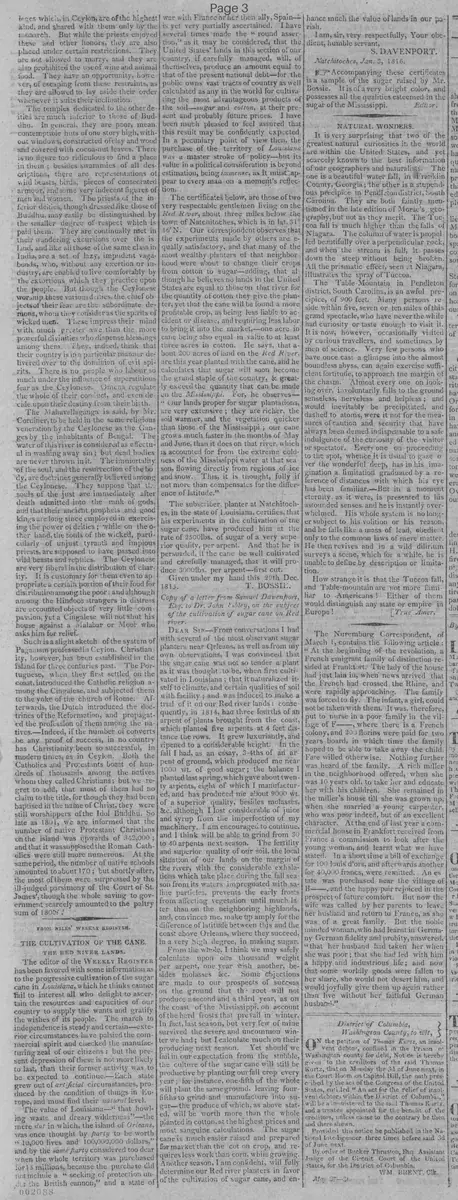
THE CULTIVATION OF THE CANE.
THE RED RIVER LANDS.
The editor of the Weekly Register has been favored with some information as to the progressive cultivation of the sugar cane in Louisiana, which he thinks cannot fail to interest all who delight to ascertain the resources and capacities of our country to supply the wants and gratify the wishes of its people. The march to independence is steady and certain—exterior circumstances have palsied the commercial spirit and checked the manufacturing zeal of our citizens: but the present depression of these is not more likely to last, than their former activity was to be expected to continue. Each state grew out of artificial circumstances, produced by the condition of things in Europe, and must find their natural level.
'The value of Louisiana—' that howling waste and dreary wilderness'—the mere dot in which, the island of Orleans, was once thought by Hartley to be worth '10,000 lives and 100,000,000 dollars,' and by the same Hartley considered too dear when the whole territory was purchased for 15 millions, because the purchase did not include a 'seeking of protection under the British cannon,' and a state of war with France or her then ally, Spain—is yet very partially ascertained. I have several times made the 'round assertion,' as it may be considered, that the United States' lands in this section of our country, if carefully managed, will, of themselves, produce an amount equal to that of the present national debt for the public owns vast tracts of country as well calculated as any in the world for cultivating the most advantageous products of the soil—sugar and cotton, at their present and probably future prices. I have been much pleased to feel assured that this result may be confidently expected.
In a pecuniary point of view then, the purchase of the territory of Louisiana was a master stroke of policy—but its value in a political consideration is beyond estimation, being immense, as it must appear to every man on a moment's reflection.
The certificates below, are those of two very respectable gentlemen living on the Red River, about three miles below the town of Natchitoches, which is in lat. 31° 46' N. Our correspondent observes that the experiments made by others are equally satisfactory, and that many of the most wealthy planters of that neighborhood were about to change their crops from cotton to sugar—adding, that although he believes no lands in the United States are equal to those on that river for the quantity of cotton they give the planter, yet that the cane will be found a more profitable crop, as being less liable to accident or disease, and requiring less labor to bring it into the market,—one acre in cane being also equal in value to at least three acres in cotton. He says, that about 200 acres of land on the Red River are this year planted with the cane, and he calculates that sugar will soon become the grand staple of the country, & greatly exceed the quantity that can be made on the Mississippi. For, he observes—
"Our lands proper for sugar plantations, are very extensive; they are richer, the soil warmer, and the vegetation quicker than those of the Mississippi; our cane grows much faster in the months of May and June, than it does on that river, which is accounted for from the extreme coldness of the Mississippi water at that season, flowing directly from regions of ice and snow. This, it is thought, fully if not more than compensates for the difference of latitude."
The subscriber, planter at Natchitoches, in the state of Louisiana, Certifies, that his experiments in the cultivation of the sugar cane, have produced him at the rate of 2500lbs. of sugar of a very superior quality, per arpent. And that he is persuaded, if the cane be well cultivated and carefully managed, that it will produce 3000lbs. per arpent—first cut.
Given under my hand this 29th Dec. 1813.
T. BOSSIE.
Copy of a letter from Samuel Davenport, Esq. to Dr. John Fibley, on the subject of the cultivation of sugar cane on Red river.
DEAR SIR—From conversations I had with several of the most observant sugar planters near Orleans, as well as from my own observations, I was convinced that the sugar cane was not so tender a plant as it was thought to be, when first cultivated in Louisiana: that it naturalized itself to climate, and certain qualities of soil with facility: and was induced to make a trial of it on our Red river lands: consequently, in 1814, had three fourths of an arpent of plants brought from the coast, which planted five arpents at 4 feet distance the rows. It grew luxuriantly, and ripened to a considerable height. In the fall I had, as an essay, 3-4ths of an arpent of ground, which produced me near 1000 wt. of good sugar; the balance I planted last spring, which gave about twenty arpents, eight of which I manufactured, and has produced me about 9000 wt. of a superior quality, besides molasses. &c. although I lost considerable of juice and syrup from the imperfection of my machinery. I am encouraged to continue, and I think will be able to grind from 30 to 40 arpents next season. The fertility and superior quality of our soil, the local situation of our lands on the margin of the river, with the considerable exhalations which take place during the fall season from its waters impregnated with saline particles, prevents the early frosts from affecting vegetation until much later than on the neighboring highlands, and, convinces me, make up amply for the difference of latitude between this and the coast above Orleans, where they succeed, in a very high degree, in making sugar.
From the whole, I think we may safely calculate upon one thousand weight per arpent, one year with another, besides molasses &c. Some objections are made to our prospects of success on the ground that the root will not produce a second and a third year, as on the coast of the Mississippi, on account of the hard frosts that prevail in winter. In fact, last season, but very few of mine survived the severe and uncommon winter we had; but I calculate much on their producing next season. Yet should we fail in our expectation from the stubble, the culture of the sugar cane will still be productive by planting our fall crop every year; for instance, one-fifth of the whole will plant the same ground, leaving four-fifths to grind and manufacture into sugar—the produce of which, as above stated, will be worth more than the whole planted in cotton, at the highest prices and most sanguine calculations. The sugar cane is much easier raised and prepared for market than the cotton crop, and requires less work than corn, while growing. Another season, I am confident, will fully determine our Red river planters in favor of the cultivation of sugar cane, and hence much the value of lands in our parish.
I am, sir, very respectfully, Your obedient, humble servant,
S. DAVENPORT.
Natchitoches, Jan. 5, 1816.
Accompanying these certificates is a sample of the sugar raised by Mr. Bossie. It is of a very bright color, and possesses all the qualities esteemed in the sugar of the Mississippi
Editor.
What sub-type of article is it?
What keywords are associated?
What entities or persons were involved?
Where did it happen?
Domestic News Details
Primary Location
Red River, Near Natchitoches, Louisiana
Event Date
1813 1816
Key Persons
Outcome
yields of 2500-3000 lbs sugar per arpent; 9000 wt from 8 arpents; expected to exceed mississippi production; more profitable than cotton
Event Details
Editor shares information on sugar cane cultivation success on Red River lands, including certificates from planters reporting high yields, faster growth due to warmer soil and river conditions, and plans to shift from cotton; highlights economic and political value of Louisiana territory.