Thank you for visiting SNEWPapers!
Sign up free
Editorial
June 29, 1815
Daily National Intelligencer
Washington, District Of Columbia
What is this article about?
An editorial discusses a correspondent's suggestions for improving Fourth of July celebrations in Washington, criticizing party exclusivity, high costs, and exclusion of ladies, while advocating for more rational, inclusive festivities that avoid excess and promote national unity.
Clipping
OCR Quality
95%
Excellent
Full Text
WASHINGTON
THURSDAY. JUNE 29.
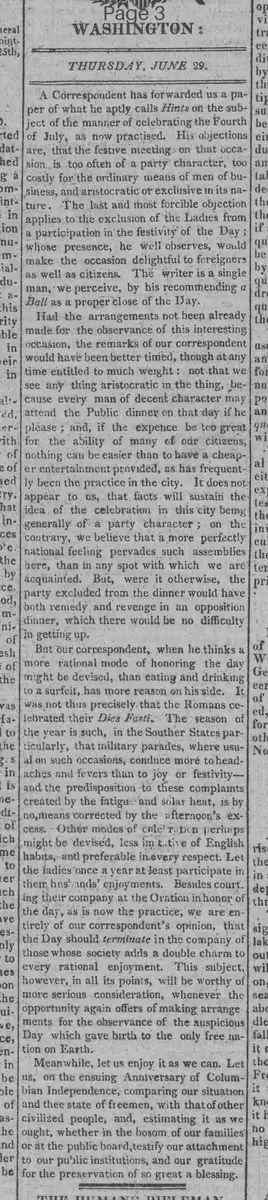
A Correspondent has forwarded us a paper of what he aptly calls Hints on the subject of the manner of celebrating the Fourth of July. as now practised. His objections are, that the festive meeting on that occasion. is too often of a party character, too costly for the ordinary means of men of business, and aristocratic or exclusive in its nature. The last and most forcible objection applies to the exclusion of the Ladies from a participation in the festivity of the Day ; whose presence, he well observes, would make the occasion delightful to foreigners as well as citizens. The writer is a single man, we perceive, by his recommending a Ball as a proper close of the Day.
Had the arrangements not been already made for the observance of this interesting occasion, the remarks of our correspondent would have been better timed, though at any time entitled to much weight : not that we see any thing aristocratic in the thing, because every man of decent character may attend the Public dinner on that day if he please ; and, if the expence be too great for the ability of many of our citizens; nothing can be easier than to have a cheaper entertainment provided, as has frequently been the practice in the city. It does not. appear to us, that facts will sustain the idea of the celebration in this city being generally of a party character; on the contrary, we believe that a more perfectly national feeling pervades such assemblies here, than in any spot with which we are acquainted. But, were it otherwise, the party excluded from the dinner would have both remedy and revenge in an opposition dinner, which there would be no difficulty in getting up.
But our correspondent, when he thinks a more rational mode of honoring the day might be devised, than eating and drinking to a surfeit, has more reason on his side. It was not thus precisely. that the Romans celebrated their Dies Fasti. The season of the year is such, in the Southern States particularly, that military parades, where usual on such occasions, conduce more to head- aches and fevers than to joy or festivity- and the predisposition to these complaints created by the fatigue and solar heat, is by no means corrected by the afternoon's excess. -Other modes of celebration perhaps might be devised, less imitative of English habits, and preferable in every respect. Let the ladies once a year at least participate in their husbands' enjoyments. Besides courting their company at the Oration in honor of the day, as is now the practice, we are entirely of our correspondent's opinion, that the Day should terminate in the company of those whose society adds a double charm to every rational enjoyment. This subject, however, in all its points, will be worthy of more serious consideration, whenever the opportunity again offers of making arrangements for the observance of the auspicious Day which gave birth to the only free nation on Earth.
Meanwhile, let us enjoy it as we can. Let us, on the ensuing Anniversary of Columbian Independence, comparing our situation and the state of freemen, with that of other civilized people, and, estimating it as we ought, whether in the bosom of our families or at the public board, testify our attachment to our public institutions, and our gratitude for the preservation of so great a blessing.
THURSDAY. JUNE 29.
A Correspondent has forwarded us a paper of what he aptly calls Hints on the subject of the manner of celebrating the Fourth of July. as now practised. His objections are, that the festive meeting on that occasion. is too often of a party character, too costly for the ordinary means of men of business, and aristocratic or exclusive in its nature. The last and most forcible objection applies to the exclusion of the Ladies from a participation in the festivity of the Day ; whose presence, he well observes, would make the occasion delightful to foreigners as well as citizens. The writer is a single man, we perceive, by his recommending a Ball as a proper close of the Day.
Had the arrangements not been already made for the observance of this interesting occasion, the remarks of our correspondent would have been better timed, though at any time entitled to much weight : not that we see any thing aristocratic in the thing, because every man of decent character may attend the Public dinner on that day if he please ; and, if the expence be too great for the ability of many of our citizens; nothing can be easier than to have a cheaper entertainment provided, as has frequently been the practice in the city. It does not. appear to us, that facts will sustain the idea of the celebration in this city being generally of a party character; on the contrary, we believe that a more perfectly national feeling pervades such assemblies here, than in any spot with which we are acquainted. But, were it otherwise, the party excluded from the dinner would have both remedy and revenge in an opposition dinner, which there would be no difficulty in getting up.
But our correspondent, when he thinks a more rational mode of honoring the day might be devised, than eating and drinking to a surfeit, has more reason on his side. It was not thus precisely. that the Romans celebrated their Dies Fasti. The season of the year is such, in the Southern States particularly, that military parades, where usual on such occasions, conduce more to head- aches and fevers than to joy or festivity- and the predisposition to these complaints created by the fatigue and solar heat, is by no means corrected by the afternoon's excess. -Other modes of celebration perhaps might be devised, less imitative of English habits, and preferable in every respect. Let the ladies once a year at least participate in their husbands' enjoyments. Besides courting their company at the Oration in honor of the day, as is now the practice, we are entirely of our correspondent's opinion, that the Day should terminate in the company of those whose society adds a double charm to every rational enjoyment. This subject, however, in all its points, will be worthy of more serious consideration, whenever the opportunity again offers of making arrangements for the observance of the auspicious Day which gave birth to the only free nation on Earth.
Meanwhile, let us enjoy it as we can. Let us, on the ensuing Anniversary of Columbian Independence, comparing our situation and the state of freemen, with that of other civilized people, and, estimating it as we ought, whether in the bosom of our families or at the public board, testify our attachment to our public institutions, and our gratitude for the preservation of so great a blessing.
What sub-type of article is it?
Social Reform
Moral Or Religious
What keywords are associated?
Fourth Of July
Independence Day
Celebration Reform
Ladies Participation
National Festivity
Avoid Excess
Social Inclusion
What entities or persons were involved?
Correspondent
Ladies
Citizens Of Washington
Editorial Details
Primary Topic
Improving Fourth Of July Celebrations
Stance / Tone
Supportive Of Inclusive And Rational Festivities
Key Figures
Correspondent
Ladies
Citizens Of Washington
Key Arguments
Festive Meetings Often Party Like And Exclusive
Too Costly For Ordinary Businessmen
Exclusion Of Ladies Diminishes Delight
Prefer Rational Modes Over Eating And Drinking To Excess
Include Ladies In Oration And Ball For Charm
Avoid Imitative English Habits And Military Parades In Heat
Promote National Unity And Gratitude For Independence