Thank you for visiting SNEWPapers!
Sign up free
Story
January 27, 1880
The News And Herald
Winnsboro, Fairfield County, South Carolina
What is this article about?
Opinion piece debating the use of salt on stored hay to prevent spoilage. Author doubts its efficacy, notes uneven application, and advocates drying hay fully in the field instead. (187 characters)
Clipping
OCR Quality
98%
Excellent
Full Text
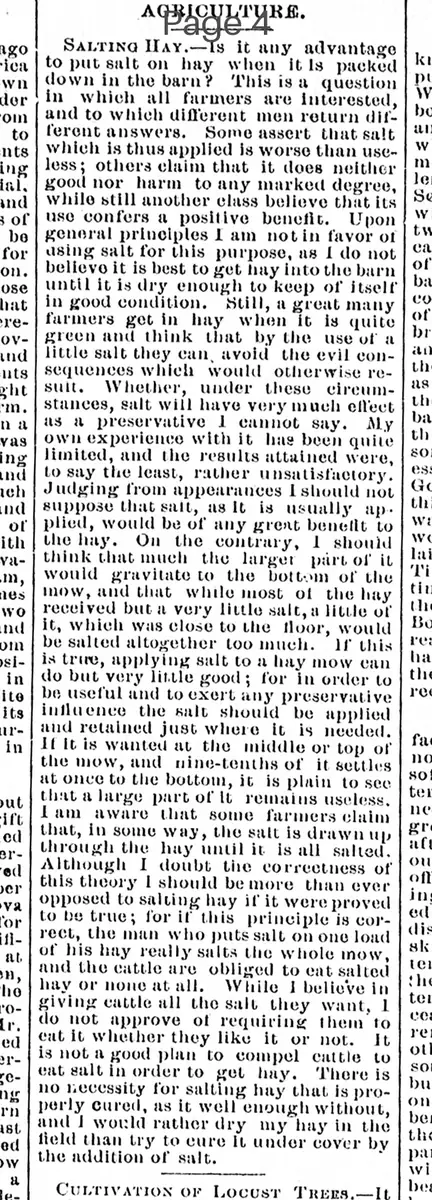
Salting Hay.—Is it any advantage to put salt on hay when it is packed down in the barn? This is a question in which all farmers are interested and to which different men return different answers. Some assert that salt which is thus applied is worse than useless; others claim that it does neither good nor harm to any marked degree, while still another class believe that its use confers a positive benefit.
Upon general principles I am not in favor of using salt for this purpose, as I do not believe it is best to get hay into the barn until it is dry enough to keep of itself in good condition. Still, a great many farmers get in hay when it is quite green and think that by the use of a little salt they can avoid the evil consequences which would otherwise result. Whether, under these circumstances, salt will have very much effect as a preservative I cannot say. My own experience with it has been quite limited, and the results attained were, to say the least, rather unsatisfactory.
Judging from appearances I should not suppose that salt, as it is usually applied, would be of any great benefit to the hay. On the contrary, I should think that much the larger part of it would gravitate to the bottom of the mow, and that while most of the hay received but a very little salt, a little of it, which was close to the floor, would be salted altogether too much. If this is true, applying salt to a hay mow can do but very little good; for in order to be useful and to exert any preservative influence the salt should be applied and retained just where it is needed. If it is wanted at the middle or top of the mow, and nine-tenths of it settles at once to the bottom, it is plain to see that a large part of it remains useless.
I am aware that some farmers claim that, in some way, the salt is drawn up through the hay until it is all salted. Although I doubt the correctness of this theory I should be more than ever opposed to salting hay if it were proved to be true; for if this principle is correct, the man who puts salt on one load of his hay really salts the whole mow, and the cattle are obliged to eat salted hay or none at all. While I believe in giving cattle all the salt they want, I do not approve of requiring them to eat it whether they like it or not. It is not a good plan to compel cattle to eat salt in order to get hay.
There is no necessity for salting hay that is properly cured, as it will keep well enough without, and I would rather dry my hay in the field than try to cure it under cover by the addition of salt.
Upon general principles I am not in favor of using salt for this purpose, as I do not believe it is best to get hay into the barn until it is dry enough to keep of itself in good condition. Still, a great many farmers get in hay when it is quite green and think that by the use of a little salt they can avoid the evil consequences which would otherwise result. Whether, under these circumstances, salt will have very much effect as a preservative I cannot say. My own experience with it has been quite limited, and the results attained were, to say the least, rather unsatisfactory.
Judging from appearances I should not suppose that salt, as it is usually applied, would be of any great benefit to the hay. On the contrary, I should think that much the larger part of it would gravitate to the bottom of the mow, and that while most of the hay received but a very little salt, a little of it, which was close to the floor, would be salted altogether too much. If this is true, applying salt to a hay mow can do but very little good; for in order to be useful and to exert any preservative influence the salt should be applied and retained just where it is needed. If it is wanted at the middle or top of the mow, and nine-tenths of it settles at once to the bottom, it is plain to see that a large part of it remains useless.
I am aware that some farmers claim that, in some way, the salt is drawn up through the hay until it is all salted. Although I doubt the correctness of this theory I should be more than ever opposed to salting hay if it were proved to be true; for if this principle is correct, the man who puts salt on one load of his hay really salts the whole mow, and the cattle are obliged to eat salted hay or none at all. While I believe in giving cattle all the salt they want, I do not approve of requiring them to eat it whether they like it or not. It is not a good plan to compel cattle to eat salt in order to get hay.
There is no necessity for salting hay that is properly cured, as it will keep well enough without, and I would rather dry my hay in the field than try to cure it under cover by the addition of salt.
What sub-type of article is it?
Curiosity
What themes does it cover?
Nature
Moral Virtue
What keywords are associated?
Salting Hay
Hay Preservation
Farming Advice
Barn Storage
Cattle Feeding
Story Details
Story Details
Discussion on the advantages of salting hay in barns, with the author expressing skepticism about its preservative effects and preferring to dry hay properly before storage to avoid uneven distribution and forcing salt intake on cattle.