Thank you for visiting SNEWPapers!
Sign up free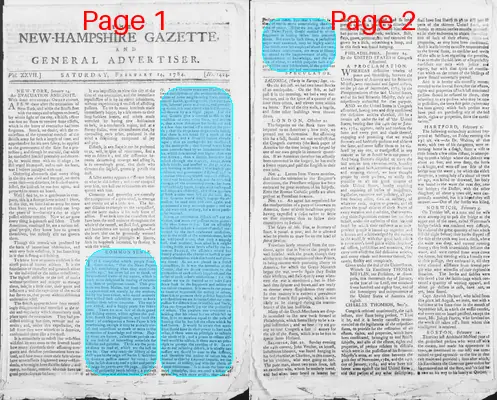
The New Hampshire Gazette And General Advertiser
Portsmouth, Exeter, Rockingham County, New Hampshire
What is this article about?
The editorial reflects on why newspapers seem less entertaining in peacetime compared to wartime, attributing it to human nature's greater fascination with calamities than prosperity. It argues this stems from compassion and the Creator's design, and suggests peaceful times allow papers to promote knowledge and virtue.
Merged-components note: This is a continuation of the 'Common Sense' essay discussing why newspapers are less entertaining in peacetime compared to wartime, with philosophical observations; the text flows directly from the end of the first component to the start of the second, indicating they were split across pages but form a single coherent editorial piece.
Clippings
1 of 2
OCR Quality
Full Text
THE complaint which people sometimes make, "that the News-Papers are less entertaining than they were some months ago," has often led me to think of the wonderful frame of our nature, which is much more delighted in reading of calamitous than of prosperous events. This proceeds not from Malice, but from nature. It is experienced not merely by the envious, but by the benevolent, who would ardently have wished such calamities never to have befallen their fellow-creatures. The war is now ended, and a happy peace has taken place. There are now few of those grand and striking events, which agitate the passions, stretch the imagination, and swell the mind; of consequence a News-Paper is less entertaining, though it may be as really useful, and contribute as much or more to the promotion of knowledge and virtue. Happy times are barren, calamitous periods only are fruitful of interesting materials for histories and gazettes. Those are the poorest times to read of, which are the best to live in. One who reads the history of the civil wars in the reign of Charles I. feels every humane passion moved by tumults: but when he sits down to read a quiet and peaceful reign he yawns over his page. Descriptions of prosperity touch faintly; a portrait of misfortunes and distress moves powerfully.
Let a Gazette come out filled with the finest descriptions of the prosperous circumstances of some neighboring State, such a general health, growing trade, plentiful harvests, internal peace and union, and prevailing virtue, it is read almost with indifference, and thrown by as a frigid paper. Let the next Gazette give a contrast to this in the condition of some other State, and inform us, that a new distemper has broke out and in a few days carried off a third of the people; that the crops have so generally failed, that there is not bread for a tenth of the inhabitants, and a dreadful famine already rages; that an earthquake has swallowed up the metropolis; that several towns have been overwhelmed by an inundation of the sea, which rose several feet higher than was ever known: than a furious hurricane has rushed through the country, swept down whole forests, and levelled to the ground every building in its course; that trade is annihilated, and government dissolved, and so complete this complicated scene of distress, a civil war has burst forth, and the collected strength of the contending parties has been tried in bloody battle, fought with such equal and desperate obstinacy, that three quarters of both armies were left on the field, &c.
This Gazette would dearly engage the attention, be read over and over again, and pronounced a very valuable paper; and we would wait with anxiety for a more particular account.
Scenes of uncommon distress call our attention, and move our passions more powerfully than scenes of joy. Let an assembly be collected to hear a concert of music performed by the most celebrated musicians, and in the midst of this entertainment, let it be whispered round, that such a tragedy had, that moment, been acted in a neighbouring house, as was lately acted by the infamous BandiÉ, the assembly would instantly abandon the charms of music to entertain themselves with this horrid and gloomy scene. As we are placed in a social connection, so it was the intention of the Creator, that we should contribute to the promotion of each other's happiness, and the relief of each other's misfortunes: for this reason we are so framed as to take some share both in the happiness and misery of our fellow creatures. It is more in our power to cause or to prevent the misery of others, than it is to promote their positive happiness and therefore we are so framed, that our compassion for distress is more sensible and lively, than our sympathetic joy for the prosperity of others. The pleasure one conceives on hearing that his friend has an estate fall to him, is in no measure equal to the pain of hearing that he has lost the estate which he had before. It would be unsafe that mankind should have in their power to hurt each other, if there were no principle to restrain the abuse of it: and a power to relieve distress would be useless, if there were no principle to prompt the exertion of it. In order to our relieving distress, it is usually necessary we should be near to the sufferer, and therefore the author of nature has so framed us that by a natural impulse, we run to scenes of misery, and visit the places of recent misfortune. It is from the same natural principles, that we read a history of calamities, with more avidity, than one of
Propitious times. and that a Gazette in a time of war is more entertaining than in a time of peace. What we are apt to call a dull News-Paper. should remind us of our happiness in having fallen into peaceful times. But even in such times. a periodical paper well executed, may be highly useful. Our minds, now less employed about our own, and others misfortunes, are more at liberty to attend to the improvement of arts, the advancement of knowledge. and the culture of virtue, to which purposes such a paper will be very subservient, if the publisher receives proper aid and encouragement.
What sub-type of article is it?
What keywords are associated?
Editorial Details
Primary Topic
Human Fascination With Calamitous News Over Prosperous Events
Stance / Tone
Reflective And Philosophical
Key Arguments