Thank you for visiting SNEWPapers!
Sign up free
The Daily Union
Washington, District Of Columbia
What is this article about?
Reports from Puebla and Vera Cruz detail U.S. efforts for prisoner exchanges, failed diplomatic negotiations by Mr. Trist and Buchanan's letter, Santa Anna's constraints, and General Scott's preparations to advance on Mexico City with 25,000 Mexican troops opposing, amid hopes for peace but likely continued war.
Clipping
OCR Quality
Full Text
MONDAY NIGHT, AUGUST 23, 1847.
Appointment by the President
Andrew R. Potts, to be assistant commissary, with the rank of captain, in the volunteer service.
From the Army.
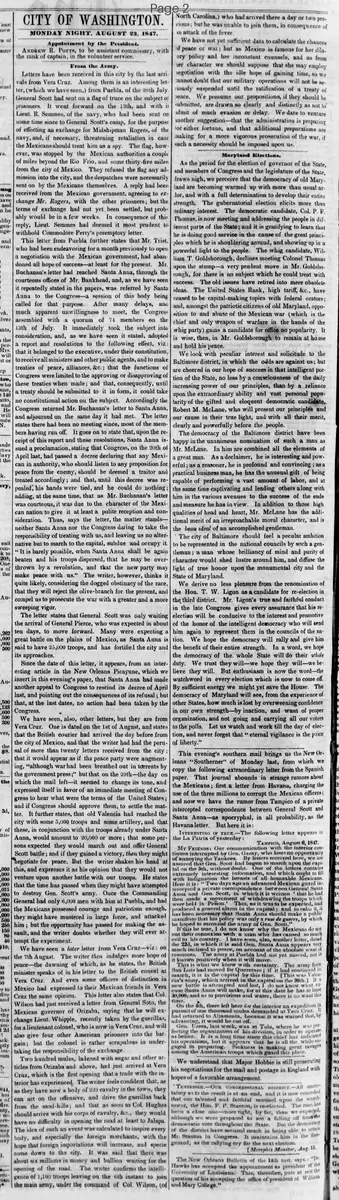
Letters have been received in this city by the last arrivals from Vera Cruz. Among them is an interesting letter, (which we have seen,) from Puebla, of the 28th July. General Scott had sent on a flag of truce on the subject of prisoners. It went forward on the 13th, and with it Lieut. R. Semmes, of the navy, who had been sent on some time since to General Scott's camp, for the purpose of effecting an exchange for Midshipman Rogers, of the navy, and, if necessary, threatening retaliation in case the Mexicans should treat him as a spy. The flag, however, was stopped by the Mexican authorities a couple of miles beyond the Rio Frio, and some thirty-five miles from the city of Mexico. They refused the flag any admission into the city, and the despatches were necessarily sent on by the Mexicans themselves. A reply had been received from the Mexican government, agreeing to exchange Mr. Rogers, with the other prisoners; but the terms of exchange had not yet been settled, but probably would be in a few weeks. In consequence of this reply, Lieut. Semmes had deemed it most prudent to withhold Commodore Perry's peremptory letter.
This letter from Puebla further states that Mr. Trist, who had been endeavoring for a month previously to open a negotiation with the Mexican government, had abandoned all hope of success—at least for the present. Mr. Buchanan's letter had reached Santa Anna, through the courteous offices of Mr. Bankhead, and, as we have seen it repeatedly stated in the papers, was referred by Santa Anna to the Congress—a session of this body being called for that purpose. After many delays, and much apparent unwillingness to meet, the Congress assembled with a quorum of 74 members on the 13th of July. It immediately took the subject into consideration, and, as we have seen it stated, adopted a report and resolutions to the following effect, viz: that it belonged to the executive, under their constitution, to receive all ministers and other public agents, and to make treaties of peace, alliances, &c.; that the functions of Congress were limited to the approving or disapproving of these treaties when made; and that, consequently, until a treaty should be submitted to it in form, it could take no constitutional action on the subject. Accordingly the Congress returned Mr. Buchanan's letter to Santa Anna, and adjourned on the same day it had met. The letter states there had been no meeting since, most of the members having run off. It goes on to state that, upon the receipt of this report and these resolutions, Santa Anna issued a proclamation, stating that Congress, on the 20th of April last, had passed a decree declaring that any Mexican in authority, who should listen to any proposition for peace from the enemy, should be deemed a traitor and treated accordingly; and that, until this decree was repealed, his hands were tied, and he could do nothing; adding, at the same time, that as Mr. Buchanan's letter was courteous, it was due to the character of the Mexican nation to give it at least a polite reception and consideration. Thus, says the letter, the matter stands—neither Santa Anna nor the Congress daring to take the responsibility of treating with us, and leaving us no alternative but to march to the capital, subdue and occupy it.
"It is barely possible, when Santa Anna shall be again beaten and his troops dispersed, that he may be overthrown by a revolution, and that the new party may make peace with us." The writer, however, thinks it quite likely, considering the dogged obstinacy of the race, that they will reject the olive-branch for the present, and compel us to prosecute the war with a greater and a more sweeping vigor.
The letter states that General Scott was only waiting the arrival of General Pierce, who was expected in about ten days, to move forward. Many were expecting a great battle on the plains of Mexico, as Santa Anna is said to have 25,000 troops, and has fortified the city and its approaches.
Since the date of this letter, it appears, from an interesting article in the New Orleans Picayune, which we insert in this evening's paper, that Santa Anna had made another appeal to Congress to rescind its decree of April last, and pointing out the consequences of its refusal; but that, at the last dates, no action had been taken by the Congress.
We have seen, also, other letters, but they are from Vera Cruz. One is dated on the 1st of August, and states that the British courier had arrived the day before from the city of Mexico, and that the writer had had the perusal of more than twenty letters received from the city: that it would appear as if the peace party were augmenting, "although war had been breathed out in torrents by the government press;" but that on the 29th—the day on which the mail left—it seemed to change its tone, and expressed itself in favor of an immediate meeting of Congress to hear what were the terms of the United States; and if Congress should approve them, to settle the matter. It further states, that old Valencia had reached the city with some 5,000 troops and some artillery, and that these, in conjunction with the troops already under Santa Anna, would amount to 20,000 or more; that some persons expected they would march out and offer General Scott battle; and if they gained a victory, then they might negotiate for peace. But the writer shakes his head at this, and expresses it as his opinion that they would not venture upon another battle with our troops. He states that the time has passed when they might have attempted to destroy Gen. Scott's army. Once the Commanding General had only 6,000 men with him at Puebla, and had the Mexicans possessed courage and patriotism enough, they might have mustered in large force, and attacked him; but the opportunity has passed for making the assault, and the writer doubts whether they will ever attempt the experiment.
We have seen a later letter from Vera Cruz—viz: on the 7th August. The writer then indulges more hope of peace—the dawning of which, as he states, the British minister speaks of in his letter to the British consul at Vera Cruz. And even some officers of distinction in Mexico had expressed to their Mexican friends in Vera Cruz the same opinion. This letter also states that Col. Wilson had just received a letter from General Soto, the Mexican governor of Orizaba, saying that he will exchange Lieut. Whipple, recently taken by the guerillas, for a lieutenant colonel, who is now in Vera Cruz, and will also give four other American prisoners into the bargain; but the colonel is rather scrupulous in undertaking the responsibility of the exchange.
Two hundred mules, laden with sugar and other articles from Orizaba and above, had just arrived at Vera Cruz, which is the first opening that a trade with the interior has experienced. The writer feels confident that, as they have now a body of 200 cavalry in the town, they can act on the offensive, and drive the guerillas back from the sand-hills; and that as soon as Col. Hughes should arrive with his corps of cavalry, &c., they would have no difficulty in opening the road at least to Jalapa.
The idea of such an event was calculated to inspire everybody, and especially the foreign merchants, with the hope that foreign importations will increase, and specie come down to the city. It was said that there was about six millions in money and bullion waiting for the opening of the road. The writer confirms the intelligence of 1,100 troops leaving on the 6th instant to join the main army, under the command of Col. Wilson, (of North Carolina,) who had arrived there a day or two previous; but he was unable to join them, in consequence of an attack of the fever.
We have not yet sufficient data to calculate the chances of peace or war; but as Mexico is famous for her dilatory policy and her inconstant counsels, and as from her character we should suppose that she may employ negotiation with the idle hope of gaining time, so we cannot doubt that our military operations will not be seriously suspended until the ratification of a treaty of peace. We presume our propositions, if they should be submitted, are drawn so clearly and distinctly as not to admit of much evasion or delay. We dare to venture another suggestion—that the administration is preparing for either fortune, and that additional preparations are making for a more vigorous prosecution of the war, if such a necessity should be imposed upon us.
What sub-type of article is it?
What keywords are associated?
What entities or persons were involved?
Where did it happen?
Foreign News Details
Primary Location
Mexico
Event Date
July 28, 1847 To August 7, 1847
Key Persons
Outcome
stalled peace negotiations; agreement to exchange prisoners including mr. rogers but terms unsettled; mexican congress refuses action on peace propositions; u.s. forces prepare to advance on mexico city facing 25,000 mexican troops; hopes for peace but expectation of continued vigorous war.
Event Details
Letters from Puebla and Vera Cruz report U.S. flag of truce for prisoner exchange stopped near Mexico City; Mexican agreement to exchange but terms pending; Mr. Trist's negotiations abandoned; Mexican Congress defers to executive and adjourns without action on Buchanan's letter; Santa Anna cites decree against peace talks; Scott awaits Pierce to advance; Mexican forces fortify city; later reports show growing peace sentiment, troop arrivals, and local exchanges; first interior trade resumes; U.S. troops reinforce.