Thank you for visiting SNEWPapers!
Sign up free
Phenix Gazette
Alexandria, Virginia
What is this article about?
Biographical and critical profile of John Randolph of Roanoke, detailing his physical appearance, early political career, opposition to Patrick Henry in 1799, support for Jefferson until 1806, subsequent disillusionment, role in disorderly Senate debates, insult leading to duel with Henry Clay, and perceived mental deterioration at age 52.
Clipping
OCR Quality
Full Text
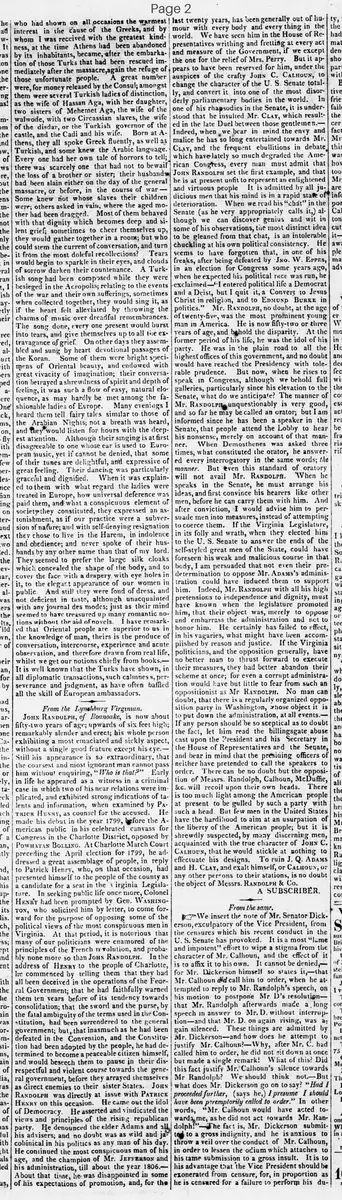
John Randolph, of Roanoke, is now about fifty-two years of age; upwards of six feet high; remarkably slender and erect; his whole person exhibiting a most emaciated and sickly aspect, without a single good feature except his eye. Still his appearance is so extraordinary, that the coarsest and most ignorant man cannot pass him without enquiring, "Who is that?" Early in life he appeared as a witness in a criminal case in which two of his near relations were implicated, and exhibited strong indications of talents and information, when examined by Patrick Henry, as counsel for the accused. He made his debut in the year 1799, before the American public in his celebrated canvass for Congress in the Charlotte District, opposed by Powhatan Bolling. At Charlotte March Court preceding the April election for 1799, he addressed a great assemblage of people, in reply to Patrick Henry, who, on that occasion, had presented himself to the people of the county as a candidate for a seat in the Virginia Legislature. In seeking public life once more, Colonel Henry had been prompted by Gen. Washington, who solicited him by letter, to come forward for the purpose of opposing some of the political views of the most conspicuous men in Virginia. At that period, it is notorious that many of our politicians were enamored of the principles of the French revolution, and probably none more so than John Randolph. In the address of Henry to the people of Charlotte, he commenced by telling them that they had all been deceived in the operations of the Federal Government: that he had faithfully warned them ten years before of its tendency towards consolidation; that the sword and the purse, by the fatal ambiguity of the terms used in the Constitution, had been surrendered to the general government; but, that inasmuch as he had been defeated in the Convention, and the Constitution had been adopted by the people, he had determined to become a peaceable citizen himself, and would beseech them to pause in their disrespectful and violent course towards the general government, before they arrayed themselves as direct enemies to their sister States. John Randolph was directly at issue with Patrick Henry on this occasion. He came out the idol of Democracy. He asserted and vindicated the views and principles of the rising republican party. He denounced the elder Adams and all his advisers; and no doubt was as wild and jacobinical in his politics as any man of his day. He continued the most conspicuous man of his age, and the champion of Mr. Jefferson and his administration, till about the year 1806. About that time, he was disappointed in some of his expectations of promotion, and, for the last twenty years, has been generally out of humour with every body and every thing in the world. We have seen him in the House of Representatives writhing and fretting at every act and measure of the Government, if we except the one for the relief of Mrs. Perry. But it appears to have been reserved for him, under the auspices of the crafty John C. Calhoun, to change the character of the U. S. Senate totally, and convert it into one of the most disorderly parliamentary bodies in the world. In one of his rhapsodies in the Senate, it is understood that he insulted Mr. Clay, which resulted in the late Duel between those gentlemen. Indeed, when we bear in mind the envy and malice he has so long entertained towards Mr. Clay, and the frequent ebullitions in debate which have lately so much degraded the American Congress, every man must admit that John Randolph set the first example, and that he is at present unfit to represent an enlightened and virtuous people. It is admitted by all judicious men that his mind is in a rapid state of deterioration. When we read his "chat" in the Senate (as he very appropriately calls it,) although we can discover genius and wit in some of his observations, the most distinct idea to be gleaned from that chat, is an intolerable chuckling at his own political consistency. He seems to have forgotten that, in one of his freaks, after being defeated by Jno. W. Eppes, in an election for Congress some years ago, when he expected his political race was run, he exclaimed 'I entered political life a Democrat and a Deist, but I quit it, a Convert to Jesus Christ in religion, and to Edmund Burke in politics.' Mr. Randolph, no doubt, at the age of twenty-five, was the most prominent young man in America. He is now fifty-two or three years of age, and behold the disparity. At the former period of his life, he was the idol of his party. He was in the plain road to all the highest offices of this government, and no doubt would have reached the Presidency with tolerable prudence. But now, when he rises to speak in Congress, although we behold full galleries, particularly since his elevation to the Senate, what do we anticipate? The manner of Mr. Randolph unquestionably is very good, and so far he may be called an orator; but I am informed since he has been a speaker in the Senate, that people attend the Lobby to hear his nonsense, merely on account of that manner.
When Demosthenes was asked three times, what constituted the orator, he answered every interrogatory in the same words; the manner. But even this standard of oratory will not avail Mr. Randolph. When he speaks in the Senate, he must arrange his ideas, and first convince his hearers like other men, before he can carry them with him. And after conviction, I would advise him to persuade men into measures, instead of attempting to coerce them. If the Virginia Legislature, in its folly and wrath, when they elected him to the U. S. Senate to answer the ends of the self-styled great men of the State, could have foreseen his weak and malicious course in that body, I am persuaded that not even their predetermination to oppose Mr. Adams's administration could have induced them to support him. Indeed, Mr. Randolph with all his high pretensions to independence and dignity, must have known when the legislature promoted him, that their object was, merely to oppose and embarrass the administration and not to honor him. He certainly has failed to effect, in his vagaries, what might have been accomplished by reason and justice. If the Virginia politicians, and the opposition generally, have no better man to thrust forward to execute their measures, they had better abandon their scheme at once; for even a corrupt administration would have but little to fear from such an oppositionist as Mr. Randolph. No man can doubt, that there is a regularly organized opposition party in Washington, whose object it is to put down the administration, at all events. If any person should be so sceptical as to doubt the fact, let him read the billingsgate abuse cast upon the President and his Secretary in the House of Representatives and the Senate, and bear in mind that the presiding officers of neither have pretended to call the speakers to order. There can be no doubt but the opposition of Messrs. Randolph, Calhoun, McDuffie, &c. will recoil upon their own heads. There is too much light among the American people at present to be gulled by such a party with such a head. But few men in the United States have the hardihood to aim at an usurpation of the liberty of the American people; but it is shrewdly suspected, by many discerning men, acquainted with the true character of John C. Calhoun, that he would stickle at nothing to effectuate his designs. To ruin J. Q. Adams and H. Clay, and exalt himself, or Calhoun, or any other persons to their stations, is no doubt the object of Messrs. Randolph & Co.
A SUBSCRIBER.
What sub-type of article is it?
What keywords are associated?
What entities or persons were involved?
Where did it happen?
Domestic News Details
Primary Location
Roanoke, Virginia
Key Persons
Outcome
insult in senate led to duel with mr. clay; perceived rapid deterioration of mind; political opposition likely to fail.
Event Details
John Randolph, aged about 52, described physically as tall, slender, and sickly; early witness in criminal case examined by Patrick Henry; debuted in 1799 canvass for Congress opposing Powhatan Bolling and replying to Patrick Henry; supported French revolution principles and Republican party, denounced Adams; championed Jefferson until 1806; disappointed in promotion, became critical of government; elevated to U.S. Senate by Virginia Legislature to oppose Adams administration; under Calhoun's influence, contributed to Senate disorder; insulted Clay leading to duel; seen as unfit representative due to malice and deterioration.