Thank you for visiting SNEWPapers!
Sign up free
Domestic News
May 12, 1931
Las Vegas Age
Las Vegas, Clark County, Lincoln County, Nevada
What is this article about?
James Francis Burke, Pennsylvania Republican and former House member, reflects on 40 years in politics, noting higher integrity in public life but declining statesmanship due to business rewards and legislative formality.
Clipping
OCR Quality
98%
Excellent
Full Text
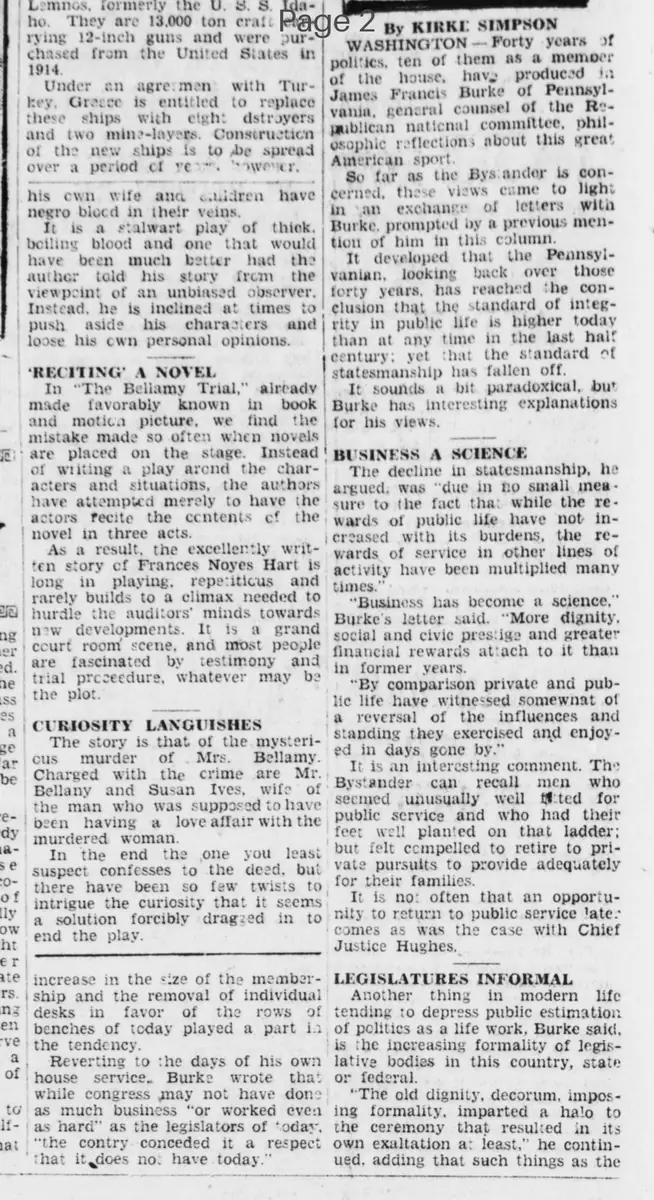
WASHINGTON—Forty years of politics, ten of them as a member of the house, have produced in James Francis Burke of Pennsylvania, general counsel of the Republican national committee, philosophic reflections about this great American sport.
So far as the Bystander is concerned, these views come to light in an exchange of letters with Burke, prompted by a previous mention of him in this column.
It developed that the Pennsylvanian, looking back over those forty years, has reached the conclusion that the standard of integrity in public life is higher today than at any time in the last half century; yet that the standard of statesmanship has fallen off.
It sounds a bit paradoxical, but Burke has interesting explanations for his views.
BUSINESS A SCIENCE
The decline in statesmanship, he argued, was "due in no small measure to the fact that while the rewards of public life have not increased with its burdens, the rewards of service in other lines of activity have been multiplied many times."
"Business has become a science." Burke's letter said. "More dignity, social and civic prestige and greater financial rewards attach to it than in former years."
"By comparison private and public life have witnessed somewhat of a reversal of the influences and standing they exercised and enjoyed in days gone by."
It is an interesting comment. The Bystander can recall men who seemed unusually well fitted for public service and who had their feet well planted on that ladder; but felt compelled to retire to private pursuits to provide adequately for their families.
It is not often that an opportunity to return to public service late comes as was the case with Chief Justice Hughes.
LEGISLATURES INFORMAL
Another thing in modern life tending to depress public estimation of politics as a life work, Burke said, is the increasing formality of legislative bodies in this country, state or federal.
"The old dignity, decorum, imposing formality, imparted a halo to the ceremony that resulted in its own exaltation at least," he continued, adding that such things as the increase in the size of the membership and the removal of individual desks in favor of the rows of benches of today played a part in the tendency.
Reverting to the days of his own house service, Burke wrote that while congress may not have done as much business "or worked even as hard" as the legislators of today, "the country conceded it a respect that it does not have today."
So far as the Bystander is concerned, these views come to light in an exchange of letters with Burke, prompted by a previous mention of him in this column.
It developed that the Pennsylvanian, looking back over those forty years, has reached the conclusion that the standard of integrity in public life is higher today than at any time in the last half century; yet that the standard of statesmanship has fallen off.
It sounds a bit paradoxical, but Burke has interesting explanations for his views.
BUSINESS A SCIENCE
The decline in statesmanship, he argued, was "due in no small measure to the fact that while the rewards of public life have not increased with its burdens, the rewards of service in other lines of activity have been multiplied many times."
"Business has become a science." Burke's letter said. "More dignity, social and civic prestige and greater financial rewards attach to it than in former years."
"By comparison private and public life have witnessed somewhat of a reversal of the influences and standing they exercised and enjoyed in days gone by."
It is an interesting comment. The Bystander can recall men who seemed unusually well fitted for public service and who had their feet well planted on that ladder; but felt compelled to retire to private pursuits to provide adequately for their families.
It is not often that an opportunity to return to public service late comes as was the case with Chief Justice Hughes.
LEGISLATURES INFORMAL
Another thing in modern life tending to depress public estimation of politics as a life work, Burke said, is the increasing formality of legislative bodies in this country, state or federal.
"The old dignity, decorum, imposing formality, imparted a halo to the ceremony that resulted in its own exaltation at least," he continued, adding that such things as the increase in the size of the membership and the removal of individual desks in favor of the rows of benches of today played a part in the tendency.
Reverting to the days of his own house service, Burke wrote that while congress may not have done as much business "or worked even as hard" as the legislators of today, "the country conceded it a respect that it does not have today."
What sub-type of article is it?
Politics
What keywords are associated?
Politics
Integrity
Statesmanship
James Burke
Republican Committee
What entities or persons were involved?
James Francis Burke
Chief Justice Hughes
Where did it happen?
Pennsylvania
Domestic News Details
Primary Location
Pennsylvania
Key Persons
James Francis Burke
Chief Justice Hughes
Event Details
James Francis Burke reflects on 40 years in politics, concluding higher integrity in public life but declining statesmanship due to business rewards and legislative formality changes.