Thank you for visiting SNEWPapers!
Sign up free
The Enquirer
Richmond, Henrico County, Virginia
What is this article about?
The Virginia General Assembly, in its session starting December 6, 1813, passed numerous acts including appropriations of public revenue, changes to the fiscal year, amendments to superior courts and militia laws, tax collection procedures, and specific provisions for individuals and properties, with some acts passed by February 14, 1814.
Clipping
OCR Quality
Full Text
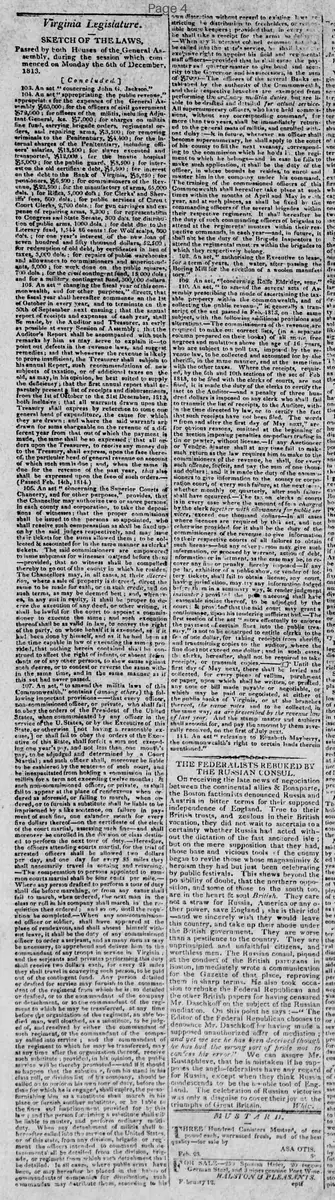
SKETCH OF THE LAWS,
Passed by both Houses of the General Assembly, during the session which commenced on Monday the 6th of December, 1813.
[Concluded.]
103. An act "concerning John G. Jackson."
104. An act "appropriating the public revenue." appropriates for the expenses of the General Assembly $60,000; for the officers of civil government $79,000; for officers of the militia, including Adjutant-General, &c. $7,000; for charges on militia fine fund, carrying brigade orders, regimental orders, and repairing arms, $3,500; for removing criminals to the Penitentiary, $4,000; for the internal charges of the Penitentiary, including officers' salaries, $15,500; for slaves executed and transported, $12,000; for the lunatic hospital $5,000; for the public guard, $8,500; for interest on the old certificate debt, $5,500; for interest on the debt to the Bank of Virginia, $5,250; for pensioners, $6,500; for commissioners of the Revenue, $22,500; for the manufactory of arms, $65,000 dols. for Rifles, $5,000 dols; for Clerks' and Sheriffs' fees, $500 dols.; for public services of Circuit Court Clerks, $2,700 dols.; for gun carriages and expense of repairing arms, $8,500; for representation to Congress and State Senate, $300 dols. for distribution of public arms, $1,000 dols.; for debt due to the Literary fund, $1,544 86 cents; for Wolf scalps, $600 dols.; for one year's interest of the new Loan of seven hundred and fifty thousand dollars, $52,500; for redemption of old debt, by certificates in lieu of taxes, $8,000 dols.; for repairs of public warehouses and allowances to commissioners and superintendents, $5,000; for work done on the public squares, $700 dols.; for the civil contingent fund, $15,000 dols.; and for a military contingent fund, $50,000 dollars.
105. An act "changing the fiscal year of this commonwealth, and for other purposes," directs, that the fiscal year shall hereafter commence on the 1st of October in every year, and to terminate on the 30th of September next ensuing; that the annual report of receipts and expenses of each year, shall be made, by the Auditor and Treasurer, as early as possible at every Session of Assembly; that the Auditor's Report shall be accompanied with such remarks by him as may serve to explain it--to point out defects in the revenue laws, and suggest remedies; and that whenever the revenue is likely to prove insufficient, the Treasurer shall subjoin to his annual Report, such recommendations of new subjects of taxation, or of additional taxes on the old, as may, in his opinion, be best suited to supply the deficiency; that the first annual report shall separately present a list of receipts and disbursements, from the 1st of October to the 31st December, 1813, both inclusive; that all warrants drawn upon the Treasury shall express by reference to some one general head of expenditure, the cause for which they are drawn; and where the said warrants are drawn for sums chargeable on the revenue of a different year from that out of which the payment is made, the same shall be so expressed; that all orders upon the Treasurer, to receive any money due to the Treasury, shall express, upon the face thereof, the particular head of general revenue on account of which such sums is due; and, when the same is due for the revenue of the past year, that also shall be expressed upon the face of such orders.
(Passed Feb. 14th, 1814.)
106. An act "concerning the Superior Courts Chancery, and for other purposes,"
provides, that the Chancellor may authorize two or more persons in each county and corporation, to take the depositions of witnesses; that the proper commissions shall be issued to the persons so appointed, who shall receive such compensation as shall be fixed upon by the said judges respectively, and may issue their tickets for the sums allowed them; to be collected & accounted for in the same manner as clerks' tickets. The said commissioners are empowered to issue subpoenas for witnesses to attend before them--provided, that no witness shall be compelled thereby to go out of the county in which he resides. The Chancellors may, in all cases, at their discretion, where a sale of property is decreed, direct the same to be made for cash, or on such credit, and on such terms, as may be deemed best; and, whenever, in any suit in equity, it shall be proper to decree the execution of any deed, or other writing, it shall be lawful for the court to appoint a commissioner to execute the same; and such execution thereof shall be as valid in law, to convey the right of the party, on whose behalf it is executed, as if it had been done by himself, and as if he had been at the time capable in law of executing the same; provided, that nothing herein contained shall be construed to affect the right of infants, or absent defendants or of any other persons, to show cause against such decree, or to contest or reverse the same within the same time, and in the same manner as if this act had never passed.
107. An act, "to amend the militia laws of this Commonwealth," contains (among others) the following important provisions--that every officer, non-commissioned officer, or private, who shall fail to obey the orders of the President of the United States, when communicated by any officer in the service of the U. States, or by the Executive of this State, or otherwise not having a reasonable excuse; or shall fail to obey the orders of the Executive of this State, shall forfeit a sum not exceeding one year's pay, and not less than one month's pay, to be adjudged and determined by a Court Martial; and such officer shall, moreover be liable to be cashiered by the sentence of such court, and be incapacitated from holding a commission in the militia for a term not exceeding twelve months; such non-commissioned officer, or private, as shall fail to appear at the place of rendezvous when ordered as aforesaid, or failing to march, when ordered, or to furnish a substitute shall be liable to be imprisoned by a like sentence, on failure in payment of such fine, one calendar month for every five dollars thereof--on the certificate of the clerk of the court martial, assessing such fine--and shall moreover be enrolled in the division or class destined to perform the next tour of duty.--Hereafter, the officers attending courts martial, for the trial of arrested officers shall be allowed two dollars per day, and one day for every 35 miles they shall necessarily travel in coming and returning.--The compensation to persons appointed to summon courts martial shall be four cents per mile.--Where any person drafted to perform a tour of duty shall die before marching, or from any cause shall fail to march, when ordered, the next man in the class or roll in his company shall march in the requisition then ordered; and so on, until the requisition be completed.--When any non-commissioned officer or soldier, shall have appeared at the place of rendezvous, and shall absent himself without leave, it shall be the duty of any commissioned officer to order a sergeant, and as many men as may be necessary, to apprehend and deliver him to the commandant of any troops in service in Virginia; and the sergeants and privates performing this duty shall receive two dollars each, for every 25 miles they shall travel in conveying such person, to be paid out of the contingent fund. "Any person detailed or drafted for service may furnish to the commandant of the regiment from which he is so detailed or drafted, or to the commandant of the company or detachment, or to the commandant of the regiment to which he may be transferred, at any time before the organization of the regiment, an able bodied man, well clothed, as a substitute, to be judged of, and received by either the commandant of such regiment, or the commandant of the company called into service; and the commandant of the regiment to which he may be transferred, may at any time after the organization thereof, receive such substitute; provided, in his opinion, the public service will be thereby promoted---and if it should so happen that the substitute, from his stand in his class roll, or division list of his company, should be called on to perform his own tour of duty, before the time for which he is engaged, shall expire, the person furnishing him as a substitute shall march in his place or furnish another substitute, or be liable to the fines and imprisonment provided for by this law; and the person furnishing a substitute shall still be liable to muster and perform ordinary militia duty. When any detachment of militia shall be hereafter called into the service of the United States or of this state, from any division, brigade or regiment the officers intended to command such detachments shall be detailed from the division, brigade, or regiment from which such detachment shall be detailed. In all cases, where public arms have been, or may hereafter be placed in the hands of commandants of companies for distribution, such commandants may distribute them, according to his discretion without regard to existing laws restricting the distribution to freeholders, or responsible house keepers; provided that, in every case he shall take a receipt for the arms so delivered.
--When any lieutenant colonel commandant shall be called into the state's service, he shall have the exclusive right to appoint his field and regimental staff officers--provided that he shall cause the paymaster and quarter master to give bond and security to the Governor and his successors, in the sum of $7,000--The officers of the several Banks established by the authority of the Commonwealth, and their respective branches are exempted from performing the ordinary militia duties, but are liable to be drafted and detailed for actual service. All supernumerary officers, who have held commissions, without any corresponding command, for more than two years, shall be immediately returned to the general mass of militia, and enrolled without delay :--& in future, whenever an officer shall become supernumerary, he shall apply to the court of his county to fill the next vacancy, corresponding to the commission which he holds in the regiment to which he belongs-and in case he fails to make such application, it shall be the duty of the officer, in whose bounds he resides, to enrol and muster him in the company under his command. The training of the commissioned officers of this Commonwealth shall hereafter take place at such times within the months of April and May in each year, and at such places, as shall be fixed by the commanding officers of the several brigades within their respective regiments. It shall hereafter be the duty of such commanding officers of brigades to attend at the regimental musters within their respective commands, in each year--and, in future, it shall not be the duty of the Brigade Inspectors to attend the regimental musters within the brigades to which they respectively belong.
108. An act. "authorising the Executive to lease for a term of years, the water, after passing the Boring Mill for the erection of a woolen manufactory."
109. An act, concerning Ralph Eldridge, senr."
110. An act, "to amend the several acts of Assembly prescribing the mode of ascertaining the taxable property within the commonwealth, and of collecting the public revenue," is, generally a transcript of the act passed in Feb. 1813, on the same subject, with the following additional provisions and alterations.--The commissioners of the revenue, are required to make out correct lists, (in a separate column prepared on their books) of all male free negroes and mulattoes above the age of 16, years, who are subject to a poll tax, imposed by the revenue law, to be collected and accounted for by the sheriffs, in the same manner, and at the same time with the other taxes. Where the receipts, required, by the 6th and 10th sections of the act of Feb. 1813, to be filed with the clerks of courts, are not filed, it is made the duty of the clerks to certify the fact to the Auditor--and a penalty of three hundred dollars is imposed on any clerk who shall fail to transmit the list of receipts, to the Auditor, within the time directed by law, or to certify the fact that such receipts have not been filed. The words "from and after the first day of May next," are for obvious reasons, omitted at the beginning of the section imposing penalties on pedlars trading in tin or pewter, without license.--If any Auctioneer or Vendue Master shall at any time fail to make such return as the law requires him to make to the commissioners of the revenue, he shall, for every such offence, forfeit, and pay the sum of one thousand dollars: and it is made the duty of the commissioners to give information to the county or corporation court, of every such failure, at the next term, whether monthly or quarterly, after such failure shall have occurred--The tax on clerks of courts is in every case where the amount of fees charged by the clerk together with allowances for public services, exceed one thousand dollars--In all cases where licences are required by this act, and not otherwise provided for it shall be the duty of the commissioners of the revenue to give information to their respective courts of all failures to obtain such licenses--but any other person may give such information, or proceed by warrant, action of debt, information or indictment, as the case may be, to recover any fine or penalty hereby imposed--If any pedlar, exhibitor of a public show, or vender of lottery tickets, shall fail to obtain license, any court, having jurisdiction, may try any information lodged before them in a summary way, & render judgment instanter; provided the person accused shall have reasonable notice thereof, to be adjudged by the court; & provided that the said court may grant a continuance, upon his tendering sufficient bail. The first section of the act "more effectually to enforce the payment of certain fines into the public treasury." is not to be construed to entitle clerks to the fee of one dollar, for taking receipts from sheriffs, and transmitting copies to the auditor, where the fine does not exceed one dollar; and in such cases, the clerks, hereafter, shall not be required to take receipts, or transmit copies.--Until the first day of May next, there shall be levied and collected, for every piece of vellum, parchment or paper, upon which shall be written, or printed, any note or bill made payable or negotiable, or which may be paid or negotiated, at either of the public banks of Virginia, or at the branches thereof, the same rates and to be collected, in the same way, as are prescribed by the revenue law of last year. And the stamp master and cashiers shall account for, and pay the amount by them severally received, on the first of July next.
111. An act "releasing to Elizabeth Mayberry, the commonwealth's right to certain lands therein mentioned."
What sub-type of article is it?
What keywords are associated?
What entities or persons were involved?
Where did it happen?
Domestic News Details
Primary Location
Virginia
Event Date
Session Which Commenced On Monday The 6th Of December, 1813; (Passed Feb. 14th, 1814.)
Key Persons
Event Details
Sketch of laws passed by the Virginia General Assembly, including acts concerning appropriations of public revenue (act 104), changing the fiscal year (act 105), superior courts chancery (act 106), amending militia laws (act 107), leasing water for woolen manufactory (act 108), amending tax and revenue collection acts (act 110), and specific acts for individuals (acts 103, 109, 111).