Thank you for visiting SNEWPapers!
Sign up free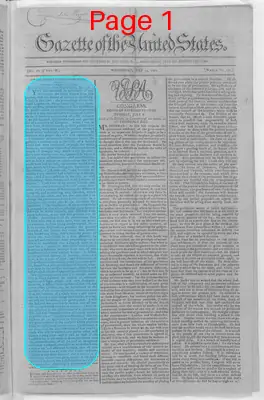
Letter to Editor
July 14, 1790
Gazette Of The United States
New York, New York County, New York
What is this article about?
An extract from a Massachusetts letter dated June 30 defends the U.S. Congress against criticism for slow proceedings, emphasizing the importance of free debate in a republic, urging patience, and reflecting on the challenges of the new Constitution's administration.
Clipping
OCR Quality
95%
Excellent
Full Text
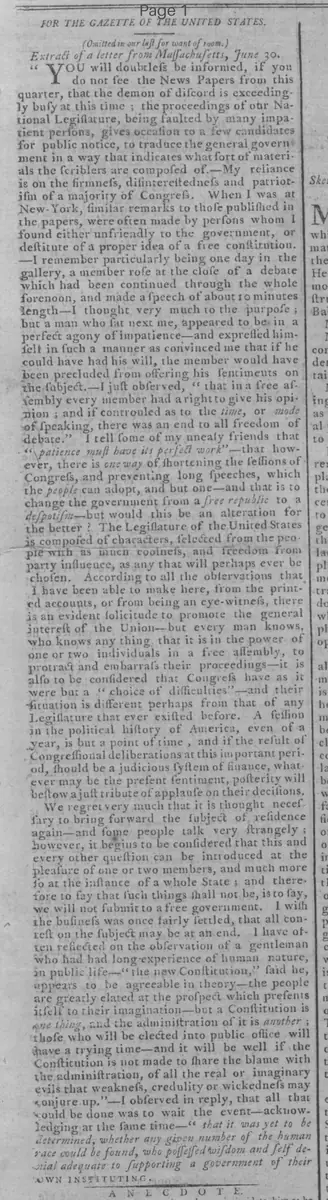
FOR THE GAZETTE OF THE UNITED STATES.
(Omitted in our last for want of room.)
Extract of a letter from Massachusetts, June 30.
You will doubtless be informed, if you do not see the News Papers from this quarter, that the demon of discord is exceedingly busy at this time; the proceedings of our National Legislature, being faulted by many impatient persons, gives occasion to a few candidates for public notice, to traduce the general government in a way that indicates what sort of materials the scribblers are composed of. My reliance is on the firmness, disinterestedness and patriotism of a majority of Congress. When I was at New-York, similar remarks to those published in the papers, were often made by persons whom I found either unfriendly to the government, or destitute of a proper idea of a free constitution.
—I remember particularly being one day in the gallery, a member rose at the close of a debate which had been continued through the whole forenoon, and made a speech of about 10 minutes length—I thought very much to the purpose; but a man who sat next me, appeared to be in a perfect agony of impatience—and expressed himself in such a manner as convinced me that if he could have had his will, the member would have been precluded from offering his sentiments on the subject.—I just observed, "that in a free assembly every member had a right to give his opinion; and if controlled as to the time, or mode of speaking, there was an end to all freedom of debate." I tell some of my uneasy friends that "patience must have its perfect work"—that however, there is one way of shortening the sessions of Congress, and preventing long speeches, which the people can adopt, and but one—and that is to change the government from a free republic to a despotism—but would this be an alteration for the better? The Legislature of the United States is composed of characters, elected from the people with as much coolness, and freedom from party influence, as any that will perhaps ever be chosen. According to all the observations that I have been able to make here, from the printed accounts, or from being an eye-witness, there is an evident solicitude to promote the general interest of the Union—but every man knows, who knows any thing, that it is in the power of one or two individuals in a free assembly, to protract and embarrass their proceedings—it is also to be considered that Congress have as it were but a "choice of difficulties"—and their situation is different perhaps from that of any Legislature that ever existed before. A session in the political history of America, even of a year, is but a point of time, and if the result of Congressional deliberations at this important period, should be a judicious system of finance, whatever may be the present sentiment, posterity will bestow a just tribute of applause on their decisions.
We regret very much that it is thought necessary to bring forward the subject of residence again—and some people talk very strangely; however, it begins to be considered that this and every other question can be introduced at the pleasure of one or two members, and much more so at the instance of a whole State; and therefore to say that such things shall not be, is to say, we will not submit to a free government. I wish the business was once fairly settled, that all contest on the subject may be at an end. I have often reflected on the observation of a gentleman who had had long experience of human nature, in public life—“the new Constitution,” said he, “appears to be agreeable in theory—the people are greatly elated at the prospect which presents itself to their imagination—but a Constitution is one thing, and the administration of it is another; those who will be elected into public office will have a trying time—and it will be well if the Constitution is not made to bear the blame with the administration, of all the real or imaginary evils that weakness, credulity or wickedness may conjure up.”—I observed in reply, that all that would be done was to wait the event—acknowledging at the same time—“that it was yet to be determined, whether any given number of the human race could be found, who possessed wisdom and self denial adequate to supporting a government of their own instituting.”
(Omitted in our last for want of room.)
Extract of a letter from Massachusetts, June 30.
You will doubtless be informed, if you do not see the News Papers from this quarter, that the demon of discord is exceedingly busy at this time; the proceedings of our National Legislature, being faulted by many impatient persons, gives occasion to a few candidates for public notice, to traduce the general government in a way that indicates what sort of materials the scribblers are composed of. My reliance is on the firmness, disinterestedness and patriotism of a majority of Congress. When I was at New-York, similar remarks to those published in the papers, were often made by persons whom I found either unfriendly to the government, or destitute of a proper idea of a free constitution.
—I remember particularly being one day in the gallery, a member rose at the close of a debate which had been continued through the whole forenoon, and made a speech of about 10 minutes length—I thought very much to the purpose; but a man who sat next me, appeared to be in a perfect agony of impatience—and expressed himself in such a manner as convinced me that if he could have had his will, the member would have been precluded from offering his sentiments on the subject.—I just observed, "that in a free assembly every member had a right to give his opinion; and if controlled as to the time, or mode of speaking, there was an end to all freedom of debate." I tell some of my uneasy friends that "patience must have its perfect work"—that however, there is one way of shortening the sessions of Congress, and preventing long speeches, which the people can adopt, and but one—and that is to change the government from a free republic to a despotism—but would this be an alteration for the better? The Legislature of the United States is composed of characters, elected from the people with as much coolness, and freedom from party influence, as any that will perhaps ever be chosen. According to all the observations that I have been able to make here, from the printed accounts, or from being an eye-witness, there is an evident solicitude to promote the general interest of the Union—but every man knows, who knows any thing, that it is in the power of one or two individuals in a free assembly, to protract and embarrass their proceedings—it is also to be considered that Congress have as it were but a "choice of difficulties"—and their situation is different perhaps from that of any Legislature that ever existed before. A session in the political history of America, even of a year, is but a point of time, and if the result of Congressional deliberations at this important period, should be a judicious system of finance, whatever may be the present sentiment, posterity will bestow a just tribute of applause on their decisions.
We regret very much that it is thought necessary to bring forward the subject of residence again—and some people talk very strangely; however, it begins to be considered that this and every other question can be introduced at the pleasure of one or two members, and much more so at the instance of a whole State; and therefore to say that such things shall not be, is to say, we will not submit to a free government. I wish the business was once fairly settled, that all contest on the subject may be at an end. I have often reflected on the observation of a gentleman who had had long experience of human nature, in public life—“the new Constitution,” said he, “appears to be agreeable in theory—the people are greatly elated at the prospect which presents itself to their imagination—but a Constitution is one thing, and the administration of it is another; those who will be elected into public office will have a trying time—and it will be well if the Constitution is not made to bear the blame with the administration, of all the real or imaginary evils that weakness, credulity or wickedness may conjure up.”—I observed in reply, that all that would be done was to wait the event—acknowledging at the same time—“that it was yet to be determined, whether any given number of the human race could be found, who possessed wisdom and self denial adequate to supporting a government of their own instituting.”
What sub-type of article is it?
Persuasive
Political
Reflective
What themes does it cover?
Politics
Constitutional Rights
What keywords are associated?
Congress Proceedings
Free Debate
Patience In Government
New Constitution
Federal Union
Political Discord
Republic Vs Despotism
What entities or persons were involved?
Gazette Of The United States
Letter to Editor Details
Recipient
Gazette Of The United States
Main Argument
the proceedings of congress should be met with patience rather than criticism, as free debate is essential to a republic, and changing to despotism would not improve matters; reliance on the patriotism of congress will lead to beneficial outcomes like a sound financial system.
Notable Details
Observation From The Gallery During A Debate
Quote: 'Patience Must Have Its Perfect Work'
Reflection On The New Constitution's Administration Challenges
Discussion Of The Residence Subject