Thank you for visiting SNEWPapers!
Sign up free
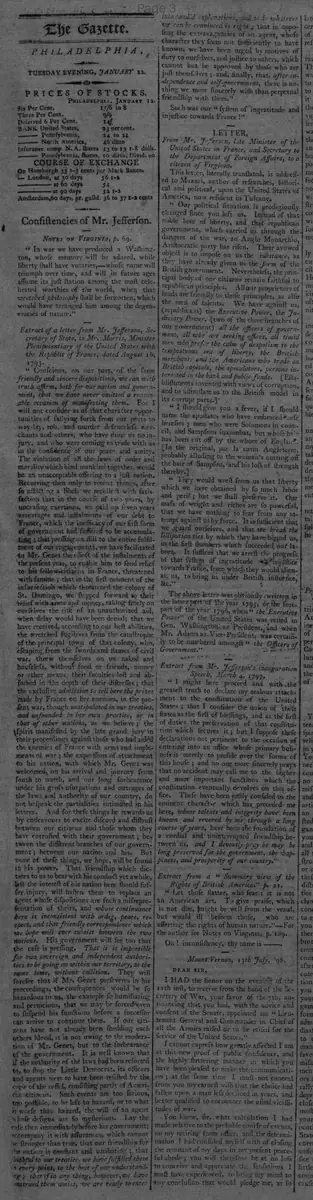
Gazette Of The United States, & Philadelphia Daily Advertiser
Philadelphia, Philadelphia County, Pennsylvania
What is this article about?
An editorial critiquing Thomas Jefferson's political inconsistencies, quoting his praise for Washington from 'Notes on Virginia,' a 1793 letter defending U.S. friendship with France against Genet's accusations, a 1795-96 letter to Mazzei decrying an 'Anglo-Monarchical' party including Washington and Adams, and excerpts from 'Summary View' on flattery, portraying Jefferson as hypocritical.
Merged-components note: Sequential components form a single cohesive editorial on the inconsistencies of Mr. Jefferson, continuing across the provided text blocks.
Clipping
OCR Quality
Full Text
NOTES ON VIRGINIA, p. 69.
"In war we have produced a Washington, whose memory will be adored, while liberty shall have votaries—whose name will triumph over time, and will in future ages assume its just station among the most celebrated worthies of the world, when that wretched philosophy shall be forgotten, which would have arranged him among the degeneracies of nature."
Extract of a letter from Mr. Jefferson, Secretary of State, to Mr. Morris, Minister Plenipotentiary of the United States with the Republic of France, dated August 16, 1793.
"Conscious, on our part, of the same friendly and sincere dispositions, we can with truth affirm, both for our nation and government, that we have never omitted a reasonable occasion of manifesting them. For I will not consider as of that character opportunities of sailing forth from our ports to way-lay, rob, and murder defenceless merchants and others, who have done us no injury, and who were coming to trade with us in the confidence of our peace and amity. The violation of all the laws of order and morality which bind mankind together, would be an unacceptable offering to a just nation. Recurring then only to recent things, after so afflicting a libel, we recollect with satisfaction that in the course of two years, by unceasing exertions, we paid up even years' arrearages and installments of our debt to France, which the inefficacy of our first form of government had suffered to be accumulating; that pressing on still to the entire fulfillment of our engagements, we have facilitated to Mr. Genet the effect of the installments of the present year, to enable him to send relief to his fellow-citizens in France, threatened with famine; that in the first moment of the insurrection which threatened the colony of St. Domingo, we stepped forward to their relief with arms and money, taking freely on ourselves the risk of an unauthorized aid, when delay would have been denial; that we have received, according to our best abilities, the wretched fugitives from the catastrophe of the principal town of that colony, who, escaping from the swords and flames of civil war, threw themselves on us naked and houseless, without food or friends, money or other means, their faculties lost and absorbed in the depth of their distresses; that the exclusive admission to sell here the prizes made by France on her enemies, in the present war, though unstipulated in our treaties, and unfounded in her own practice, or in that of other nations, as we believe; the spirit manifested by the late grand jury in their proceedings against those who had aided the enemies of France with arms and implements of war; the expression of attachment to his nation, with which Mr. Genet was welcomed, on his arrival and journey from south to north, and our long forbearance under his gross usurpations and outrages of the laws and authority of our country, do not bespeak the partialities intimated in his letters. And for these things he rewards us by endeavours to excite discord and distrust between our citizens and those whom they have entrusted with their government; between the different branches of our government; between our nation and his. But none of these things, we hope, will be found in his power. That friendship which dictates to us to bear with his conduct yet awhile, lest the interests of his nation here should suffer injury, will hasten them to replace an agent whose dispositions are such a misrepresentation of theirs, and whose continuance here is inconsistent with order, peace, respect, and that friendly correspondence which we hope will ever subsist between the two nations. His government will see too that the case is pressing. That it is impossible for two sovereign and independent authorities to be going on within our territory, at the same time, without collision. They will foresee that if Mr. Genet perseveres in his proceedings, the consequences would be so hazardous to us, the example so humiliating and pernicious, that we may be forced even to suspend his functions before a successor can arrive to continue them. If our citizens have not already been shedding each others' blood, it is not owing to the moderation of Mr. Genet, but to the forbearance of the government. It is well known that if the authority of the laws had been resorted to, to stop the Little Democrat, its officers and agents were to have been resisted by the crew of the vessel, consisting partly of American citizens. Such events are too serious, too possible, to be let to hazard, or to what is worse than hazard, the will of an agent whose designs are so mysterious. Lay the case then immediately before his government; accompany it with assurances, which cannot be stronger than true, that our friendship for the nation is constant and unabating; that faithful to our treaties, we have fulfilled them in every point, to the best of our understanding; that if in anything, however, we have construed them amiss, we are ready to enter
into candid explanations, and to do whatever we can be convinced is right; in opposing the extravagancies of an agent, whose character they seem not sufficiently to have known, we have been urged by motives of duty to ourselves, and justice to others, which cannot but be approved by those who are just themselves; and, finally, that, after independence and self-government, there is nothing we more sincerely wish than perpetual friendship with them."
Such was our "system of ingratitude and injustice towards France!"
LETTER,
From Mr. Jefferson, late Minister of the United States in France, and Secretary to the Department of Foreign Affairs, to a citizen of Virginia.
This letter, literally translated, is addressed to Mazzei, author of researches, historical and political, upon the United States of America, now resident in Tuscany.
"Our political situation is prodigiously changed since you left us. Instead of that noble love of liberty, and that republican government, which carried us through the dangers of the war, an Anglo-Monarchial, Aristocratic party has risen. Their avowed object is to impose on us the substance, as they have already given us the form of the British government. Nevertheless, the principal body of our citizens remain faithful to republican principles. All our proprietors of lands are friendly to those principles, as also the men of talents. We have against us, (republicans) the Executive Power, the Judiciary Power, (two of the three branches of our government) all the officers of government, all who are seeking offices, all timid men who prefer the calm of despotism to the tempestuous sea of liberty, the British merchants and the Americans who trade on British capitals, the speculators, persons interested in the bank and public funds. [Establishments invented with views of corruption, and to assimilate us to the British model in its corrupt parts.]
"I should give you a fever, if I should name the apostates who have embraced new heresies; men who were Solomons in council, and Samsons in combat, but whose hair has been cut off by the whore of England. [In the original, par la catin Angleterre, probably alluding to the woman's cutting off the hair of Samson, and his loss of strength thereby.]
"They would wrest from us that liberty which we have obtained by so much labor and peril; but we shall preserve it. Our mass of weight and riches are so powerful, that we have nothing to fear from any attempt against us by force. It is sufficient that we guard ourselves, and that we break the Lilliputian ties by which they have bound us, in the first slumbers which succeeded our labors. It suffices that we arrest the progress of that system of ingratitude and injustice towards France, from which they would alienate us, to bring us under British influence, &c."
The above letter was obviously written in the latter part of the year 1795; or the fore part of the year 1796, when "the Executive Power" of the United States was vested in Gen. Washington: as President, and when Mr. Adams as Vice-President, was certainly to be numbered amongst "the Officers of Government."
"I might here proceed and with the greatest truth to declare my zealous attachment to the constitution of the United States; that I consider the union of these states as the first of blessings, and as the first of duties the preservation of that constitution which secures it; but I suppose these declarations not pertinent to the occasion of entering into an office whose primary business is merely to preside over the forms of this house; and no one more sincerely prays that no accident may call me to the higher and more important functions which the constitution eventually devolves on this office. These have been justly confided to the eminent character which has preceded me here, whose talents and integrity have been known and revered by me through a long course of years, have been the foundation of a cordial and uninterrupted friendship between us, and I devoutly pray he may be long preserved for the government, the happiness, and prosperity of our country."
Extract from a "Summary view of the Rights of British America." p. 21.
"Let those flatter, who fear; it is not an American art. To give praise, which is not due, might be well from the venal, but would ill beseem those, who are asserting the rights of human nature." For the author see Notes on Virginia, p. 189.
Oh! inconsistency, thy name is—
What sub-type of article is it?
What keywords are associated?
What entities or persons were involved?
Editorial Details
Primary Topic
Inconsistencies In Thomas Jefferson's Political Statements And Actions
Stance / Tone
Strongly Critical And Accusatory Of Hypocrisy
Key Figures
Key Arguments