Thank you for visiting SNEWPapers!
Sign up free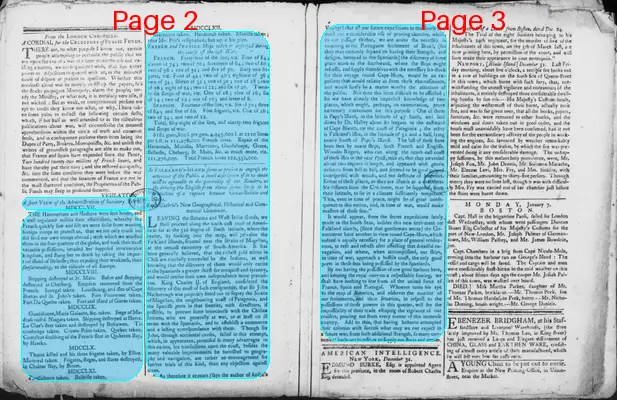
The Massachusetts Spy
Boston, Suffolk County, Massachusetts
What is this article about?
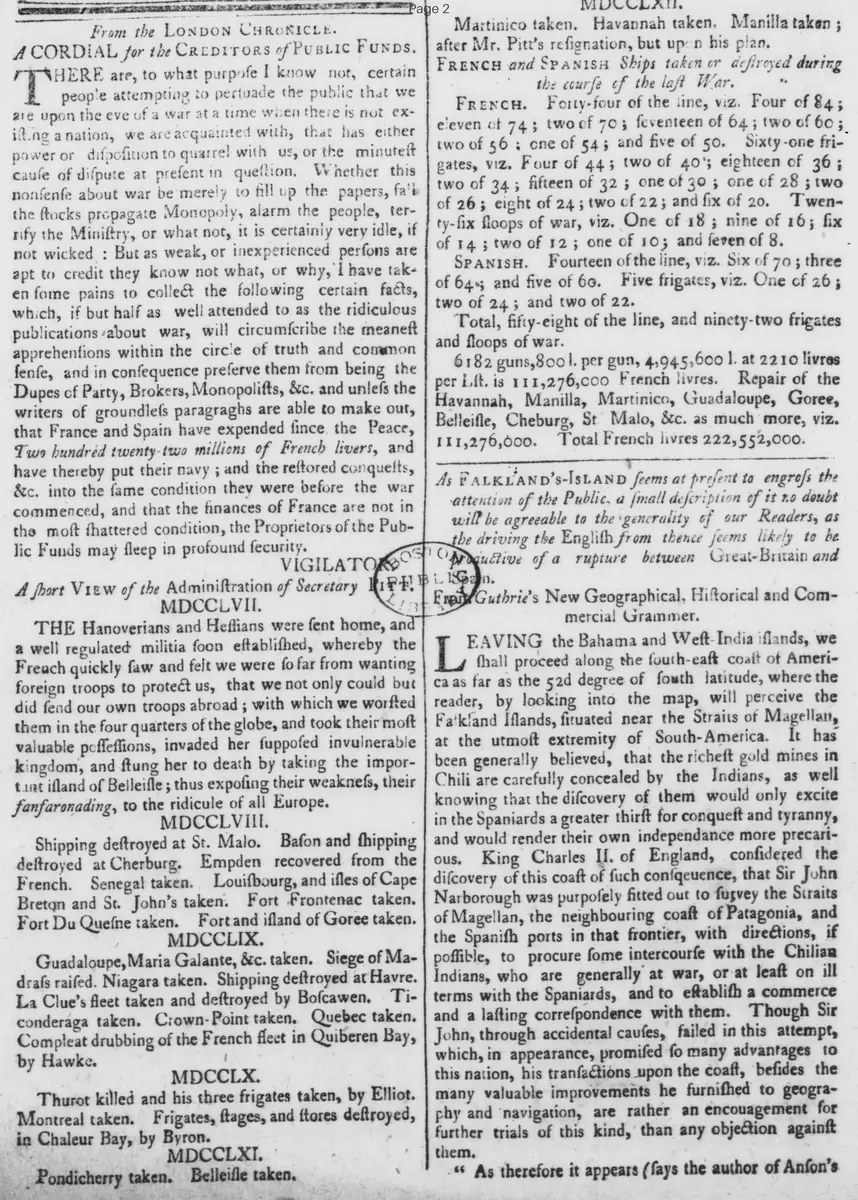
Review of British military triumphs under Secretary Hillsborough from 1757-1761, listing captures of French and Spanish ships and territories during the Seven Years' War, followed by a geographical description and strategic importance of the Falkland Islands amid contemporary tensions with Spain.
Merged-components note: These two components form a single coherent narrative article on the administration of Secretary Hillsborough, historical war events, and discussions of Falkland Islands and South Seas expeditions. The text flows continuously from one to the next, indicating a page break split. Label set to 'story' as it is a full narrative article with historical and foreign policy elements.
Clippings
1 of 2
OCR Quality
Full Text
THE Hanoverians and Hessians were sent home, and a well regulated militia soon established, whereby the French quickly saw and felt we were so far from wanting foreign troops to protect us, that we not only could but did send our own troops abroad; with which we worsted them in the four quarters of the globe, and took their most valuable possessions, invaded her supposed invulnerable kingdom, and stung her to death by taking the important island of Belleisle; thus exposing their weakness, their fanfaronading, to the ridicule of all Europe.
MDCCLVIII Shipping destroyed at St. Malo. Basin and Shipping destroyed at Cherburg. Emden recovered from the French. Senegal taken. Louisbourg, and isles of Cape Breton and St. John's taken. Fort Frontenac taken. Fort Du Quesne taken. Fort and island of Goree taken.
MDCCLIX. Guadaloupe, Maria Galante, &c. taken. Siege of Madras raised. Niagara taken. Shipping destroyed at Havre. La Clue's fleet taken and destroyed by Boscawen. Ticonderaga taken. Crown Point taken. Quebec taken. Compleat drubbing of the French fleet in Quiberon Bay, by Hawke.
MDCCLX Thurot killed and his three frigates taken, by Elliot. Montreal taken. Frigates, stages, and stores destroyed, in Chaleur Bay, by Byron.
MDCCLXI Pondicherry taken. Belleisle taken.
Martinico taken. Havannah taken. Manilla taken; after Mr. Pitt's resignation, but upon his plan.
French and Spanish Ships taken or destroyed during the course of the last War.
French. Sixty-four of the line, viz. Four of 84; eleven of 74; two of 70; seventeen of 64; two of 60; two of 56: one of 54; and five of 50. Sixty-one frigates, viz. Four of 44; two of 40; eighteen of 36; two of 34; fifteen of 32; one of 30; one of 28; two of 26; eight of 24; two of 22; and six of 20. Twenty-six sloops of war, viz. One of 18; nine of 16; six of 14: two of 12; one of 10; and seven of 8.
Spanish. Fourteen of the line, viz. Six of 70; three of 64; and five of 60. Five frigates, viz. One of 26; two of 24; and two of 22.
Total, fifty-eight of the line, and ninety-two frigates and sloops of war. 6182 guns, 800l. per gun, 4,945,600 l. at 22 1/2 livres per £ st. is 111,276,000 French livres. Repair of the Havannah, Manilla, Martinico, Guadaloupe, Goree, Belleisle, Cherburg, St Malo, &c. as much more, viz. 111,276,000.
Total French livres 222,552,000.
As Falkland's Island seems at present to engross the attention of the Public, a small description of it no doubt will be agreeable to the generality of our Readers, as the driving the English from thence seems likely to be productive of a rupture between Great-Britain and Spain.
From Guthrie's New Geographical, Historical and Commercial Grammar.
Leaving the Bahama and West-India islands, we shall proceed along the south-east coast of America as far as the 52d degree of south latitude, where the reader, by looking into the map, will perceive the Falkland Islands, situated near the Straits of Magellan, at the utmost extremity of South-America. It has been generally believed, that the richest gold mines in Chili are carefully concealed by the Indians, as well knowing that the discovery of them would only excite in the Spaniards a greater thirst for conquest and tyranny, and would render their own independence more precarious.
King Charles II. of England, considered the discovery of this coast of such consequence, that Sir John Narborough was purposely fitted out to survey the Straits of Magellan, the neighbouring coast of Patagonia, and the Spanish ports in that frontier, with directions, if possible, to procure some intercourse with the Chilian Indians, who are generally at war, or at least on ill terms with the Spaniards, and to establish a commerce and a lasting correspondence with them. Though Sir John, through accidental causes, failed in this attempt, which, in appearance, promised so many advantages to this nation, his transactions upon the coast, besides the many valuable improvements he furnished to geography and navigation, are rather an encouragement for further trials of this kind, than any objection against them.
"As therefore it appears (says the author of Anon's
that all our future expeditions to the South Seas must run a considerable risk of proving abortive, whilst, in our passage thither, we are under the necessity of touching at the Portuguese Settlement of Brazil, (for they may certainly depend on having their strength, and designs, betrayed to the Spaniards) the discovery of some place more to the southward, where the ships might refresh, and supply themselves with the necessary sea-stock for their voyage round Cape-Horn, would be an expedient that would relieve us from these embarrassments, and would surely be a matter worthy the attention of the public.
Nor does this seem difficult to be effected: for we have already the imperfect knowledge of two places, which might, perhaps, on examination, prove extremely convenient for this purpose: One of them is Pepy's Island, in the latitude of 47 south, and laid down by Dr. Halley about 80 leagues to the eastward of Cape Blanco, on the coast of Patagonia; the other is Falkland's Isles, in the latitude of 51 and a half, lying nearly South of Pepy's Island. The last of these have been seen by many Ships, both French and English. Woodes Rogers, who run along the north east coast of these isles in the year 1708, tells us, that they extended about two degrees in length, and appeared with gentle descents from hill to hill, and seemed to be good ground interspersed with woods, and not destitute of harbours.
Either of these places, as they are islands at a considerable distance from the Continent, may be supposed, from their latitude, to lie in a climate sufficiently temperate. This, even in time of peace, might be of great consequence to this nation, and, in time of war, would make matters of those seas.
It would appear, from the secret expeditions lately made to the South Seas, besides this new settlement on Falkland Islands, (since that gentleman wrote) the Government have another in view round Cape-Horn, which indeed is equally necessary for a place of general rendezvous, to refit and refresh after effecting that dreadful navigation, and where, when accomplished, our ships, in time of war, approach a hostile coast, the only good ports in those seas being possessed by the Spaniards. By our having the possession of one good harbour here, and keeping the royal navy on a respectable footing, we shall have nothing to fear from all the united force of France, Spain and Portugal. Whoever turns his eye to the map of America, and observes the number of our settlements, and their situation, in respect to the possessions of those powers in this quarter, will see the impossibility of their trade escaping the vigilance of our cruisers, pouring out from every corner of this immense country. Add to this, that having hitherto attempted their colonies with success what may we not expect in a future war, from such additional strength, so many convenient harbours to refit, or to supply our fleets and armies.
What sub-type of article is it?
What themes does it cover?
What keywords are associated?
What entities or persons were involved?
Where did it happen?
Story Details
Key Persons
Location
Europe, Americas, South Seas, Falkland Islands
Event Date
Mdcclvii Mdcclxi
Story Details
British forces under Hillsborough's administration achieved victories over French and Spanish in the Seven Years' War, capturing territories like Quebec, Louisbourg, and ships totaling significant losses to enemies; description highlights Falkland Islands' strategic value for British naval operations near South America.