Thank you for visiting SNEWPapers!
Sign up free
Literary
May 2, 1828
Rhode Island American And Providence Gazette
Providence, Providence County, Rhode Island
What is this article about?
Editorial apology for misplacing a submitted poem by Mr. T. B., followed by an introduction to plowman-poet Robert Anderson and his dialect ballad 'The Impatient Lassie,' expressing a rural girl's anxious wait for her lover's clandestine visit after her parents sleep.
Clipping
OCR Quality
95%
Excellent
Full Text
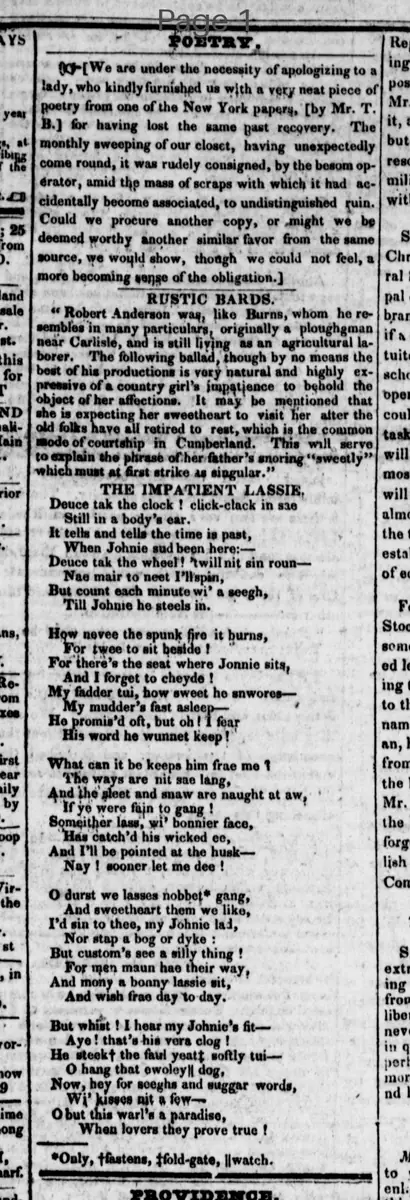
POETRY
We are under the necessity of apologizing to a lady, who kindly furnished us with a very neat piece of poetry from one of the New York papers, [by Mr. T. B.] for having lost the same past recovery. The monthly sweeping of our closet, having unexpectedly come round, it was rudely consigned, by the besom operator, amid the mass of scraps with which it had accidentally become associated, to undistinguished ruin. Could we procure another copy, or might we be deemed worthy another similar favor from the same source, we would show, though we could not feel, a more becoming sense of the obligation.
RUSTIC BARDS.
"Robert Anderson was, like Burns, whom he resembles in many particulars, originally a ploughman near Carlisle, and is still living as an agricultural laborer. The following ballad, though by no means the best of his productions is very natural and highly expressive of a country girl's impatience to behold the object of her affections. It may be mentioned that she is expecting her sweetheart to visit her after the old folks have all retired to rest, which is the common mode of courtship in Cumberland. This will serve to explain the phrase of her father's snoring 'sweetly' which must at first strike as singular."
THE IMPATIENT LASSIE.
Deuce tak the clock! click-clack in sae
Still in a body's ear.
It tells and tells the time is past,
When Johnie sud been here:—
Deuce tak the wheel! twill nit spin roun—
Nae mair to neet I'll spin,
But count each minute wi' a seegh,
Till Johnie he steals in.
How nices the spunk fire it burns,
For twee to sit beside!
For there's the seat where Johnie sits,
And I forget to chide!
My fadder tui, how sweet he snores—
My mudder's fast asleep
He promis'd oft, but oh! I fear
His word he wunnet keep!
What can it be keeps him sae late!
The ways are nit sae lang,
And the sleet and snaw are naught at aw,
If ye were fain to gang!
Some ither lass, wi' bonnier face,
Has catch'd his wicked ee,
And I'll be pointed at the kirk—
Nay I sooner let me dee!
O durst we lasses nobbet gang,
And sweetheart them we like,
I'd rin to thee, my Johnie lad,
Nor stap a bog or dyke:
But custom's see a silly thing!
For men maun hae their way,
And mony a bonny lassie sit,
And wish frae day to day.
But whist! I hear my Johnie's fit—
Aye! that's his vera clog!
He steekt the aul yet at sotly tui—
O hang that woolly dog.
Now, hey for sighs and sugar words,
Wi' kisses nit a few—
O but this warl's a paradise,
When lovers they prove true!
*Only, fastens, fold-gate, watch.
We are under the necessity of apologizing to a lady, who kindly furnished us with a very neat piece of poetry from one of the New York papers, [by Mr. T. B.] for having lost the same past recovery. The monthly sweeping of our closet, having unexpectedly come round, it was rudely consigned, by the besom operator, amid the mass of scraps with which it had accidentally become associated, to undistinguished ruin. Could we procure another copy, or might we be deemed worthy another similar favor from the same source, we would show, though we could not feel, a more becoming sense of the obligation.
RUSTIC BARDS.
"Robert Anderson was, like Burns, whom he resembles in many particulars, originally a ploughman near Carlisle, and is still living as an agricultural laborer. The following ballad, though by no means the best of his productions is very natural and highly expressive of a country girl's impatience to behold the object of her affections. It may be mentioned that she is expecting her sweetheart to visit her after the old folks have all retired to rest, which is the common mode of courtship in Cumberland. This will serve to explain the phrase of her father's snoring 'sweetly' which must at first strike as singular."
THE IMPATIENT LASSIE.
Deuce tak the clock! click-clack in sae
Still in a body's ear.
It tells and tells the time is past,
When Johnie sud been here:—
Deuce tak the wheel! twill nit spin roun—
Nae mair to neet I'll spin,
But count each minute wi' a seegh,
Till Johnie he steals in.
How nices the spunk fire it burns,
For twee to sit beside!
For there's the seat where Johnie sits,
And I forget to chide!
My fadder tui, how sweet he snores—
My mudder's fast asleep
He promis'd oft, but oh! I fear
His word he wunnet keep!
What can it be keeps him sae late!
The ways are nit sae lang,
And the sleet and snaw are naught at aw,
If ye were fain to gang!
Some ither lass, wi' bonnier face,
Has catch'd his wicked ee,
And I'll be pointed at the kirk—
Nay I sooner let me dee!
O durst we lasses nobbet gang,
And sweetheart them we like,
I'd rin to thee, my Johnie lad,
Nor stap a bog or dyke:
But custom's see a silly thing!
For men maun hae their way,
And mony a bonny lassie sit,
And wish frae day to day.
But whist! I hear my Johnie's fit—
Aye! that's his vera clog!
He steekt the aul yet at sotly tui—
O hang that woolly dog.
Now, hey for sighs and sugar words,
Wi' kisses nit a few—
O but this warl's a paradise,
When lovers they prove true!
*Only, fastens, fold-gate, watch.
What sub-type of article is it?
Poem
Soliloquy
What themes does it cover?
Love Romance
Social Manners
What keywords are associated?
Rustic Ballad
Impatient Lassie
Cumberland Courtship
Dialect Poetry
Night Visit
What entities or persons were involved?
Robert Anderson
Literary Details
Title
The Impatient Lassie.
Author
Robert Anderson
Subject
A Country Girl's Impatience To Behold The Object Of Her Affections
Form / Style
Ballad In Dialect
Key Lines
Deuce Tak The Clock! Click Clack In Sae
Still In A Body's Ear.
It Tells And Tells The Time Is Past,
When Johnie Sud Been Here:—
O Durst We Lasses Nobbet Gang,
And Sweetheart Them We Like,
I'd Rin To Thee, My Johnie Lad,
Nor Stap A Bog Or Dyke:
Now, Hey For Sighs And Sugar Words,
Wi' Kisses Nit A Few—
O But This Warl's A Paradise,
When Lovers They Prove True!