Thank you for visiting SNEWPapers!
Sign up free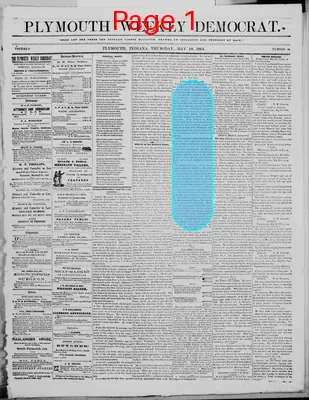
Story
May 19, 1864
The Plymouth Weekly Democrat
Plymouth, Marshall County, Indiana
What is this article about?
Intense Civil War battles south of the Rapidan, involving Grant's Union army and Lee's Confederates, result in massive casualties over days without significant territorial changes, likened to ancient barbaric combats.
Clipping
OCR Quality
98%
Excellent
Full Text
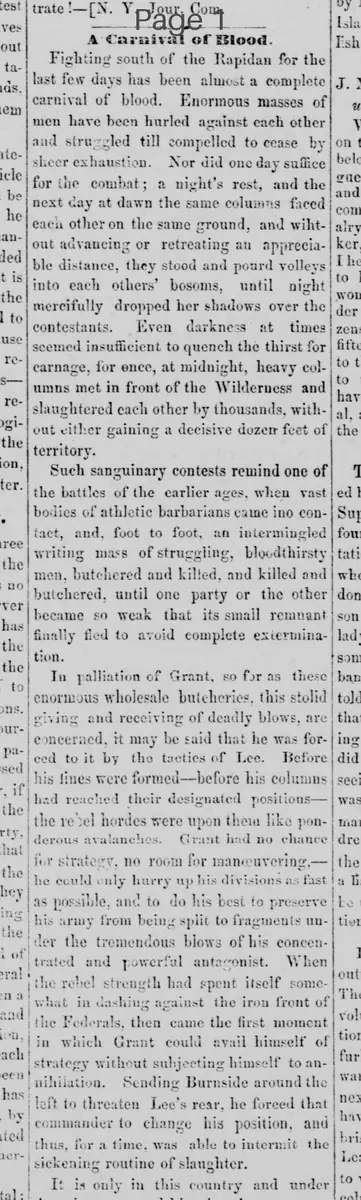
A Carnival of Blood.
Fighting south of the Rapidan for the last few days has been almost a complete carnival of blood. Enormous masses of men have been hurled against each other and struggled till compelled to cease by sheer exhaustion. Nor did one day suffice for the combat; a night's rest, and the next day at dawn the same columns faced each other on the same ground, and without advancing or retreating an appreciable distance, they stood and poured volleys into each others' bosoms, until night mercifully dropped her shadows over the contestants. Even darkness at times seemed insufficient to quench the thirst for carnage, for once, at midnight, heavy columns met in front of the Wilderness and slaughtered each other by thousands, without either gaining a decisive dozen feet of territory.
Such sanguinary contests remind one of the battles of the earlier ages, when vast bodies of athletic barbarians came into contact, and, foot to foot, an intermingled writhing mass of struggling, bloodthirsty men, butchered and killed, and killed and butchered, until one party or the other became so weak that its small remnant finally fled to avoid complete extermination.
In palliation of Grant, so far as these enormous wholesale butcheries, this stolid giving and receiving of deadly blows, are concerned, it may be said that he was forced to it by the tactics of Lee. Before his lines were formed—before his columns had reached their designated positions—the rebel hordes were upon them like ponderous avalanches. Grant had no chance for strategy, no room for maneuvering,—he could only hurry up his divisions as fast as possible, and do his best to preserve his army from being split to fragments under the tremendous blows of his concentrated and powerful antagonist. When the rebel strength had spent itself somewhat in dashing against the iron front of the Federals, then came the first moment in which Grant could avail himself of strategy without subjecting himself to annihilation. Sending Burnside around the left to threaten Lee's rear, he forced that commander to change his position, and thus, for a time, was able to intermit the sickening routine of slaughter.
It is only in this country and under American generalship that immense armies meet and struggle for days on a restricted space, and then separate with no other results than limitless lists of wounded and dead.—Chicago Times.
Fighting south of the Rapidan for the last few days has been almost a complete carnival of blood. Enormous masses of men have been hurled against each other and struggled till compelled to cease by sheer exhaustion. Nor did one day suffice for the combat; a night's rest, and the next day at dawn the same columns faced each other on the same ground, and without advancing or retreating an appreciable distance, they stood and poured volleys into each others' bosoms, until night mercifully dropped her shadows over the contestants. Even darkness at times seemed insufficient to quench the thirst for carnage, for once, at midnight, heavy columns met in front of the Wilderness and slaughtered each other by thousands, without either gaining a decisive dozen feet of territory.
Such sanguinary contests remind one of the battles of the earlier ages, when vast bodies of athletic barbarians came into contact, and, foot to foot, an intermingled writhing mass of struggling, bloodthirsty men, butchered and killed, and killed and butchered, until one party or the other became so weak that its small remnant finally fled to avoid complete extermination.
In palliation of Grant, so far as these enormous wholesale butcheries, this stolid giving and receiving of deadly blows, are concerned, it may be said that he was forced to it by the tactics of Lee. Before his lines were formed—before his columns had reached their designated positions—the rebel hordes were upon them like ponderous avalanches. Grant had no chance for strategy, no room for maneuvering,—he could only hurry up his divisions as fast as possible, and do his best to preserve his army from being split to fragments under the tremendous blows of his concentrated and powerful antagonist. When the rebel strength had spent itself somewhat in dashing against the iron front of the Federals, then came the first moment in which Grant could avail himself of strategy without subjecting himself to annihilation. Sending Burnside around the left to threaten Lee's rear, he forced that commander to change his position, and thus, for a time, was able to intermit the sickening routine of slaughter.
It is only in this country and under American generalship that immense armies meet and struggle for days on a restricted space, and then separate with no other results than limitless lists of wounded and dead.—Chicago Times.
What sub-type of article is it?
Historical Event
Military Action
What themes does it cover?
Catastrophe
Tragedy
What keywords are associated?
Battle Of Wilderness
Civil War Carnage
Grant Lee Confrontation
Union Confederate Fighting
Military Strategy
What entities or persons were involved?
Grant
Lee
Burnside
Where did it happen?
South Of The Rapidan, Front Of The Wilderness
Story Details
Key Persons
Grant
Lee
Burnside
Location
South Of The Rapidan, Front Of The Wilderness
Event Date
Last Few Days
Story Details
Union and Confederate armies engage in prolonged, bloody battles with heavy losses but no territorial gains; Grant maneuvers Burnside to threaten Lee's rear, interrupting the slaughter.