Thank you for visiting SNEWPapers!
Sign up free
Virginia Argus
Richmond, Virginia
What is this article about?
Report from Lisbon via Norfolk: Lord Wellington retreats towards Lisbon as French forces under Soult and former Massena army concentrate in Estremadura. No general action; allied troops reposition along Caya River. Markets in Lisbon sluggish with low prices for provisions. Dispatch dated June 20, 1811 details enemy advances and blockade lift at Badajoz.
Merged-components note: Continuation of the Norfolk report on Portuguese affairs and Lord Wellington's movements; merging for coherent foreign news item.
Clipping
OCR Quality
Full Text
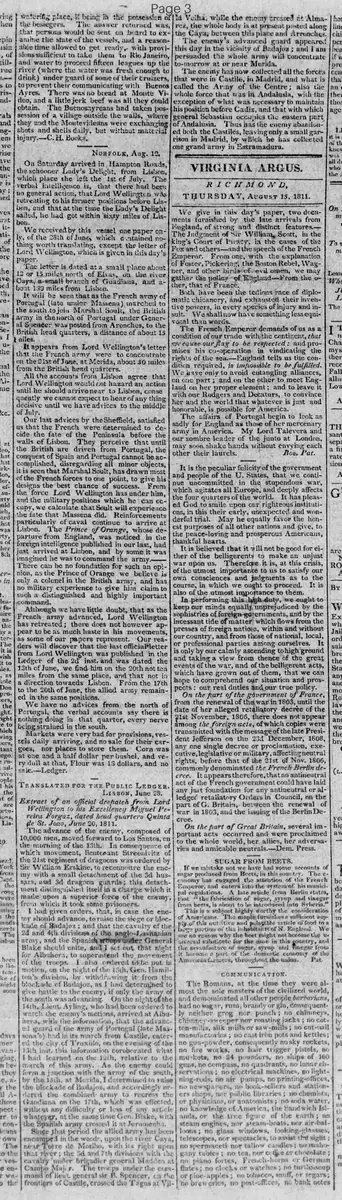
On Saturday arrived in Hampton Roads, the schooner Lady's Delight, from Lisbon, which place she left the 1st of July. The verbal intelligence is, that there had been no general action, that Lord Wellington was retreating to his former positions before Lisbon, and that at the time the Lady's Delight sailed, he had got within sixty miles of Lisbon.
We received by this vessel one paper only, of the 25th of June, which contained nothing worth translating, except the letter of Lord Wellington, which is given in this day's paper.
The letter is dated at a small place about 12 or 15 miles north of Elvas, on the river Caya, a small branch of Guadiana, and about 130 miles from Lisbon.
It will be seen that as the French army of Portugal (late under Massena) marched to the south to join Marshal Soult, the British army in the north of Portugal under General Spencer was posted from Arronches, to the British head quarters, a distance of about 15 miles.
It appears from Lord Wellington's letter that the French army were to concentrate on the left of June, at Merida, about 50 miles from the British head quarters.
All the accounts from Lisbon agree that Lord Wellington would not hazard an action until he should arrive near to Lisbon, consequently we cannot expect to hear of any thing decisive until we have advices to the middle of July.
Our last advices by the Sheffield, satisfied us that the French were determined to decide the fate of the Peninsula before the walls of Lisbon. They perceive that until the British are driven from Portugal, the conquest of Spain and Portugal cannot be accomplished, disregarding all minor objects, it is seen that Marshal Soult, has drawn most of the French forces to one point, to give his designs the best chance of success. From the force Lord Wellington has under him, and the military positions which he can occupy, we calculate that Soult will experience the fate that Massena did. Reinforcements particularly of cavalry continue to arrive at Lisbon. The Prince of Orange, whose departure from England, was noticed in the foreign intelligence published in our last, had just arrived at Lisbon, and by some it was imagined he was to command the army.
There can be no foundation for such an opinion, as the Prince of Orange we believe is only a colonel in the British army, and has no military experience to give him claim to such a distinguished and highly important command.
Although we have little doubt, that as the French army advanced, Lord Wellington has retreated; there does not however appear to be as much haste in his movements, as some of our papers represent. Our readers will discover that the last official letter from Lord Wellington was published in the Ledger of the 2d inst. and was dated the 13th of June, we find him on the 20th not ten miles from the same place, and that not in a direction towards Lisbon. From the 17th to the 20th of June, the allied army remained in the same positions.
We have no advices from the north of Portugal, the verbal accounts say there is nothing doing in that quarter, every nerve being strained in the south.
Markets were very bad for provisions, vessels daily arriving, and no sale for their cargoes, nor places to store them. Corn was at one and a half dollar per bushel, and very dull at that, Flour was 13 dollars, and no sale.
Ledger.
Translated for the Public Ledger.
LISBON, June 28.
Extract of an official dispatch from Lord Wellington to his Excellency Miguel Pereira Forjaz, dated head quarters Quinta de St. Joao, June 20, 1811.
The advance of the enemy, composed of 10,000 men, moved forward to Los Santos, on the morning of the 13th. In consequence of which movement, lieutenant Steevenwitz of the 21st regiment of dragoons was ordered by Sir William Erskine, to reconnoitre the enemy with a small detachment of the 3d hussars, and 3d dragoon guards; this detachment distinguished itself in a charge which it made upon a superior force of the enemy, from which it took some prisoners.
I had given orders, that, in case the enemy should advance, to raise the siege or blockade of Badajoz: and that the cavalry of the 2d and 4th divisions of the anglo-Lusitanian army, and the Spanish troops under General Blake should unite, and I set out that night for Albuhera, to superintend the movement of the troops. I also ordered to be put in motion, on the night of the 15th, Gen. Hamilton's division, by withdrawing it from the blockade of Badajoz, as I had determined to give battle to the enemy, if only the army of the south was advancing. On the night of the 14th. Lieut. Ayling, who had been ordered to watch the enemy's motions, arrived at Albuhera, with the information, that the advanced guard of the army of Portugal (late Massena's) had in its march from Castile, entered the city of Truxillo, on the evening of the 13th inst. this information corroborated what I had learned on the 12th, relative to the march of this army. As the enemy could form a junction with the army of the south, by the 15th, at Merida, I determined to raise the blockade of Badajoz, and accordingly ordered the combined army to recross the Guadiana on the 17th, which was effected without any difficulty or loss of any article whatever, at the same time Gen. Blake, with the Spanish army crossed it at Jerumenha.
Since that period the allied army has been encamped in the woods, upon the river Caya, near Torre de Mori bo, with its right upon that river; the 3d and 7th divisions with the Cavalry under brigadier general Madden at Campo Mayor. The troops under the command of lieut. general sir B. Spencer, on the frontiers of Castile, crossed the Tagus at Vila Velha, while the enemy crossed at Almarez, the whole body is at present posted along the Caya; between this place and Arronches.
The enemy's advanced guard appeared this day in the vicinity of Badajoz; and I am persuaded the whole army will concentrate to-morrow at or near Merida.
The enemy has now collected all the forces that were in Castile, in Madrid, and what is called the Army of the Centre; also the whole force that was in Andalusia, with the exception of what was necessary to maintain his position before Cadiz, and that with which general Sebastian occupies the eastern part of Andalusia. Thus has the enemy abandoned both the Castiles, leaving only a small garrison in Madrid, by which he has collected one grand army in Estremadura.
What sub-type of article is it?
What keywords are associated?
What entities or persons were involved?
Where did it happen?
Foreign News Details
Primary Location
Lisbon, Portugal
Event Date
June 20, 1811
Key Persons
Outcome
no general action; allied army retreats to positions near lisbon; french concentrate at merida; small number of prisoners taken by british cavalry; blockade of badajoz raised without loss.
Event Details
Schooner Lady's Delight arrives from Lisbon (left July 1) reporting no general action; Wellington retreating to positions before Lisbon, within 60 miles. French army from Portugal joins Soult in south; British under Spencer posted from Arronches. French to concentrate at Merida. Wellington's dispatch (June 20) details enemy advance to Los Santos; British cavalry charge takes prisoners; siege of Badajoz lifted; allied army recrosses Guadiana to Caya River positions. Enemy gathers grand army in Estremadura, abandoning Castiles. No news from north Portugal. Markets bad: corn 1.5 dollars/bushel, flour 13 dollars, no sales.