Thank you for visiting SNEWPapers!
Sign up free
The Monmouth Inquirer
Freehold, Monmouth County, New Jersey
What is this article about?
Article describes various primitive currencies used by indigenous peoples worldwide, including slaves, cattle, shells like cowries and wampum, cacao beans, and stone blocks, emphasizing their utility, rarity, and regional variations.
Clipping
OCR Quality
Full Text
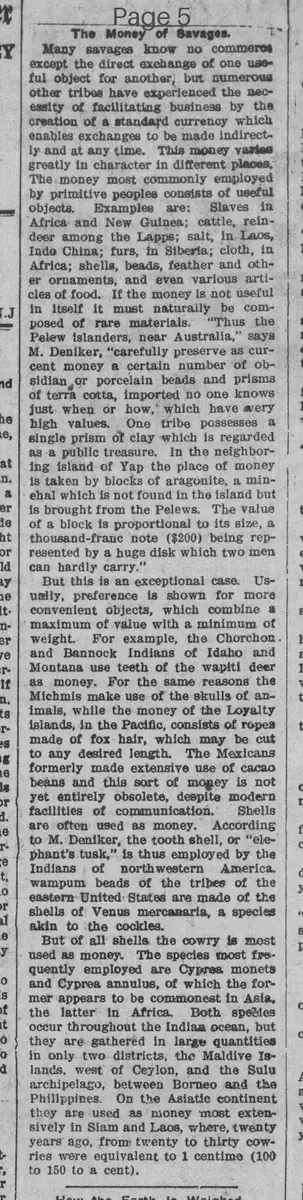
Many savages know no commerce except the direct exchange of one useful object for another, but numerous other tribes have experienced the necessity of facilitating business by the creation of a standard currency which enables exchanges to be made indirectly and at any time. This money varies greatly in character in different places.
The money most commonly employed by primitive peoples consists of useful objects. Examples are: Slaves in Africa and New Guinea; cattle, reindeer among the Lapps; salt, in Laos, Indo China; furs, in Siberia; cloth, in Africa; shells, beads, feather and other ornaments, and even various articles of food. If the money is not useful in itself it must naturally be composed of rare materials. "Thus the Pelew islanders, near Australia," says M. Deniker, "carefully preserve as current money a certain number of obsidian or porcelain beads and prisms of terra cotta, imported no one knows just when or how," which have very high values. One tribe possesses a single prism of clay which is regarded as a public treasure. In the neighboring island of Yap the place of money is taken by blocks of aragonite, a mineral which is not found in the island but is brought from the Pelews. The value of a block is proportional to its size, a thousand-franc note ($200) being represented by a huge disk which two men can hardly carry."
But this is an exceptional case. Usually, preference is shown for more convenient objects, which combine a maximum of value with a minimum of weight. For example, the Chorchon and Bannock Indians of Idaho and Montana use teeth of the wapiti deer as money. For the same reasons the Michmis make use of the skulls of animals, while the money of the Loyalty islands, in the Pacific, consists of ropes made of fox hair, which may be cut to any desired length. The Mexicans formerly made extensive use of cacao beans and this sort of money is not yet entirely obsolete, despite modern facilities of communication. Shells are often used as money. According to M. Deniker, the tooth shell, or "elephant's tusk," is thus employed by the Indians of northwestern America.
Wampum beads of the tribes of the eastern United States are made of the shells of Venus mercanaria, a species akin to the cockles.
But of all shells the cowry is most used as money. The species most frequently employed are Cyprea moneta and Cyprea annulus, of which the former appears to be commonest in Asia, the latter in Africa. Both species occur throughout the Indian ocean, but they are gathered in large quantities in only two districts, the Maldive Islands, west of Ceylon, and the Sulu archipelago, between Borneo and the Philippines. On the Asiatic continent they are used as money most extensively in Siam and Laos, where, twenty years ago, from twenty to thirty cowries were equivalent to 1 centime (100 to 150 to a cent)
What sub-type of article is it?
What themes does it cover?
What keywords are associated?
What entities or persons were involved?
Where did it happen?
Story Details
Key Persons
Location
Africa, New Guinea, Laos, Indo China, Siberia, Pelew Islands Near Australia, Yap Island, Idaho And Montana, Loyalty Islands In The Pacific, Mexico, Northwestern America, Eastern United States, Asia, Africa, Indian Ocean, Maldive Islands, Sulu Archipelago, Siam
Story Details
Exploration of primitive money systems used by various tribes, ranging from useful items like slaves, cattle, and food to rare materials such as obsidian beads, aragonite blocks, animal teeth, skulls, cacao beans, and especially cowry shells, with details on their values and regional uses.