Thank you for visiting SNEWPapers!
Sign up free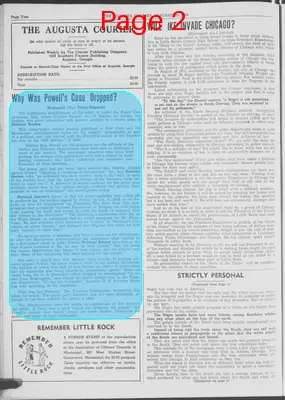
The Augusta Courier
Augusta, Richmond County, Georgia
What is this article about?
Analysis of the mysterious dropping of income tax charges against Rep. Adam Clayton Powell Jr., possibly due to a political deal after his endorsement of Eisenhower in 1956. The investigation ended abruptly despite substantial evidence, raising questions about administration motives.
Clipping
OCR Quality
Full Text
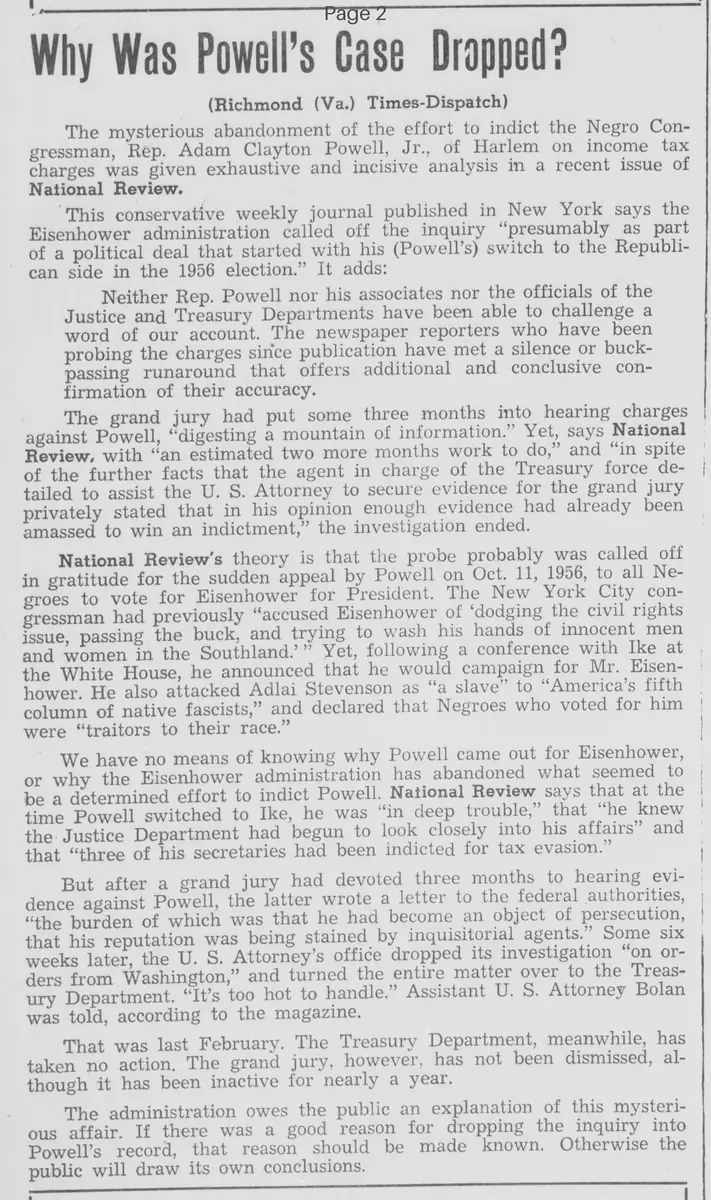
(Richmond (Va.) Times-Dispatch)
The mysterious abandonment of the effort to indict the Negro Congressman, Rep. Adam Clayton Powell, Jr., of Harlem on income tax charges was given exhaustive and incisive analysis in a recent issue of National Review.
This conservative weekly journal published in New York says the Eisenhower administration called off the inquiry "presumably as part of a political deal that started with his (Powell's) switch to the Republican side in the 1956 election." It adds:
Neither Rep. Powell nor his associates nor the officials of the Justice and Treasury Departments have been able to challenge a word of our account. The newspaper reporters who have been probing the charges since publication have met a silence or buck-passing runaround that offers additional and conclusive confirmation of their accuracy.
The grand jury had put some three months into hearing charges against Powell, "digesting a mountain of information." Yet, says National Review, with "an estimated two more months work to do," and "in spite of the further facts that the agent in charge of the Treasury force detailed to assist the U. S. Attorney to secure evidence for the grand jury privately stated that in his opinion enough evidence had already been amassed to win an indictment," the investigation ended.
National Review's theory is that the probe probably was called off in gratitude for the sudden appeal by Powell on Oct. 11, 1956, to all Negroes to vote for Eisenhower for President. The New York City congressman had previously "accused Eisenhower of 'dodging the civil rights issue, passing the buck, and trying to wash his hands of innocent men and women in the Southland.'" Yet, following a conference with Ike at the White House, he announced that he would campaign for Mr. Eisenhower. He also attacked Adlai Stevenson as "a slave" to "America's fifth column of native fascists," and declared that Negroes who voted for him were "traitors to their race."
We have no means of knowing why Powell came out for Eisenhower, or why the Eisenhower administration has abandoned what seemed to be a determined effort to indict Powell. National Review says that at the time Powell switched to Ike, he was "in deep trouble," that "he knew the Justice Department had begun to look closely into his affairs" and that "three of his secretaries had been indicted for tax evasion."
But after a grand jury had devoted three months to hearing evidence against Powell, the latter wrote a letter to the federal authorities, U the burden of which was that he had become an object of persecution, that his reputation was being stained by inquisitorial agents. Some six weeks later, the U. S. Attorney's office dropped its investigation "on orders from Washington," and turned the entire matter over to the Treasury Department. "It's too hot to handle." Assistant U. S. Attorney Bolan was told, according to the magazine.
That was last February. The Treasury Department, meanwhile, has taken no action. The grand jury, however, has not been dismissed, although it has been inactive for nearly a year.
The administration owes the public an explanation of this mysterious affair. If there was a good reason for dropping the inquiry into Powell's record, that reason should be made known. Otherwise the public will draw its own conclusions.
What sub-type of article is it?
What themes does it cover?
What keywords are associated?
What entities or persons were involved?
Where did it happen?
Story Details
Key Persons
Location
New York, Washington
Event Date
1956 10 11 To Last February
Story Details
The Justice Department investigation into Rep. Powell's income tax evasion ended abruptly after three months of grand jury hearings, despite sufficient evidence for indictment. National Review suggests it was due to a political deal following Powell's endorsement of Eisenhower in the 1956 election, after which the probe was dropped on orders from Washington.