Thank you for visiting SNEWPapers!
Sign up free
Story
November 25, 1846
Morning Star
Limerick, York County, Maine
What is this article about?
Merchants debate granting an extension to struggling businessman Mr. Carlton, considering his family. Despite Mr. Elder's opposition, they agree, allowing Carlton to recover. Years later, Elder faces financial ruin and receives aid from Carlton, learning the value of empathy and mercy in business.
Clipping
OCR Quality
98%
Excellent
Full Text
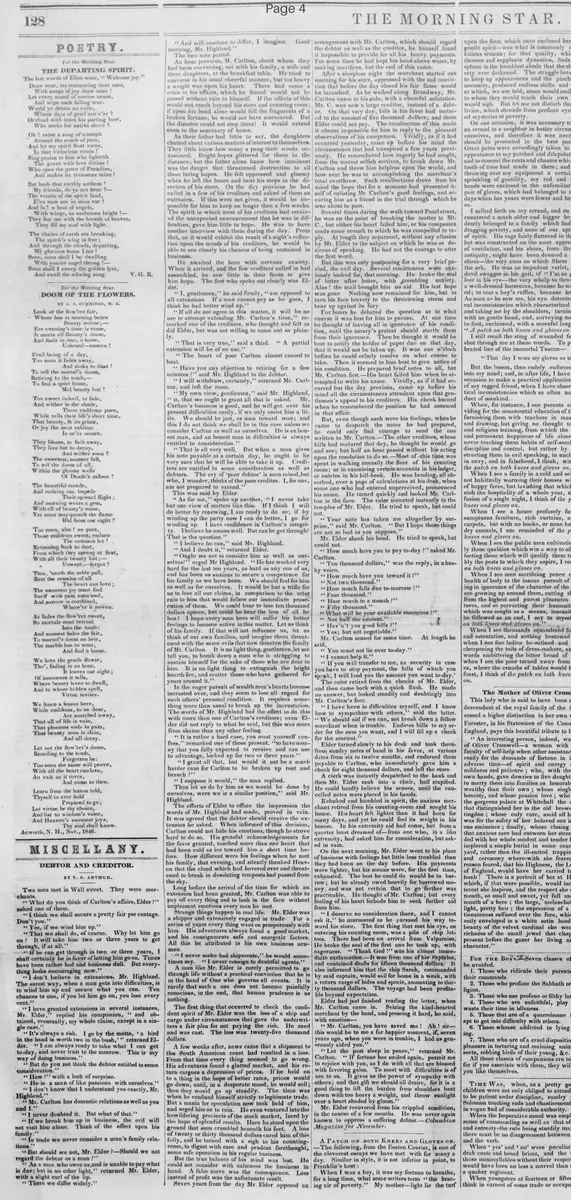
MISCELLANY.
DEBTOR AND CREDITOR.
BY T. S. ARTHUR.
Two men met in Wall street. They were merchants.
"What do you think of Carlton's affairs, Elder?" asked one of them.
"I think we shall secure a pretty fair percentage. Don't you?"
"Yes, if we wind him up."
"That we shall do, of course. Why let him go on? It will take him two or three years to get through, if at all."
"If he can get through in two or three years, I shall certainly be in favor of letting him go on. Times have been rather bad and business dull. But everything looks encouraging now."
"I don't believe in extensions, Mr. Highland. The surest way, when a man gets into difficulties, is to wind him up and secure what you can. Ten chances to one, if you let him go on, you lose every cent."
"I have granted extensions in several instances, Mr. Elder," replied his companion, "and obtained, eventually, my whole claim, except in a single case."
"It's always a risk. I go by the motto, 'a bird in the hand is worth two in the bush,'" returned Elder. "I am always ready to take what I can get to-day, and never trust to the morrow. This is my way of doing business."
"But do you not think the debtor entitled to some consideration?"
"How?" with a look of surprise.
"He is a man of like passions with ourselves."
"I don't know that I understand you exactly, Mr. Highland."
"Mr. Carlton has domestic relations as well as you and I."
"I never doubted it. But what of that?"
"If we break him up in business, the evil will not visit him alone. Think of the effect upon his family."
"In trade we never consider a man's family relations."
"But should we not, Mr. Elder? — Should we not regard the debtor as a man?"
"As a man who owes us, and is unable to pay what is due; but in no other light," returned Mr. Elder, with a slight curl of the lip.
"There we differ widely."
"And will continue to differ, I imagine. Good morning, Mr. Highland."
The two men parted.
An hour previous, Mr. Carlton, about whom they had been conversing, sat with his family, a wife and three daughters, at the breakfast table. He tried to converse in his usual cheerful manner, but too heavy a weight was upon his heart. There had come a crisis in his affairs, which he feared would not be passed without ruin to himself. If the effects of this would not reach beyond his store and counting room — if upon his head alone would fall the fragments of a broken fortune, he would not have murmured. But the disaster could not stop there! It would extend even to the sanctuary of home.
As their father had little to say, the daughters chatted about various matters of interest to themselves. They little knew how many a pang their words occasioned. Bright hopes glittered for them in the distance: but the father alone knew how imminent was the danger that threatened destruction to all these luring hopes. He felt oppressed and gloomy when he left the house and bent his steps in the direction of his store. On the day previous he had called in a few of his creditors and asked of them an extension. If this were not given, it would be impossible for him to keep on longer than a few weeks. The spirit in which most of his creditors had received the unexpected announcement that he was in difficulties, gave him little to hope. He was to have another interview with them during the day. From that, as it would exhibit the result of a night's reflection upon the minds of his creditors, he would be able to see clearly his chances of being sustained in business.
He awaited the hour with nervous anxiety.
When it arrived, and the few creditors called in had assembled, he saw little in their faces to give him hope. The first who spoke out clearly was Elder.
"I, gentlemen," he said firmly, "am opposed to all extensions. If a man cannot pay as he goes, I think he had better wind up.'"
"If all do not agree in this matter, it will be no use to attempt extending Mr. Carlton's time," remarked one of the creditors, who thought and felt as did Elder, but was not willing to come out so plainly.
"That is very true," said a third. "A partial extension will be of no use."
The heart of poor Carlton almost ceased to beat.
"Have you any objection to retiring for a few minutes?" said Mr. Highland to the debtor.
"I will withdraw, certainly," returned Mr. Carlton, and left the room.
"My own view, gentlemen," said Mr. Highland, "is, that we ought to grant all that is asked. Mr. Carlton's business is good, and he will get over his present difficulties easily, if we only assist him a little. We should be just, as man toward man; and this I do not think we shall be in this case unless we consider Carlton as well as ourselves. He is an honest man, and an honest man in difficulties is always entitled to consideration."
"That is all very well. But when a man gives his note payable at a certain day, he ought to be very sure that he will be able to take it up. Creditors are entitled to some consideration as well as debtors. The cry of 'poor debtor' is soon raised, but who, I wonder, thinks of the poor creditor. I, for one, am not prepared to extend.'"
This was said by Elder.
"As for me," spoke up another, "I never take but one view of matters like this. If I think I will do better by renewing, I am ready to do so; if by winding up the party now I can do better, I go for winding up. I have confidence in Carlton's integrity. I believe he means well. But can he get through? That is the question."
"I believe he can," said Mr. Highland.
"And I doubt it," returned Elder.
"Ought we not to consider him as well as ourselves?" urged Mr. Highland. "He has worked very hard for the last ten years, as hard as any one of us, and has been as anxious to secure a competence for his family as we have been. We should feel for him as well as for ourselves. It would be but a trifle for us to lose all our claims, in comparison to the utter ruin to him that would follow our immediate prosecution of them. We could bear to lose ten thousand dollars apiece, but could he bear the loss of all he has? I hope every man here will suffer his better feelings to become active in this matter. Let us think of his family. If that will not influence us, let us think of our own families, and imagine them threatened with the same evils that now threaten the family of Mr. Carlton. It is no light thing, gentlemen, let me tell you, to break down a man who is struggling to sustain himself for the sake of those who are dear to him. It is no light thing to extinguish the bright hearth fire, and scatter those who have gathered for years around it."
In the eager pursuit of wealth men's hearts become incrusted over, and they seem to lose all regard for each others' personal condition. It requires something more than usual to break up the incrustation. The words of Mr. Highland had the effect to do this with more than one of Carlton's creditors; even Elder did not reply to what he said, but this was more from shame than any other feeling.
"It is rather a hard case, you must yourself confess," remarked one of those present, "to have money that you fully expected to receive and can use to advantage, locked up for two or three years."
"I grant all that, but would it not be a much harder case for Carlton to be broken up root and branch?"
"I suppose it would," the man replied.
"Then let us do by him as we would be done by ourselves, were we in a similar position," said Mr. Highland.
The efforts of Elder to efface the impression the words of Mr. Highland had made, proved in vain. It was agreed that the debtor should receive the extension he asked. When informed of this decision, Carlton could not hide his emotions, though he strove hard to do so. His grateful acknowledgements for the favor granted, touched more than one heart that had been cold as ice toward him a short time before. How different were his feelings when he met his family, that evening, and silently thanked Heaven that the cloud which had hovered over and threatened to break in desolating tempests had passed from the sky.
Long before the arrival of the time for which an extension had been granted, Mr. Carlton was able to pay off every thing and to look in the face without unpleasant emotions every man he met.
Strange things happen in real life. Mr. Elder was a shipper and extensively engaged in trade. For a series of years every thing went on prosperously with him. His adventures always found a good market, and his consignments safe and energetic factors. All this he attributed to his own business acumen.
"I never make bad shipments," he would sometimes say. "I never consign to doubtful agents."
A man like Mr. Elder is rarely permitted to go through life without a practical conviction that he is in the hand of One who governs all events. It is rarely that such a one does not become painfully conscious, in the end, that human prudence is as nothing.
The first thing that occurred to check the confident spirit of Mr. Elder was the loss of a ship and cargo under circumstances that gave the underwriters a fair plea for not paying the risk. He sued and was cast. The loss was twenty-five thousand dollars.
A few weeks after, news came that a shipment to the South American coast had resulted in a loss. From that time every thing seemed to go wrong. His adventures found a glutted market, and his return cargoes a depression of prices. If he held on to a thing in the hope of better rates, prices would go down, until, in a desperate mood, he would sell; then they would go up steadily. The time was when he confined himself strictly to legitimate trade. But a mania for speculation now took hold of him, and urged him on to ruin. He even ventured into the bewildering precincts of the stock market, lured by the hope of splendid results. Here he stood upon the ground that soon crumbled beneath his feet. A loss of twenty or thirty thousand dollars cured him of this folly, and he turned with a sigh to his counting-room, to digest with care and prudent forethought, some safe operation in his regular business.
But the true balance of his mind was lost. He could not consider with calmness the business in hand. A false move was the consequence. Loss instead of profit was the unfortunate result.
Seven years from the day Mr. Elder opposed an arrangement with Mr. Carlton, which should regard the debtor as well as the creditor, he himself found it impossible to provide for all his heavy payments. For some time he had kept his head above water, by making sacrifices, but the end of this came.
After a sleepless night the merchant started one morning for his store, oppressed with the sad conviction that before the day closed his fair fame would be tarnished. As he walked along Broadway, Mr. Carlton came to his side, with a cheerful salutation. Mr. C. was now a large creditor, instead of a debtor. On that very day, bills in his favor had matured to the amount of five thousand dollars; and these Elder could not pay. The recollection of this made it almost impossible for him to reply to the pleasant observations of his companion. Vividly, as if it had occurred yesterday, came up before his mind the circumstance that had transpired a few years previously. He remembered how eagerly he had sought, from the merest selfish motives, to break down Mr. Carlton and throw him helpless upon the world, and how near he was to accomplishing the merchant's total overthrow. Such recollections drove from his mind the hope that for a moment had presented itself of enlisting Mr. Carlton's good feelings, and securing him as a friend in the trial through which he was about to pass.
Several times during the walk toward Pearl street, he was on the point of breaking the matter to Mr. C., but either his heart failed him, or his companion made some remark to which he was compelled to reply. At length they separated, without any allusion by Mr. Elder to the subject on which he was so desirous of speaking. He had not the courage to utter the first word.
But this was only postponing for a very brief period, the evil day. Several remittances were anxiously looked for, that morning. He broke the seal of letter after letter, with trembling anxiety. Alas! the mail brought him no aid. His last hope was gone. Nothing now remained for him, but to turn his face bravely to the threatening storm and bear up against its fury.
For hours he debated the question as to what course it was best for him to pursue. At one time he thought of leaving all in ignorance of his condition, until the notary's protest should startle them from their ignorance. Then he thought it would be best to notify the holder of paper due on that day, that it would not be taken up. It was one o'clock before he could calmly resolve on what course to take. Then it seemed to him best to give notice of his condition. He prepared brief notes to all, but Mr. Carlton first. His heart failed him when he attempted to write his name. Vividly, as if it had occurred but the day previous, came up before his mind all the circumstances attendant upon that gentleman's appeal to his creditors. His cheek burned when he remembered the position he had assumed in that affair.
But, even though such were his feelings, when he came to despatch the notes he had prepared, he could only find courage to send the one written to Mr. Carlton. The other creditors, whose bills had matured that day, he thought he would go and see; but half an hour passed without his acting upon the resolution to do so. Most of this time was spent in walking uneasily the floor of his counting room; or in examining certain accounts in his ledger, or entries in his bill-book. He was bending, all absorbed, over a page of calculations at his desk, when some one who had entered unperceived, pronounced his name. He turned quickly and looked Mr. Carlton in the face. The color mounted instantly to the temples of Mr. Elder. He tried to speak, but could not.
"Your note has taken me altogether by surprise," said Mr. Carlton. "But I hope these things are not so bad as you suppose."
Mr. Elder shook his head. He tried to speak, but could not.
"How much have you to pay to-day?" asked Mr. Carlton.
"Ten thousand dollars," was the reply, in a husky voice.
"How much have you toward it?"
"Not two thousand."
"How much falls due to-morrow?"
"Four thousand."
"How much in a month?"
"Fifty thousand."
"What will be your available resources?"
"Not half the amount."
"Haven't you good bills?"
"Yes; but not negotiable."
Mr. Carlton mused for some time. At length he said,
"You must not lie over to-day."
"I cannot help it."
"If you will transfer to me, as security in case you have to stop payment, the bills of which you speak, I will lend you the amount you want to-day."
The color retired from the cheeks of Mr. Elder, and then came back with a quick flush. He made no answer, but looked steadily and doubtingly into Mr. Carlton's face.
"I have been in difficulties myself, and I know how to sympathize with others," said the latter. "We should aid if we can, not break down a fellow merchant when in trouble. Endorse bills to my order for the sum you want, and I will fill up a check for the amount."
Elder turned slowly to his desk and took therefrom sundry notes of hand in his favor, at various dates from six to twelve months, and endorsed them payable to Carlton, who immediately gave him a check for eight thousand dollars, and left the store.
A clerk was instantly despatched to the bank and then Mr. Elder sunk into a chair, half stupified. He could hardly believe his senses, until the cancelled notes were placed in his hands.
Rebuked and humbled in spirit, the anxious merchant retired from his counting-room and sought his home. His heart felt lighter than it had been for many days, and yet he could feel its weight in his bosom. In his extremity aid had come, but from a quarter least dreamed of—from one who, in a like extremity, had asked him for consideration, but asked in vain.
On the next morning, Mr. Elder went to his place of business with feelings but little less troubled than they had been on the day before. His payments were lighter, but his means were, for the first time, exhausted. The best he could do would be to borrow; but he already owed heavily for borrowed money, and was not certain that to go further was practicable. He thought of Mr. Carlton; but every feeling of his heart forbade him to seek further aid from him.
"I deserve no consideration there, and I cannot ask it," he murmured as he pursued his way toward his store. The first thing that met his eye, on entering his counting room, was a pile of ship letters. There had been an arrival from Valparaiso. He broke the seal of the first one he took up, with eagerness. "Thank God!" was his almost immediate exclamation. It was from one of his captains, and contained drafts for fifteen thousand dollars. It also informed him that the ship Sarah, commanded by said captain, would sail for home in a week, with a return cargo of hides and specie, amounting to thirty thousand dollars. The voyage had been profitable beyond expectation.
Elder had just finished reading the letter, when Mr. Carlton came in. Seizing the kind-hearted merchant by the hand, and pressing it hard, he said, with emotion—
"Mr. Carlton, you have saved me! Ah! sir—this would be to me a far happier moment, if, seven years ago, when you were in trouble, I had as generously aided you."
"Let the past sleep in peace," returned Mr. Carlton. "If fortune has smiled again, permit me to rejoice with you, as I do with all that are blessed with favoring gales. To meet with difficulties is of use to us. It gives us the power of sympathy with others; and that gift we should all desire, for it is a good thing to lift the burden from shoulders bent down with too heavy a weight, and throw sunlight over a heart shaded by gloom."
Mr. Elder recovered from his crippled condition, in the course of a few months. He was never again known to oppress a suffering debtor.—Columbian Magazine for November.
DEBTOR AND CREDITOR.
BY T. S. ARTHUR.
Two men met in Wall street. They were merchants.
"What do you think of Carlton's affairs, Elder?" asked one of them.
"I think we shall secure a pretty fair percentage. Don't you?"
"Yes, if we wind him up."
"That we shall do, of course. Why let him go on? It will take him two or three years to get through, if at all."
"If he can get through in two or three years, I shall certainly be in favor of letting him go on. Times have been rather bad and business dull. But everything looks encouraging now."
"I don't believe in extensions, Mr. Highland. The surest way, when a man gets into difficulties, is to wind him up and secure what you can. Ten chances to one, if you let him go on, you lose every cent."
"I have granted extensions in several instances, Mr. Elder," replied his companion, "and obtained, eventually, my whole claim, except in a single case."
"It's always a risk. I go by the motto, 'a bird in the hand is worth two in the bush,'" returned Elder. "I am always ready to take what I can get to-day, and never trust to the morrow. This is my way of doing business."
"But do you not think the debtor entitled to some consideration?"
"How?" with a look of surprise.
"He is a man of like passions with ourselves."
"I don't know that I understand you exactly, Mr. Highland."
"Mr. Carlton has domestic relations as well as you and I."
"I never doubted it. But what of that?"
"If we break him up in business, the evil will not visit him alone. Think of the effect upon his family."
"In trade we never consider a man's family relations."
"But should we not, Mr. Elder? — Should we not regard the debtor as a man?"
"As a man who owes us, and is unable to pay what is due; but in no other light," returned Mr. Elder, with a slight curl of the lip.
"There we differ widely."
"And will continue to differ, I imagine. Good morning, Mr. Highland."
The two men parted.
An hour previous, Mr. Carlton, about whom they had been conversing, sat with his family, a wife and three daughters, at the breakfast table. He tried to converse in his usual cheerful manner, but too heavy a weight was upon his heart. There had come a crisis in his affairs, which he feared would not be passed without ruin to himself. If the effects of this would not reach beyond his store and counting room — if upon his head alone would fall the fragments of a broken fortune, he would not have murmured. But the disaster could not stop there! It would extend even to the sanctuary of home.
As their father had little to say, the daughters chatted about various matters of interest to themselves. They little knew how many a pang their words occasioned. Bright hopes glittered for them in the distance: but the father alone knew how imminent was the danger that threatened destruction to all these luring hopes. He felt oppressed and gloomy when he left the house and bent his steps in the direction of his store. On the day previous he had called in a few of his creditors and asked of them an extension. If this were not given, it would be impossible for him to keep on longer than a few weeks. The spirit in which most of his creditors had received the unexpected announcement that he was in difficulties, gave him little to hope. He was to have another interview with them during the day. From that, as it would exhibit the result of a night's reflection upon the minds of his creditors, he would be able to see clearly his chances of being sustained in business.
He awaited the hour with nervous anxiety.
When it arrived, and the few creditors called in had assembled, he saw little in their faces to give him hope. The first who spoke out clearly was Elder.
"I, gentlemen," he said firmly, "am opposed to all extensions. If a man cannot pay as he goes, I think he had better wind up.'"
"If all do not agree in this matter, it will be no use to attempt extending Mr. Carlton's time," remarked one of the creditors, who thought and felt as did Elder, but was not willing to come out so plainly.
"That is very true," said a third. "A partial extension will be of no use."
The heart of poor Carlton almost ceased to beat.
"Have you any objection to retiring for a few minutes?" said Mr. Highland to the debtor.
"I will withdraw, certainly," returned Mr. Carlton, and left the room.
"My own view, gentlemen," said Mr. Highland, "is, that we ought to grant all that is asked. Mr. Carlton's business is good, and he will get over his present difficulties easily, if we only assist him a little. We should be just, as man toward man; and this I do not think we shall be in this case unless we consider Carlton as well as ourselves. He is an honest man, and an honest man in difficulties is always entitled to consideration."
"That is all very well. But when a man gives his note payable at a certain day, he ought to be very sure that he will be able to take it up. Creditors are entitled to some consideration as well as debtors. The cry of 'poor debtor' is soon raised, but who, I wonder, thinks of the poor creditor. I, for one, am not prepared to extend.'"
This was said by Elder.
"As for me," spoke up another, "I never take but one view of matters like this. If I think I will do better by renewing, I am ready to do so; if by winding up the party now I can do better, I go for winding up. I have confidence in Carlton's integrity. I believe he means well. But can he get through? That is the question."
"I believe he can," said Mr. Highland.
"And I doubt it," returned Elder.
"Ought we not to consider him as well as ourselves?" urged Mr. Highland. "He has worked very hard for the last ten years, as hard as any one of us, and has been as anxious to secure a competence for his family as we have been. We should feel for him as well as for ourselves. It would be but a trifle for us to lose all our claims, in comparison to the utter ruin to him that would follow our immediate prosecution of them. We could bear to lose ten thousand dollars apiece, but could he bear the loss of all he has? I hope every man here will suffer his better feelings to become active in this matter. Let us think of his family. If that will not influence us, let us think of our own families, and imagine them threatened with the same evils that now threaten the family of Mr. Carlton. It is no light thing, gentlemen, let me tell you, to break down a man who is struggling to sustain himself for the sake of those who are dear to him. It is no light thing to extinguish the bright hearth fire, and scatter those who have gathered for years around it."
In the eager pursuit of wealth men's hearts become incrusted over, and they seem to lose all regard for each others' personal condition. It requires something more than usual to break up the incrustation. The words of Mr. Highland had the effect to do this with more than one of Carlton's creditors; even Elder did not reply to what he said, but this was more from shame than any other feeling.
"It is rather a hard case, you must yourself confess," remarked one of those present, "to have money that you fully expected to receive and can use to advantage, locked up for two or three years."
"I grant all that, but would it not be a much harder case for Carlton to be broken up root and branch?"
"I suppose it would," the man replied.
"Then let us do by him as we would be done by ourselves, were we in a similar position," said Mr. Highland.
The efforts of Elder to efface the impression the words of Mr. Highland had made, proved in vain. It was agreed that the debtor should receive the extension he asked. When informed of this decision, Carlton could not hide his emotions, though he strove hard to do so. His grateful acknowledgements for the favor granted, touched more than one heart that had been cold as ice toward him a short time before. How different were his feelings when he met his family, that evening, and silently thanked Heaven that the cloud which had hovered over and threatened to break in desolating tempests had passed from the sky.
Long before the arrival of the time for which an extension had been granted, Mr. Carlton was able to pay off every thing and to look in the face without unpleasant emotions every man he met.
Strange things happen in real life. Mr. Elder was a shipper and extensively engaged in trade. For a series of years every thing went on prosperously with him. His adventures always found a good market, and his consignments safe and energetic factors. All this he attributed to his own business acumen.
"I never make bad shipments," he would sometimes say. "I never consign to doubtful agents."
A man like Mr. Elder is rarely permitted to go through life without a practical conviction that he is in the hand of One who governs all events. It is rarely that such a one does not become painfully conscious, in the end, that human prudence is as nothing.
The first thing that occurred to check the confident spirit of Mr. Elder was the loss of a ship and cargo under circumstances that gave the underwriters a fair plea for not paying the risk. He sued and was cast. The loss was twenty-five thousand dollars.
A few weeks after, news came that a shipment to the South American coast had resulted in a loss. From that time every thing seemed to go wrong. His adventures found a glutted market, and his return cargoes a depression of prices. If he held on to a thing in the hope of better rates, prices would go down, until, in a desperate mood, he would sell; then they would go up steadily. The time was when he confined himself strictly to legitimate trade. But a mania for speculation now took hold of him, and urged him on to ruin. He even ventured into the bewildering precincts of the stock market, lured by the hope of splendid results. Here he stood upon the ground that soon crumbled beneath his feet. A loss of twenty or thirty thousand dollars cured him of this folly, and he turned with a sigh to his counting-room, to digest with care and prudent forethought, some safe operation in his regular business.
But the true balance of his mind was lost. He could not consider with calmness the business in hand. A false move was the consequence. Loss instead of profit was the unfortunate result.
Seven years from the day Mr. Elder opposed an arrangement with Mr. Carlton, which should regard the debtor as well as the creditor, he himself found it impossible to provide for all his heavy payments. For some time he had kept his head above water, by making sacrifices, but the end of this came.
After a sleepless night the merchant started one morning for his store, oppressed with the sad conviction that before the day closed his fair fame would be tarnished. As he walked along Broadway, Mr. Carlton came to his side, with a cheerful salutation. Mr. C. was now a large creditor, instead of a debtor. On that very day, bills in his favor had matured to the amount of five thousand dollars; and these Elder could not pay. The recollection of this made it almost impossible for him to reply to the pleasant observations of his companion. Vividly, as if it had occurred yesterday, came up before his mind the circumstance that had transpired a few years previously. He remembered how eagerly he had sought, from the merest selfish motives, to break down Mr. Carlton and throw him helpless upon the world, and how near he was to accomplishing the merchant's total overthrow. Such recollections drove from his mind the hope that for a moment had presented itself of enlisting Mr. Carlton's good feelings, and securing him as a friend in the trial through which he was about to pass.
Several times during the walk toward Pearl street, he was on the point of breaking the matter to Mr. C., but either his heart failed him, or his companion made some remark to which he was compelled to reply. At length they separated, without any allusion by Mr. Elder to the subject on which he was so desirous of speaking. He had not the courage to utter the first word.
But this was only postponing for a very brief period, the evil day. Several remittances were anxiously looked for, that morning. He broke the seal of letter after letter, with trembling anxiety. Alas! the mail brought him no aid. His last hope was gone. Nothing now remained for him, but to turn his face bravely to the threatening storm and bear up against its fury.
For hours he debated the question as to what course it was best for him to pursue. At one time he thought of leaving all in ignorance of his condition, until the notary's protest should startle them from their ignorance. Then he thought it would be best to notify the holder of paper due on that day, that it would not be taken up. It was one o'clock before he could calmly resolve on what course to take. Then it seemed to him best to give notice of his condition. He prepared brief notes to all, but Mr. Carlton first. His heart failed him when he attempted to write his name. Vividly, as if it had occurred but the day previous, came up before his mind all the circumstances attendant upon that gentleman's appeal to his creditors. His cheek burned when he remembered the position he had assumed in that affair.
But, even though such were his feelings, when he came to despatch the notes he had prepared, he could only find courage to send the one written to Mr. Carlton. The other creditors, whose bills had matured that day, he thought he would go and see; but half an hour passed without his acting upon the resolution to do so. Most of this time was spent in walking uneasily the floor of his counting room; or in examining certain accounts in his ledger, or entries in his bill-book. He was bending, all absorbed, over a page of calculations at his desk, when some one who had entered unperceived, pronounced his name. He turned quickly and looked Mr. Carlton in the face. The color mounted instantly to the temples of Mr. Elder. He tried to speak, but could not.
"Your note has taken me altogether by surprise," said Mr. Carlton. "But I hope these things are not so bad as you suppose."
Mr. Elder shook his head. He tried to speak, but could not.
"How much have you to pay to-day?" asked Mr. Carlton.
"Ten thousand dollars," was the reply, in a husky voice.
"How much have you toward it?"
"Not two thousand."
"How much falls due to-morrow?"
"Four thousand."
"How much in a month?"
"Fifty thousand."
"What will be your available resources?"
"Not half the amount."
"Haven't you good bills?"
"Yes; but not negotiable."
Mr. Carlton mused for some time. At length he said,
"You must not lie over to-day."
"I cannot help it."
"If you will transfer to me, as security in case you have to stop payment, the bills of which you speak, I will lend you the amount you want to-day."
The color retired from the cheeks of Mr. Elder, and then came back with a quick flush. He made no answer, but looked steadily and doubtingly into Mr. Carlton's face.
"I have been in difficulties myself, and I know how to sympathize with others," said the latter. "We should aid if we can, not break down a fellow merchant when in trouble. Endorse bills to my order for the sum you want, and I will fill up a check for the amount."
Elder turned slowly to his desk and took therefrom sundry notes of hand in his favor, at various dates from six to twelve months, and endorsed them payable to Carlton, who immediately gave him a check for eight thousand dollars, and left the store.
A clerk was instantly despatched to the bank and then Mr. Elder sunk into a chair, half stupified. He could hardly believe his senses, until the cancelled notes were placed in his hands.
Rebuked and humbled in spirit, the anxious merchant retired from his counting-room and sought his home. His heart felt lighter than it had been for many days, and yet he could feel its weight in his bosom. In his extremity aid had come, but from a quarter least dreamed of—from one who, in a like extremity, had asked him for consideration, but asked in vain.
On the next morning, Mr. Elder went to his place of business with feelings but little less troubled than they had been on the day before. His payments were lighter, but his means were, for the first time, exhausted. The best he could do would be to borrow; but he already owed heavily for borrowed money, and was not certain that to go further was practicable. He thought of Mr. Carlton; but every feeling of his heart forbade him to seek further aid from him.
"I deserve no consideration there, and I cannot ask it," he murmured as he pursued his way toward his store. The first thing that met his eye, on entering his counting room, was a pile of ship letters. There had been an arrival from Valparaiso. He broke the seal of the first one he took up, with eagerness. "Thank God!" was his almost immediate exclamation. It was from one of his captains, and contained drafts for fifteen thousand dollars. It also informed him that the ship Sarah, commanded by said captain, would sail for home in a week, with a return cargo of hides and specie, amounting to thirty thousand dollars. The voyage had been profitable beyond expectation.
Elder had just finished reading the letter, when Mr. Carlton came in. Seizing the kind-hearted merchant by the hand, and pressing it hard, he said, with emotion—
"Mr. Carlton, you have saved me! Ah! sir—this would be to me a far happier moment, if, seven years ago, when you were in trouble, I had as generously aided you."
"Let the past sleep in peace," returned Mr. Carlton. "If fortune has smiled again, permit me to rejoice with you, as I do with all that are blessed with favoring gales. To meet with difficulties is of use to us. It gives us the power of sympathy with others; and that gift we should all desire, for it is a good thing to lift the burden from shoulders bent down with too heavy a weight, and throw sunlight over a heart shaded by gloom."
Mr. Elder recovered from his crippled condition, in the course of a few months. He was never again known to oppress a suffering debtor.—Columbian Magazine for November.
What sub-type of article is it?
Personal Triumph
Survival
Family Drama
What themes does it cover?
Fortune Reversal
Moral Virtue
Family
What keywords are associated?
Debtor Creditor
Business Extension
Fortune Reversal
Moral Lesson
Merchant Troubles
Family Impact
Empathy
What entities or persons were involved?
Mr. Carlton
Mr. Elder
Mr. Highland
Where did it happen?
Wall Street, New York
Story Details
Key Persons
Mr. Carlton
Mr. Elder
Mr. Highland
Location
Wall Street, New York
Story Details
Struggling merchant Mr. Carlton seeks extension from creditors; Mr. Highland persuades them to grant it despite Mr. Elder's opposition, saving Carlton's business and family. Seven years later, Elder faces ruin; Carlton aids him financially, leading to Elder's recovery and reformed views on debtors.