Thank you for visiting SNEWPapers!
Sign up free
Story
September 21, 1847
Richmond Palladium
Richmond, Wayne County, Indiana
What is this article about?
Anecdote of philosopher Hume labeled an infidel by a child after overhearing a conversation; she refuses his affection, pities him, and prays for his belief in God, illustrating a biblical moral.
Clipping
OCR Quality
98%
Excellent
Full Text
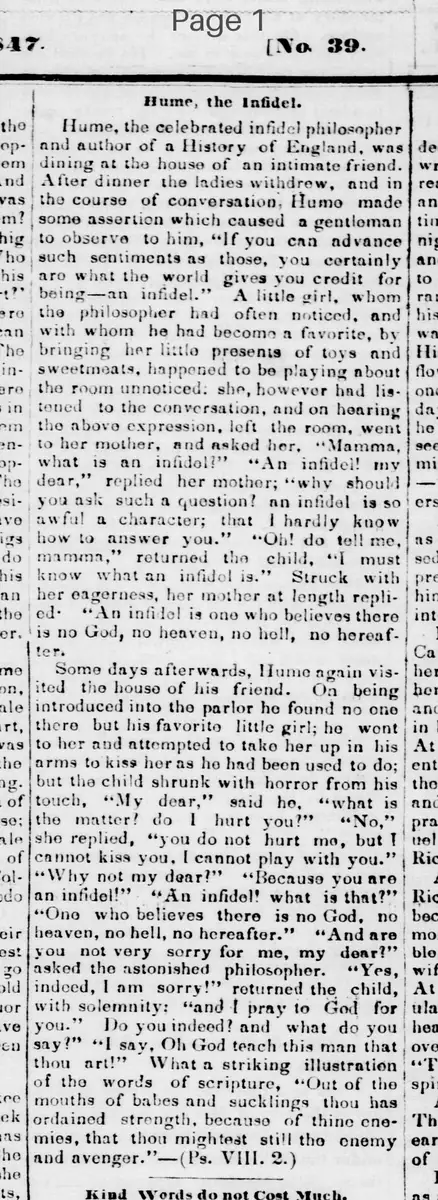
Hume, the Infidel.
Hume, the celebrated infidel philosopher and author of a History of England, was dining at the house of an intimate friend. After dinner the ladies withdrew, and in the course of conversation, Hume made some assertion which caused a gentleman to observe to him, "If you can advance such sentiments as those, you certainly are what the world gives you credit for being-an infidel."
A little girl, whom the philosopher had often noticed, and with whom he had become a favorite, by bringing her little presents of toys and sweetmeats, happened to be playing about the room unnoticed: she, however had listened to the conversation, and on hearing the above expression, left the room, went to her mother, and asked her, "Mamma, what is an infidel?" "An infidel! my dear," replied her mother; "why should you ask such a question? an infidel is so awful a character; that I hardly know how to answer you." "Oh! do tell me, mamma," returned the child, "I must know what an infidel is." Struck with her eagerness, her mother at length replied, "An infidel is one who believes there is no God, no heaven, no hell, no hereafter."
Some days afterwards, Hume again visited the house of his friend. On being introduced into the parlor he found no one there but his favorite little girl; he went to her and attempted to take her up in his arms to kiss her as he had been used to do: but the child shrunk with horror from his touch, "My dear," said he, "what is the matter? do I hurt you?" "No," she replied, "you do not hurt me, but I cannot kiss you, I cannot play with you." "Why not my dear?" "Because you are an infidel!" "An infidel! what is that?" "One who believes there is no God, no heaven, no hell, no hereafter." "And are you not very sorry for me, my dear?" asked the astonished philosopher. "Yes, indeed, I am sorry!" returned the child, with solemnity: "and I pray to God for you." "Do you indeed? and what do you say?" "I say, Oh God teach this man that thou art!" What a striking illustration of the words of scripture. "Out of the mouths of babes and sucklings thou hast ordained strength, because of thine enemies, that thou mightest still the enemy and avenger."-(Ps. VIII. 2.)
Hume, the celebrated infidel philosopher and author of a History of England, was dining at the house of an intimate friend. After dinner the ladies withdrew, and in the course of conversation, Hume made some assertion which caused a gentleman to observe to him, "If you can advance such sentiments as those, you certainly are what the world gives you credit for being-an infidel."
A little girl, whom the philosopher had often noticed, and with whom he had become a favorite, by bringing her little presents of toys and sweetmeats, happened to be playing about the room unnoticed: she, however had listened to the conversation, and on hearing the above expression, left the room, went to her mother, and asked her, "Mamma, what is an infidel?" "An infidel! my dear," replied her mother; "why should you ask such a question? an infidel is so awful a character; that I hardly know how to answer you." "Oh! do tell me, mamma," returned the child, "I must know what an infidel is." Struck with her eagerness, her mother at length replied, "An infidel is one who believes there is no God, no heaven, no hell, no hereafter."
Some days afterwards, Hume again visited the house of his friend. On being introduced into the parlor he found no one there but his favorite little girl; he went to her and attempted to take her up in his arms to kiss her as he had been used to do: but the child shrunk with horror from his touch, "My dear," said he, "what is the matter? do I hurt you?" "No," she replied, "you do not hurt me, but I cannot kiss you, I cannot play with you." "Why not my dear?" "Because you are an infidel!" "An infidel! what is that?" "One who believes there is no God, no heaven, no hell, no hereafter." "And are you not very sorry for me, my dear?" asked the astonished philosopher. "Yes, indeed, I am sorry!" returned the child, with solemnity: "and I pray to God for you." "Do you indeed? and what do you say?" "I say, Oh God teach this man that thou art!" What a striking illustration of the words of scripture. "Out of the mouths of babes and sucklings thou hast ordained strength, because of thine enemies, that thou mightest still the enemy and avenger."-(Ps. VIII. 2.)
What sub-type of article is it?
Biography
What themes does it cover?
Moral Virtue
Providence Divine
What keywords are associated?
Hume
Infidel
Little Girl
Faith
Prayer
Philosopher
What entities or persons were involved?
Hume
Little Girl
Where did it happen?
House Of An Intimate Friend
Story Details
Key Persons
Hume
Little Girl
Location
House Of An Intimate Friend
Story Details
Hume dines at a friend's house and is called an infidel in conversation. A little girl overhears her mother's definition of an infidel and later refuses to kiss or play with Hume, explaining he believes there is no God, heaven, hell, or hereafter. She expresses sorrow and prays for him to learn of God.