Thank you for visiting SNEWPapers!
Sign up free
Story
May 18, 1883
Port Tobacco Times, And Charles County Advertiser
Port Tobacco, Charles County, Maryland
What is this article about?
Sam'l Cox, Esq., achieves a magnificent wheat crop at his Rich Hill residence through liberal application of shell lime on previously unproductive land, promising a large yield.
Clipping
OCR Quality
98%
Excellent
Full Text
Fine Wheat.
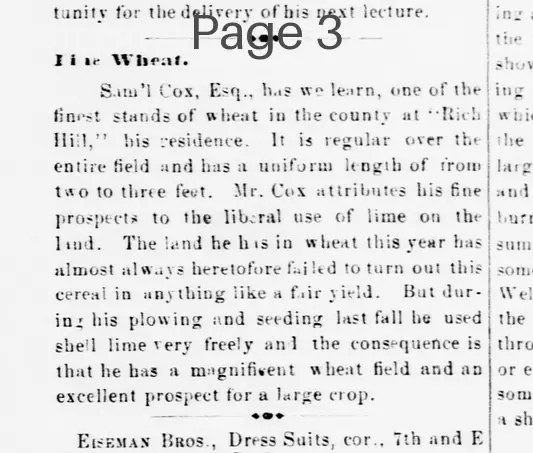
Sam'l Cox, Esq., has, we learn, one of the finest stands of wheat in the county at 'Rich Hill,' his residence. It is regular over the entire field and has a uniform length of from two to three feet. Mr. Cox attributes his fine prospects to the liberal use of lime on the land. The land he has in wheat this year has almost always heretofore failed to turn out this cereal in anything like a fair yield. But during his plowing and seeding last fall he used shell lime very freely and the consequence is that he has a magnificent wheat field and an excellent prospect for a large crop.
Sam'l Cox, Esq., has, we learn, one of the finest stands of wheat in the county at 'Rich Hill,' his residence. It is regular over the entire field and has a uniform length of from two to three feet. Mr. Cox attributes his fine prospects to the liberal use of lime on the land. The land he has in wheat this year has almost always heretofore failed to turn out this cereal in anything like a fair yield. But during his plowing and seeding last fall he used shell lime very freely and the consequence is that he has a magnificent wheat field and an excellent prospect for a large crop.
What sub-type of article is it?
Curiosity
Personal Triumph
What themes does it cover?
Triumph
Fortune Reversal
What keywords are associated?
Fine Wheat
Lime Use
Rich Hill
Crop Success
What entities or persons were involved?
Sam'l Cox, Esq.
Where did it happen?
Rich Hill
Story Details
Key Persons
Sam'l Cox, Esq.
Location
Rich Hill
Event Date
Last Fall
Story Details
Sam'l Cox has one of the finest stands of wheat in the county at his residence 'Rich Hill,' with uniform length of two to three feet, attributed to liberal use of shell lime during plowing and seeding on land that previously failed to yield fair crops.