Thank you for visiting SNEWPapers!
Sign up free
The National Intelligencer And Washington Advertiser
Washington, District Of Columbia
What is this article about?
Lord Henry Petty's speech in British Parliament critiques the mismanagement of public accounts totaling 455 million sterling, highlights frauds in West Indies and military expenditures, and proposes reforms including new commissions to audit accounts and prevent abuses.
Clipping
OCR Quality
Full Text
MONDAY, JULY 28.
Among our late English papers, we have received one containing the following speech of lord Henry Petty, Chancellor of the Exchequer. We have considered it sufficiently interesting to republish it in full length. It presents an admirable view of that splendid system, which we are so frequently called upon to admire. If it does not prove the "most stupendous monument of human wisdom," to be the most gigantic scheme of fraud and prodigality that has ever been devised, it, at least, demonstrates a degree of corruption and abuse, not probably equalled under any other government. Accounts remain unadjusted and uncontrolled to the amount of 455 millions sterling, or a sum, exceeding two thousand millions of dollars, a sum more than twenty times as large as our whole national debt, and nearly two hundred times as great as the annual revenues of the general government.
PUBLIC ACCOUNTS, AND WEST INDIA ABUSES.
LORD HENRY PETTY in Opening the plan relative to the public accounts, spoke nearly as follows:
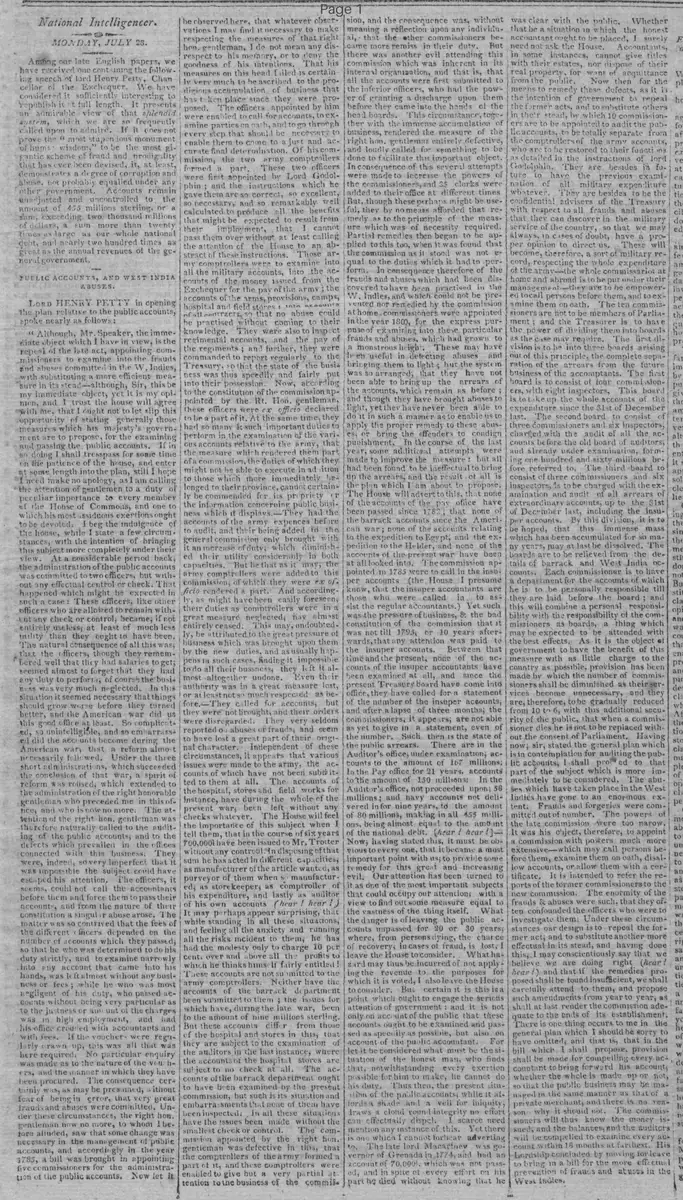
"Although, Mr. Speaker, the immediate object which I have in view, is the repeal of the late act, appointing commissioners to examine into the frauds and abuses committed in the W. Indies, with substituting a more efficient measure in its stead—although, Sir, this be my immediate object, yet it is my opinion, and I trust the house will agree with me, that I ought not to let slip this opportunity of stating generally those measures which his majesty's government are to propose, for the examining and passing the public accounts. If in so doing I shall trespass for some time on the patience of the house, and enter at some length into the plan, still I hope I need make no apology, as I am calling the attention of gentlemen to a duty of peculiar importance to every member of the House of Commons, and one to which his most assiduous exertions ought to be devoted. I beg the indulgence of the house, while I state a few circumstances, with the intention of bringing this subject more completely under their view. At a considerable period back, the administration of the public accounts was committed to two officers, but without any effectual control or check. That happened which might be expected in such a case: These officers, like other officers who are allowed to remain without any check or control, became, if not entirely useless at least of much less utility than they ought to have been. The natural consequence of all this was, that the officers, though they remembered well that they had salaries to get; seemed almost to forget that they had any duty to perform, of course the business was very much neglected. In this situation it seemed necessary that things should grow worse before they turned better, and the American war did us this good office at least. So complicated, so unintelligible, and so embarrassed did the accounts become during the American war that a reform almost necessarily followed. Under the three short administrations, which succeeded the conclusion of that war, a spirit of reform was roused, which extended to the administration of the right honorable gentleman who preceded me in this office; and who is now no more: The attention of the right hon. gentleman was therefore naturally called to the auditing of the public accounts; and to the defects which prevailed in the offices connected with this business: They were, indeed, so very imperfect that it was impossible the subject could have escaped his attention. The officers, it seems, could not call the accountants before them and force them to pass their accounts, and from the nature of their constitution a singular abuse arose. The matter was so contrived that the fees of the different officers depended on the number of accounts which they passed, so that he who was determined to do his duty strictly, and to examine narrowly into any account that came into his hands, was left almost without any business or fees; while he who was most negligent of his duty, who passed accounts without being very particular as to the justness or amount of the charges was in high employment, and had his office crowded with accountants and with fees. If the vouchers were regularly drawn up, this was all that was here required. No particular enquiry was made as to the nature of the vouchers, and the manner in which they have been procured. The consequence certainly was, as may be presumed, without fear of being in error, that very great frauds and abuses were committed. Under these circumstances, the right hon. gentleman now no more, to whom I before alluded, saw that some change was necessary in the management of public accounts, and accordingly in the year 1785, a bill was brought in appointing five commissioners for the administration of the public accounts. Now let it be observed here, that whatever observations I may find it necessary to make respecting the measures of that right hon. gentleman, I do not mean any disrespect to his memory, or to deny the goodness of his intentions. That his measures on this head failed is certain; very much to be ascribed to the prodigious accumulation of business that has taken place since they were proposed. The officers appointed by him were enabled to call for accounts, to examine parties on oath, and to go through every step that should be necessary to enable them to come to a just and accurate final determination." Of his commission, the two army comptrollers formed a part. These two officers were first appointed by Lord Godolphin; and the instructions which he gave them are so correct, so excellent, so necessary, and so remarkably well calculated to produce all the benefits that might be expected to result from their employment, that I cannot pass them over without at least calling the attention of the House to an abstract of these instructions. Those army comptrollers were to examine into all the military accounts, into the accounts of the money issued from the Exchequer for the pay of the army; the accounts of the arms, provisions, camps, hospital and field stores; into accounts of all contractors, so that no abuse could be practised without coming to their knowledge. They were also to inspect regimental accounts, and the pay of the regiments: and further, they were commanded to report regularly to the Treasury, so that the state of the business was thus speedily and fairly put into their possession. Now, according to the constitution of the commission appointed by the Rt. Hon. gentleman, these officers were ex officio declared to be a part of it. At the same time, they had so many & such important duties to perform in the examination of the various accounts relative to the army, that the measure which rendered them part of a commission, the duties of which they might not be able to execute in addition to those which more immediately belonged to their province, cannot certainly be commended for its propriety or the information concerning public business which it displays.—They had the accounts of the army expenses before to audit, and their being added to the general commission only brought with it an increase of duty; which diminished their utility considerably in both capacities. But be that as it may, the army comptrollers were added to this commission, of which they were ex officio rendered a part. And accordingly, as might have been easily foreseen, their duties as comptrollers were in a great measure neglected, nay almost entirely ceased. This may, undoubtedly, be attributed to the great pressure of business which was brought upon them by the new duties, and as usually happens in such cases, finding it impossible to do all their business, they left it almost altogether undone. Even their authority was in a great measure lost, or at least not so much respected as before. They called for accounts, but they were not brought, and their orders were disregarded. They very seldom reported on abuses or frauds, and seem to have lost a great part of their original character. Independent of these circumstances, it appears that various issues were made to the army, the accounts of which have not been submitted to them at all. The accounts of the hospital, stores and field works for instance, have during the whole of the present wars been left without any checks whatever. The House will feel the importance of this subject when I tell them, that in the course of six years 700,000l have been issued to Mr. Trotter without any controul. In disposing of that sum he has acted in different capacities, as manufacturer of the article wanted, as purveyor of them when so manufactured; as storekeeper, as comptroller of his expenditure, and lastly as auditor of his own accounts (hear! hear!). It may perhaps appear surprising, that while standing in all these situations, and feeling all the anxiety and running all the risks incident to them; he has had the modesty only to charge 10 per cent. over and above all the profits to which he thinks himself fairly entitled! These accounts are not submitted to the army comptrollers. Neither have the accounts of the barrack department been submitted to them; the issues for which have, during the late war, been to the amount of nine millions sterling. But these accounts differ from those of the hospital and stores in this, that they are subject to the examination of the auditors in the last instance, where the accounts of the hospital stores are subject to no check at all. The accounts of the barrack department ought to have been examined by the present commission, but such is its situation and embarrassments that none of them have been inspected: In all these situations have the issues been made without the smallest check or control. The commission appointed by the right hon. gentleman was defective in this, that the comptrollers of the army formed a part of it, and these comptrollers were enabled to give but a very partial attention to the business of the commission, and the consequence was, without meaning a reflection upon any individual,—that the other commissioners became more remiss in their duty. But there was another evil attending this commission which was inherent in its internal organization, and that is, that all the accounts were first submitted to the inferior officers, who had the power of granting a discharge upon them before they came into the hands of the head boards. This circumstance, together with the immense accumulation of business, rendered the measure of the right hon. gentleman entirely defective, and loudly called for something to be done to facilitate this important object. In consequence of this several attempts were made to increase the powers of the commissioners, and 55 clerks were added to their office at different times. But, though these perhaps might be useful, they by no means afforded that remedy as to the principle of the measure which was of necessity required. Partial remedies then began to be applied to this too, when it was found that the commission as it stood was not equal to the duties which it had to perform. In consequence therefore of the frauds and abuses which had been discovered to have been practised in the W. Indies, and which could not be prevented nor remedied by the commission at home commissioners were appointed in the year 1800, for the express purpose of examining into these particular frauds and abuses, which had grown to a monstrous height: These may have been useful in detecting abuses and bringing them to light; but the system was so arranged, that they have not been able to bring up the arrears of the accounts, which remain as before; and though they have brought abuses to light, yet they have never been able to do it in such a manner as to enable us to apply the proper remedy to these abuses, or bring the offenders to condign punishment. In the course of the last year, some additional attempts were made to improve the measure: but all had been found to be ineffectual to bring up the arrears, and the result of all is the plan which I am about to propose. The House will advert to this, that none of the accounts of the pay office have been passed since 1782; that none of the barrack accounts since the American war; none of the accounts relating to the expedition to Egypt, and the expedition to the Helder, and none of the accounts of the present war have been at all looked into. The commission appointed in 1785 were to call in the insuper accounts (the House I presume know, that the insuper accountants are those who were called in to assist the regular accountants.) Yet such was the pressure of business, & the bad constitution of the commission that it was not till 1795, or 10 years afterwards, that any attention was paid to the insuper accounts. Between that time and the present, none of the accounts of the insuper accountants have been examined at all, and since the present Treasury board have come into office, they have called for a statement of the number of the insuper accounts, and after a lapse of three months; the commissioners, it appears; are not able as yet to give in a statement, even of the number. Such then is the state of the public arrears. There are in the Auditor's office, under examination; accounts to the amount of 16½ millions: In the Pay office for 21 years, accounts to the amount of 150 millions: In the Auditor's office, not proceeded upon; 58 millions: and navy accounts not delivered in for nine years, to the amount of 80 millions, making in all 455 millions, being almost equal to the amount of the national debt. hear! hear!]- Now; having stated this, it must be obvious to every one, that it became a most important point with us; to provide some remedy for this great and increasing evil. Our attention has been turned to it as one of the most important subjects that could occupy our attention; with a view to find out some measure equal to the vastness of the thing itself. What the danger is of leaving the public accounts unpassed for 20 or 30 years, where, from persons dying, the chance of recovery, in cases of fraud, is lost, I leave the House to consider. What hazard may thus be incurred of not applying the revenue to the purposes for which it is voted, I also leave the House to consider. But certain it is this is a point which ought to engage the serious attention of government: and it is not only on account of the public that these accounts ought to be examined and passed as speedily as possible, but also on account of the public accountant. For let it be considered what must be the situation of the honest man, who finds that, notwithstanding every exertion possible for him to make, he cannot do his duty. Thus then, the present situation of the public accounts while it affords a shade and a veil for iniquity, draws a cloud round integrity no effort can effectually dispel. I scarce need mention any instance of this. Yet there is one which I cannot forbear adverting to. The late lord Macartney was governor of Grenada in 1774, and had an account of 70,000l. which was not passed, and in spite of every effort on his part he died without knowing that he was clear with the public. Whether that be a situation in which the honest accountant ought to be placed, I surely need not ask the House. Accountants, in some instances, cannot give titles with their estates, nor dispose of their real property, for want of acquittance from the public. Now then for the means to remedy these defects, as it is the intention of government to repeal the former acts. and to substitute others in their stead, by which 10 commissioners are to be appointed to audit the public accounts, to be totally separate from the comptrollers of the army accounts, who are to be restored to their functions as detailed in the instructions of lord Godolphin. They are besides in future to have the previous examination of all military expenditure whatever. They are besides to be the confidential advisers of the Treasury with respect to all frauds and abuses that they can discover in the military service of the country, so that we may always, in cases of doubt, have a proper opinion to direct us. These will become, therefore, a sort of military record, respecting the whole expenditure of the army the whole commissariat at home and abroad is to be put under their management—they are to be empowered to call persons before them, and to examine them on oath. The ten commissioners are not to be members of Parliament; and the Treasurer is to have the power of dividing them into boards as the case may require. The first division is to be into three boards arising out of this principle, the complete separation of the arrears from the future business of the accountants. The first board is to consist of four commissioners, with eight inspectors, This board is to take up the whole accounts of the expenditure since the 31st of December last. The second board to consist of three commissioners and six inspectors, charged with the audit of all the accounts before the old board of auditors, and already under examination, forming one hundred and sixty millions before referred to. The third board to consist of three commissioners and six inspectors, is to be charged with the examination and audit of all arrears of extraordinary accounts, up to the 31st of December last, including the insuper accounts. By this division, it is to be hoped, that this immense mass which has been accumulated for so many years, may at last be dissolved. The boards are to be relieved from the details of barrack and West India accounts. Each commissioner is to have a department for the accounts of which he is to be personally responsible till they are laid before the board; and this will combine a personal responsibility with the responsibility of the commissioners as boards, a thing which may be expected to be attended with the best effects. As it is the object of government to have the benefit of this measure with as little charge to the country as possible, provision has been made by which the number of commissioners shall be diminished as their services become unnecessary, and they are, therefore, to be gradually reduced from 10 to 6, with this additional security of the public, that when a commissioner dies he is not to be replaced without the consent of Parliament. Having now, sir, stated the general plan which is in contemplation for auditing the public accounts, I shall proceed to that part of the subject which is more immediately to be considered. The abuses which have taken place in the West Indies have gone to an enormous extent. Frauds and forgeries were committed out of number. The powers of the late commission were too narrow. It was his object, therefore, to appoint a commission with powers much more extensive -which may call persons before them, examine them on oath, disallow accounts, or allow them with a certificate. It is intended to refer the reports of the former commissioners to the new commission. The enormity of the frauds & abuses were such, that they often confounded the officers who were to investigate them. Under these circumstances our design is to repeal the former act; and to substitute another more effectual in its stead, and having done this, I may conscientiously say that we believe we are doing right (hear! hear!) and that if the remedies proposed shall be found insufficient, we shall carefully attend to them, and propose such amendments from year to year, as shall at last render the commission adequate to the ends of its establishment. There is one thing occurs to me in the general plan which I should be sorry to have omitted; and that is, that in the bill which I shall propose, provision shall be made for compelling every accountant to bring forward his account whether the whole is made up or not, so that the public business may be managed in the same manner as that of a private merchant, and there is no reason why it should not. The commissioners will thus know the money issued, and the balances, and the auditors will be compelled to examine every account within 18 months at farthest. His Lordship concluded by moving for leave to bring in a bill for the more effectual prevention of frauds and abuses in the West Indies.
What sub-type of article is it?
What keywords are associated?
What entities or persons were involved?
Where did it happen?
Foreign News Details
Primary Location
West Indies
Key Persons
Outcome
unadjusted public accounts totaling 455 million sterling; proposed reforms include appointing 10 new commissioners separate from army comptrollers, dividing into boards to handle arrears and future accounts, and a new commission for west indies frauds with expanded powers.
Event Details
Lord Henry Petty delivers a speech in Parliament outlining the history of mismanagement in British public accounts since the American War, detailing failures of previous commissions established in 1785 and 1800, highlighting specific abuses like those by Mr. Trotter and in West Indies colonies, and proposing a comprehensive reform plan to audit the massive arrears, restore army comptrollers' roles, and establish efficient boards to prevent future frauds.