Thank you for visiting SNEWPapers!
Sign up free
Letter to Editor
October 6, 1827
Phenix Gazette
Alexandria, Virginia
What is this article about?
Curtius publishes the first part of a series defending Clay and Adams against corruption charges in the 1828 election, accusing Jackson's supporters like Isaacs, Buchanan, and Markley of intrigue to deceive Clay by promising him Secretary of State if Jackson wins.
Clipping
OCR Quality
85%
Good
Full Text
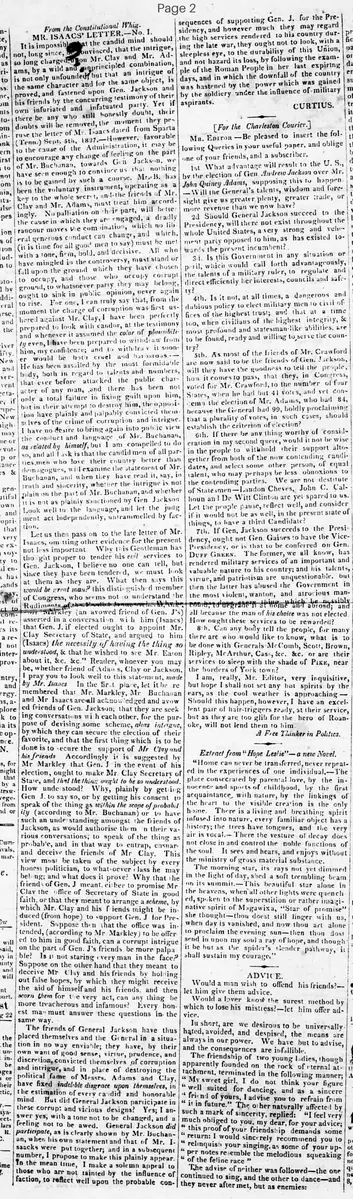
MR. ISAACS' LETTER.—No. I.
From The Constitution
It is impossible that the candid mind should so long [believe the charges] charged upon Mr. Clay and Mr. Adams, by a wild and unprincipled combination, is not only unfounded but that an intrigue of the same character and for the same object, is proved, and fastened upon Gen. Jackson and his own infuriated and infatuated party. Yet if there be any who still honestly doubt, their doubts will be removed, the moment they peruse the letter of Mr. Isaacs dated from Sparta (Tenn.) Sept. 5th, 1827.—However favorable it may be of Mr. Buchanan, towards Gen Jackson, we have seen enough to convince us that nothing is to be gained by such a course. Mr. B. has been the voluntary instrument, operating as a key to the whole secret, and the friends of Mr. Clay and Mr. Adams, must treat him accordingly. No palliation on their part, will be tolerated. The rancour moves the combination, which no liberal generous conduct can change, and which (it is time for all good men to say) must be met with atone, firm, bold, and decisive. All who have mingled in the controversy, must stand or fall upon the ground which they have chosen to occupy, and those who occupy corrupt ground, to whatsoever party they may belong, ought to sink in public opinion, never again to rise. For one, I can truly say that, from the moment the charge of corruption was first ushered against Mr. Clay, I have been perfectly prepared to look with candor, at the testimony and whenever it assumed the color of plausibility even, I have been prepared to withdraw from him, my confidence; and to withdraw it soon er would be but cruel and barbarous.—He has been assailed by the most formidable body, both in regard to talents and numbers, that ever before attacked the public character of any man, and there has been not only a total failure in fixing guilt upon him, but in their attempt to destroy him, the opposition have plainly and palpably convicted themselves of the crime of corruption and intrigue.
I have no desire to bring again into public view the conduct and language of Mr. Buchanan, as related by himself, but I am compelled to do so, and all I ask is that the candid men of all parties, men who love their country better than demagogues, will examine the statement of Mr. Buchanan, and when they have read it, say, in truth and sincerity, whether the intrigue is not plain on the part of Mr. Buchanan, and whether it is not as plainly sanctioned by Gen Jackson.
Look well to the language, and let the judgment act independently, untrammelled by faction.
Let us then pass on to the late letter of Mr. Isaacs, omitting other evidence for the present not less important Why this Gentleman has thought proper to tender his evil services to Gen. Jackson, I believe no one can tell, but since they have been tendered, we must look at them as they are.
What then says this would be great man? this distinguished member of Congress, who seems not to understand the rudiments of the English language—he markedly (an avowed friend of Gen. J's) asserted in a conversation with him (Isaacs) that Gen. J. if elected ought to appoint Mr. Clay Secretary of State, and argued to him (Isaacs) the necessity of having the thing so understood, & that he wished to see Mr. Eaton about it, &c. &c." Reader, whoever you may be, whether friend of Adams, Clay or Jackson, I pray you to look well to this statement, made by Mr. Isaacs In the first place, let it be remembered that Mr. Markley, Mr Buchanan and Mr Isaacs are all acknowledged and avowed friends of Gen. Jackson; that they are seeking conversations with each other. for the purpose of devising some scheme, alias intrigue, by which they can secure the election of their favorite, and that the first thing which is to be done is to secure the support of Mr Clay and his friends Accordingly it is suggested by Mr Markley that Gen. J in the event of his election, ought to make Mr. Clay Secretary of State, and that the thing ought to be so understood.
How understood? Why, plainly by getting Gen J. to say so, or by getting his consent to speak of the thing as within the scope of probability (according to Mr. Buchanan) or to have such an understanding amongst the friends of Jackson, as would authorise them in their various conversations, to speak of the thing as probable, and in that way to entrap, ensnare and deceive the friends of Mr Clay. This view must be taken of the subject by every honest politician, to whatsoever class he may belong; and what does it prove? Why that the friends of Gen. J meant. either to promise Mr Clay the office of Secretary of State in good faith, or that they meant to arrange a scheme, by which Mr. Clay and his friends might be induced (from hope) to support Gen. J for President. Suppose then that the office was intended, (according to Mr Markley) to be offered to him in good faith. can a corrupt intrigue on the part of Gen. J's friends be more palpable? Is It not staring every man in the face? Suppose on the other hand that they meant to deceive Mr Clay and his friends by holding out false hopes, by which they might receive the aid of himself and his friends. and then scorn them for the very act, can any thing be more treacherous and infamous?
Every honest man must answer these questions in the same way.
The friends of General Jackson have thus placed themselves and the General in a situation in no way enviable; they have, by their own want of good sense; virtue, prudence, and discretion, convicted themselves of corruption and intrigue, and in place of destroying the political fame of Messrs. Adams and Clay, have fixed indelible disgrace upon themselves, in the estimation of every candid and honorable mind. But did General Jackson participate in these corrupt and vicious designs? Yes; I answer yes, with a tone not to be changed, and a feeling not to be awed. General Jackson did participate, as is clearly shown by Mr. Buchanan, when his own statement and that of Mr. Isaacs were put together; and in a subsequent number, I propose to make this plainly appear.
In the mean time, I make a solemn appeal to those who are not tainted by the influence of faction, to reflect well upon the probable consequences of supporting Gen. J. or the Presidency, and however much they may regard the high services rendered to his country during the late war, they ought not to look, with a sleepless eye, to the durability of this Union, and not hazard its loss, by following the example of the Roman People in her last expiring days, and in which the downfall of the country was hastened by the power which was gained by the soldiery under the influence of military aspirants.
CURTIUS.
From The Constitution
It is impossible that the candid mind should so long [believe the charges] charged upon Mr. Clay and Mr. Adams, by a wild and unprincipled combination, is not only unfounded but that an intrigue of the same character and for the same object, is proved, and fastened upon Gen. Jackson and his own infuriated and infatuated party. Yet if there be any who still honestly doubt, their doubts will be removed, the moment they peruse the letter of Mr. Isaacs dated from Sparta (Tenn.) Sept. 5th, 1827.—However favorable it may be of Mr. Buchanan, towards Gen Jackson, we have seen enough to convince us that nothing is to be gained by such a course. Mr. B. has been the voluntary instrument, operating as a key to the whole secret, and the friends of Mr. Clay and Mr. Adams, must treat him accordingly. No palliation on their part, will be tolerated. The rancour moves the combination, which no liberal generous conduct can change, and which (it is time for all good men to say) must be met with atone, firm, bold, and decisive. All who have mingled in the controversy, must stand or fall upon the ground which they have chosen to occupy, and those who occupy corrupt ground, to whatsoever party they may belong, ought to sink in public opinion, never again to rise. For one, I can truly say that, from the moment the charge of corruption was first ushered against Mr. Clay, I have been perfectly prepared to look with candor, at the testimony and whenever it assumed the color of plausibility even, I have been prepared to withdraw from him, my confidence; and to withdraw it soon er would be but cruel and barbarous.—He has been assailed by the most formidable body, both in regard to talents and numbers, that ever before attacked the public character of any man, and there has been not only a total failure in fixing guilt upon him, but in their attempt to destroy him, the opposition have plainly and palpably convicted themselves of the crime of corruption and intrigue.
I have no desire to bring again into public view the conduct and language of Mr. Buchanan, as related by himself, but I am compelled to do so, and all I ask is that the candid men of all parties, men who love their country better than demagogues, will examine the statement of Mr. Buchanan, and when they have read it, say, in truth and sincerity, whether the intrigue is not plain on the part of Mr. Buchanan, and whether it is not as plainly sanctioned by Gen Jackson.
Look well to the language, and let the judgment act independently, untrammelled by faction.
Let us then pass on to the late letter of Mr. Isaacs, omitting other evidence for the present not less important Why this Gentleman has thought proper to tender his evil services to Gen. Jackson, I believe no one can tell, but since they have been tendered, we must look at them as they are.
What then says this would be great man? this distinguished member of Congress, who seems not to understand the rudiments of the English language—he markedly (an avowed friend of Gen. J's) asserted in a conversation with him (Isaacs) that Gen. J. if elected ought to appoint Mr. Clay Secretary of State, and argued to him (Isaacs) the necessity of having the thing so understood, & that he wished to see Mr. Eaton about it, &c. &c." Reader, whoever you may be, whether friend of Adams, Clay or Jackson, I pray you to look well to this statement, made by Mr. Isaacs In the first place, let it be remembered that Mr. Markley, Mr Buchanan and Mr Isaacs are all acknowledged and avowed friends of Gen. Jackson; that they are seeking conversations with each other. for the purpose of devising some scheme, alias intrigue, by which they can secure the election of their favorite, and that the first thing which is to be done is to secure the support of Mr Clay and his friends Accordingly it is suggested by Mr Markley that Gen. J in the event of his election, ought to make Mr. Clay Secretary of State, and that the thing ought to be so understood.
How understood? Why, plainly by getting Gen J. to say so, or by getting his consent to speak of the thing as within the scope of probability (according to Mr. Buchanan) or to have such an understanding amongst the friends of Jackson, as would authorise them in their various conversations, to speak of the thing as probable, and in that way to entrap, ensnare and deceive the friends of Mr Clay. This view must be taken of the subject by every honest politician, to whatsoever class he may belong; and what does it prove? Why that the friends of Gen. J meant. either to promise Mr Clay the office of Secretary of State in good faith, or that they meant to arrange a scheme, by which Mr. Clay and his friends might be induced (from hope) to support Gen. J for President. Suppose then that the office was intended, (according to Mr Markley) to be offered to him in good faith. can a corrupt intrigue on the part of Gen. J's friends be more palpable? Is It not staring every man in the face? Suppose on the other hand that they meant to deceive Mr Clay and his friends by holding out false hopes, by which they might receive the aid of himself and his friends. and then scorn them for the very act, can any thing be more treacherous and infamous?
Every honest man must answer these questions in the same way.
The friends of General Jackson have thus placed themselves and the General in a situation in no way enviable; they have, by their own want of good sense; virtue, prudence, and discretion, convicted themselves of corruption and intrigue, and in place of destroying the political fame of Messrs. Adams and Clay, have fixed indelible disgrace upon themselves, in the estimation of every candid and honorable mind. But did General Jackson participate in these corrupt and vicious designs? Yes; I answer yes, with a tone not to be changed, and a feeling not to be awed. General Jackson did participate, as is clearly shown by Mr. Buchanan, when his own statement and that of Mr. Isaacs were put together; and in a subsequent number, I propose to make this plainly appear.
In the mean time, I make a solemn appeal to those who are not tainted by the influence of faction, to reflect well upon the probable consequences of supporting Gen. J. or the Presidency, and however much they may regard the high services rendered to his country during the late war, they ought not to look, with a sleepless eye, to the durability of this Union, and not hazard its loss, by following the example of the Roman People in her last expiring days, and in which the downfall of the country was hastened by the power which was gained by the soldiery under the influence of military aspirants.
CURTIUS.
What sub-type of article is it?
Persuasive
Political
Investigative
What themes does it cover?
Politics
Morality
What keywords are associated?
Jackson Intrigue
Clay Corruption Charges
Adams Defense
Political Deception
Buchanan Statement
Markley Conversation
1828 Election
What entities or persons were involved?
Curtius
Letter to Editor Details
Author
Curtius
Main Argument
the charges of corruption against clay and adams are unfounded, while jackson's supporters, including isaacs, buchanan, and markley, engaged in intrigue to deceive clay into supporting jackson by promising him the secretary of state position, with jackson's participation implied.
Notable Details
References Mr. Isaacs' Letter From Sparta, Tenn., Sept. 5th, 1827
Quotes Conversation Involving Mr. Markley Suggesting Jackson Appoint Clay As Secretary Of State
Compares To Roman Downfall Due To Military Aspirants