Thank you for visiting SNEWPapers!
Sign up free
The Alexandria Herald
Alexandria, Virginia
What is this article about?
The British Chancellor of the Exchequer reports increased foreign commerce and benefits from free trade, with duties exceeding estimates by £1 million. Annual income estimated at £57,385,000. Austrian loan payments allocated to churches, Windsor Castle repairs, and a national gallery. Anticipated 1824 surplus of £2,763,000 amid policy changes like reducing bounties and duties.
Clipping
OCR Quality
Full Text
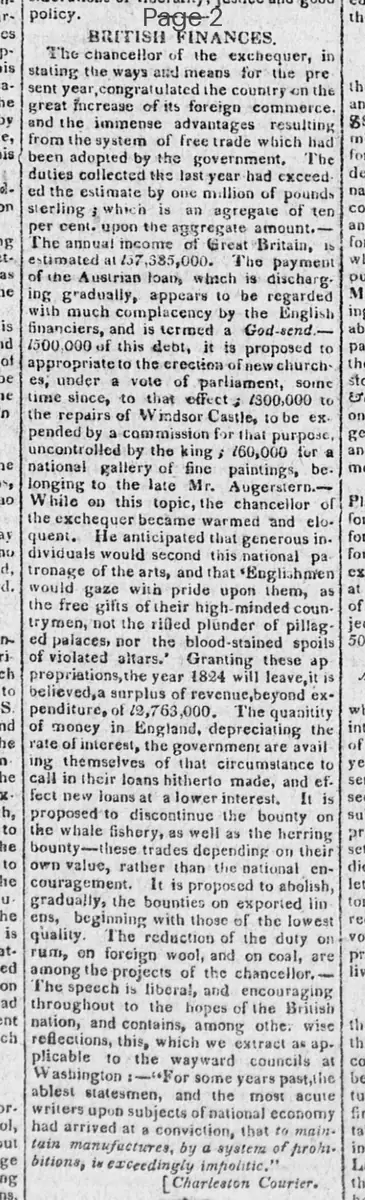
The chancellor of the exchequer, in stating the ways and means for the present year, congratulated the country on the great increase of its foreign commerce. and the immense advantages resulting from the system of free trade which had been adopted by the government. The duties collected the last year had exceeded the estimate by one million of pounds sterling ; which is an aggregate of ten per cent. upon the aggregate amount.- The annual income of Great Britain, is estimated at £57,385,000. The payment of the Austrian loan, which is discharging gradually, appears to be regarded with much complacency by the English financiers, and is termed a God-send.- £500,000 of this debt, it is proposed to appropriate to the erection of new churches; under a vote of parliament, some time since, to that effect ; £300,000 to the repairs of Windsor Castle, to be expended by a commission for that purpose, uncontrolled by the king ; £60,000 for a national gallery of fine paintings, belonging to the late Mr. Angerstein.-- While on this topic, the chancellor of the exchequer became warmed and eloquent. He anticipated that generous individuals would second this national patronage of the arts, and that Englishmen would gaze with pride upon them, as the free gifts of their high-minded countrymen, not the rifled plunder of pillaged palaces, nor the blood-stained spoils of violated altars.' Granting these appropriations, the year 1824 will leave. it is believed, a surplus of revenue, beyond expenditure, of £2,763,000. The quantity of money in England, depreciating the rate of interest, the government are availing themselves of that circumstance to call in their loans hitherto made, and effect new loans at a lower interest. It is proposed to discontinue the bounty on the whale fishery, as well as the herring bounty--these trades depending on their own value, rather than the national encouragement. It is proposed to abolish, gradually, the bounties on exported linens, beginning with those of the lowest quality. The reduction of the duty on rum, on foreign wool, and on coal, are among the projects of the chancellor.- The speech is liberal, and encouraging throughout to the hopes of the British nation, and contains, among other wise reflections, this, which we extract as applicable to the wayward councils at Washington :—'For some years past, the ablest statesmen, and the most acute writers upon subjects of national economy had arrived at a conviction, that to maintain manufactures, by a system of prohibitions, is exceedingly impolitic.'
What sub-type of article is it?
What keywords are associated?
What entities or persons were involved?
Where did it happen?
Foreign News Details
Primary Location
Great Britain
Event Date
1824
Key Persons
Outcome
surplus of revenue beyond expenditure of £2,763,000; appropriations from austrian loan: £500,000 for new churches, £300,000 for windsor castle repairs, £60,000 for national gallery; proposals to discontinue whale and herring bounties, abolish linen export bounties gradually, reduce duties on rum, foreign wool, and coal.
Event Details
The chancellor of the exchequer congratulated the country on increased foreign commerce and free trade benefits, with duties exceeding estimates by £1 million (10% aggregate). Annual income estimated at £57,385,000. Austrian loan payments viewed positively; portions allocated to churches, Windsor Castle, and Angerstein's paintings for a national gallery. Chancellor praised national arts patronage. Government to call in loans and issue new ones at lower interest due to depreciating money rates. Speech liberal, criticizing prohibition systems for manufactures.