Thank you for visiting SNEWPapers!
Sign up free
Fowle's New Hampshire Gazette And General Advertiser
Portsmouth, Rockingham County, New Hampshire
What is this article about?
Thomas Paine's essay, republished in an American newspaper, vehemently opposes the issuance of paper money by assemblies, arguing it lacks intrinsic value, promotes fraud, undermines morality, and exceeds constitutional authority. He contrasts it with gold and silver, citing historical examples and warning of economic ruin.
Merged-components note: These two components form a single continuous editorial essay 'On Paper-Money' by the author of Common Sense, spanning pages 1 and 2.
Clippings
1 of 2
OCR Quality
Full Text
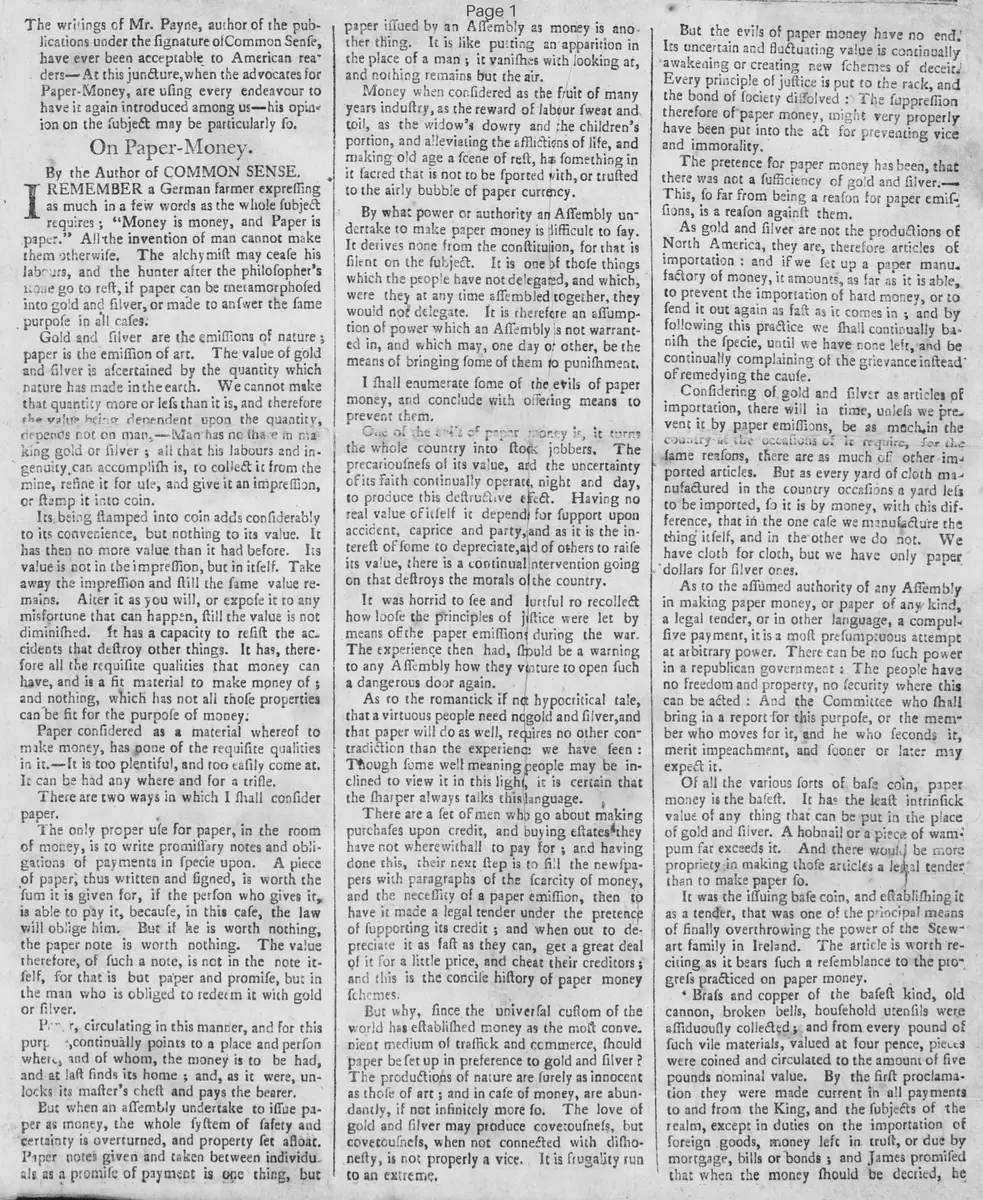
On Paper-Money.
By the Author of COMMON SENSE.
I remember a German farmer expressing as much in a few words as the whole subject requires; "Money is money, and Paper is paper." All the invention of man cannot make them otherwise. The alchymist may cease his labours, and the hunter after the philosopher's stone go to rest, if paper can be metamorphosed into gold and silver, or made to answer the same purpose in all cases.
Gold and silver are the emissions of nature; paper is the emission of art. The value of gold and silver is ascertained by the quantity which nature has made in the earth. We cannot make that quantity more or less than it is, and therefore the value being dependent upon the quantity, depends not on man. Man has no hand in making gold or silver; all that his labours and ingenuity can accomplish is, to collect it from the mine, refine it for use, and give it an impression, or stamp it into coin.
Its being stamped into coin adds considerably to its convenience, but nothing to its value. It has then no more value than it had before. Its value is not in the impression, but in itself. Take away the impression and still the same value remains. Alter it as you will, or expose it to any misfortune that can happen, still the value is not diminished. It has a capacity to resist the accidents that destroy other things. It has, therefore, all the requisite qualities that money can have, and is a fit material to make money of; and nothing, which has not all those properties can be fit for the purpose of money.
Paper considered as a material whereof to make money, has none of the requisite qualities in it. It is too plentiful, and too easily come at. It can be had any where and for a trifle.
There are two ways in which I shall consider paper.
The only proper use for paper, in the room of money, is to write promissory notes and obligations of payments in specie upon. A piece of paper, thus written and signed, is worth the sum it is given for, if the person who gives it, is able to pay it, because, in this case, the law will oblige him. But if he is worth nothing, the paper note is worth nothing. The value therefore, of such a note, is not in the note itself, for that is but paper and promise, but in the man who is obliged to redeem it with gold or silver.
Paper, circulating in this manner, and for this purpose, continually points to a place and person where, and of whom, the money is to be had, and at last finds its home; and, as it were, unlocks its master's chest and pays the bearer.
But when an assembly undertake to issue paper as money, the whole system of safety and certainty is overturned, and property set afloat. Paper notes given and taken between individuals as a promise of payment is one thing, but paper issued by an Assembly as money is another thing. It is like putting an apparition in the place of a man; it vanishes with looking at, and nothing remains but the air.
Money when considered as the fruit of many years industry, as the reward of labour sweat and toil, as the widow's dowry and the children's portion, and alleviating the afflictions of life, and making old age a scene of rest, has something in it sacred that is not to be parted with, or trusted to the airy bubble of paper currency.
By what power or authority an Assembly undertake to make paper money is difficult to say. It derives none from the constitution, for that is silent on the subject. It is one of those things which the people have not delegated, and which, were they at any time assembled together, they would not delegate. It is therefore an assumption of power which an Assembly is not warranted in, and which may, one day or other, be the means of bringing some of them to punishment.
I shall enumerate some of the evils of paper money, and conclude with offering means to prevent them.
One of the cries of paper money is, it turns the whole country into stock jobbers. The precariousness of its value, and the uncertainty of its faith continually operate, night and day, to produce this destructive effect. Having no real value of itself it depends for support upon accident, caprice and party, and as it is the interest of some to depreciate, and of others to raise its value, there is a continual intervention going on that destroys the morals of the country.
It was horrid to see and lustful to recollect how loose the principles of justice were let by means of the paper emissions during the war. The experience then had, should be a warning to any Assembly how they venture to open such a dangerous door again.
As to the romantick and hypocritical tale that a virtuous people need no gold and silver, and that paper will do as well, requires no other contradiction than the experience we have seen. Though some well meaning people may be inclined to view it in this light, it is certain that the sharper always talks this language.
There are a set of men who go about making purchases upon credit, and buying estates they have not wherewithall to pay for; and having done this, their next step is to fill the newspapers with paragraphs of the scarcity of money, and the necessity of a paper emission, then to have it made a legal tender under the pretence of supporting its credit; and when out to depreciate it as fast as they can, get a great deal of it for a little price, and cheat their creditors; and this is the concise history of paper money schemes.
But why, since the universal custom of the world has established money as the most convenient medium of traffick and commerce, should paper be set up in preference to gold and silver? The productions of nature are surely as innocent as those of art; and in case of money, are abundantly, if not infinitely more so. The love of gold and silver may produce covetousness, but covetousness, when not connected with dishonesty, is not properly a vice. It is frugality run to an extreme.
But the evils of paper money have no end. Its uncertain and fluctuating value is continually awakening or creating new schemes of deceit. Every principle of justice is put to the rack, and the bond of society dissolved: The suppression therefore of paper money, might very properly have been put into the act for preventing vice and immorality.
The pretence for paper money has been, that there was not a sufficiency of gold and silver. This, so far from being a reason for paper emissions, is a reason against them.
As gold and silver are not the productions of North America, they are, therefore articles of importation: and if we set up a paper manufactory of money, it amounts, as far as it is able, to prevent the importation of hard money, or to send it out again as fast as it comes in; and by following this practice we shall continually banish the specie, until we have none left, and be continually complaining of the grievance instead of remedying the cause.
Considering of gold and silver as articles of importation, there will in time, unless we prevent it by paper emissions, be as much, in the country as the occasions of it require, for the same reasons, there are as much of other imported articles. But as every yard of cloth manufactured in the country occasions a yard less to be imported, so it is by money, with this difference, that in the one case we manufacture the thing itself, and in the other we do not. We have cloth for cloth, but we have only paper dollars for silver ones.
As to the assumed authority of any Assembly in making paper money, or paper of any kind, a legal tender, or in other language, a compulsive payment, it is a most presumptuous attempt at arbitrary power. There can be no such power in a republican government: The people have no freedom and property, no security where this can be acted: And the Committee who shall bring in a report for this purpose, or the member who moves for it, and he who seconds it, merit impeachment, and sooner or later may expect it.
Of all the various sorts of base coin, paper money is the basest. It has the least intrinick value of any thing that can be put in the place of gold and silver. A hobnail or a piece of wampum far exceeds it. And there would be more propriety in making those articles a legal tender than to make paper so.
It was the issuing base coin, and establishing it as a tender, that was one of the principal means of finally overthrowing the power of the Stewart family in Ireland. The article is worth reciting as it bears such a resemblance to the progress practiced on paper money.
Brass and copper of the basest kind, old cannon, broken bells, household utensils were assiduously collected; and from every pound of such vile materials, valued at four pence, pieces were coined and circulated to the amount of five pounds nominal value. By the first proclamation they were made current in all payments to and from the King, and the subjects of the realm, except in duties on the importation of foreign goods, money left in trust, or due by mortgage, bills or bonds; and James promised that when the money should be decried, he
would receive it in all kinds of payment. As brass and copper grew scarce it was made of still viler materials, of tin and pewter, and old debts of one thousand pounds were discharged by pieces of vile metal, amounting to thirty shillings intrinsic value. Had King James thought of paper he needed not to have been at the trouble or expense of collecting brass and copper, broken bells and household utensils.
The laws of a country ought to be the standard of equity, and calculated to impress on the mind of the people the moral as well as the legal obligation of reciprocal justice. But tender laws, of any kind, operate to destroy morality, and to dissolve by the pretence of law what ought to be the principle of law to support, reciprocal justice between man and man: And the punishment of a member who should move for such a law ought to be death.
When the recommendation of Congress in the year 1780, for repealing the tender laws was before the Assembly of Pennsylvania, on casting up the votes for and against bringing in a bill to repeal those laws, the numbers were equal, and the casting vote rested on the Speaker, Col. Bayard. 'I give my vote,' said he, 'for the repeal, from a consciousness of justice; the tender laws operate to establish iniquity by law.'--But when the bill was brought in, the House rejected it. and the tender laws continued to be the means of fraud.
If any thing had, or could have, a value equal to gold and silver it would require no tender law: and if it had not that value it ought not to have such a law: and therefore all tender laws are tyrannical and unjust, and calculated to support fraud and oppression.
Most of the advocates for tender laws are those who have debts in discharge, and who take refuge in such a law to violate their contracts and cheat their creditors. But as no law can warrant the doing an unlawful act, therefore the proper mode of proceeding, should any such laws be enacted in future, will be to impeach and execute the members who moved for and seconded such a bill, and put the debtor & creditor in the same situation they were in, with respect to each other before the law was passed. Men ought to be made to tremble at the idea of such a barefaced act of injustice. It is in vain to talk of restoring credit, or to complain that money cannot be borrowed at legal interest, until every idea of tender laws is totally and publicly reprobated and extirpated from among us.
As to paper money, in any light it can be viewed, it is at best a bubble. Considered as property, it is inconsistent to suppose that the breath of an assembly, whose authority expires with the year, can give to paper the value and duration of gold-- They cannot even engage that the next Assembly shall receive it in taxes. And by the precedent (for authority there is none) that any one Assembly makes paper money, another may do the same, until confidence and credit are totally expelled, and all the evils of depreciation acted over again. The amount, therefore of paper money is this, that it is the illegitimate offspring of Assemblies, and when their year expires they leave it a vagrant on the hands of the public.
What sub-type of article is it?
What keywords are associated?
What entities or persons were involved?
Editorial Details
Primary Topic
Opposition To Paper Money And Tender Laws
Stance / Tone
Strongly Against Paper Currency And Assembly Issued Money
Key Figures
Key Arguments