Thank you for visiting SNEWPapers!
Sign up free
The Daily Cincinnati Republican, And Commercial Register
Cincinnati, Hamilton County, Ohio
What is this article about?
The steam boat New England exploded both boilers while landing passengers at Essex near the river mouth on a Wednesday morning around 3 AM. About 80 passengers aboard; most in berths escaped injury, but many on deck and in ladies' cabin were scalded or bruised. One passenger missing; cause unclear, possibly excessive steam pressure.
Clipping
OCR Quality
Full Text
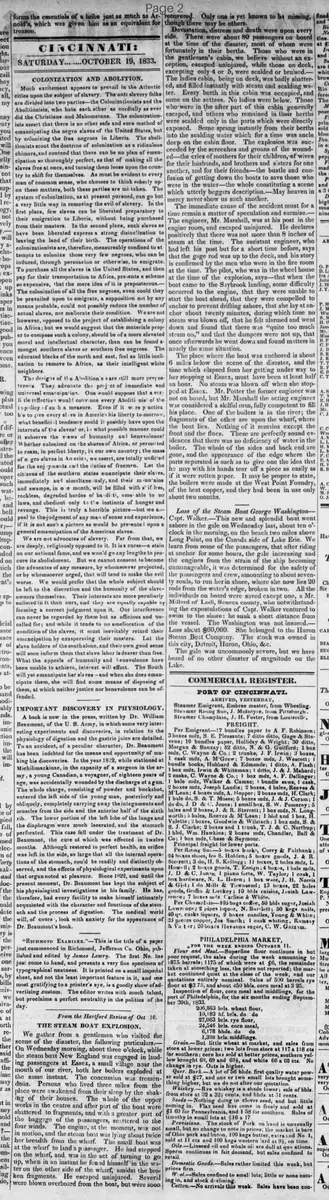
We gather from a gentleman who visited the scene of the disaster, the following particulars.
On Wednesday morning, about three o'clock, while the steam boat New England was engaged in landing passengers at Essex, a small village near the mouth of our river, both her boilers exploded at the same instant. The concussion was tremendous. Persons who lived three miles from the place were awakened from their sleep by the shaking of their houses. The whole of the upper works in the centre and after part of the boat were shattered to fragments, and with a greater part of the baggage of the passengers, scattered to the four winds. The engine, at the moment, was not in motion, and the steam boat was lying about twice her breadth from the wharf. The small boat was at the wharf to land a passenger. He had stepped on the wharf, and was in the act of turning to go up, when in an instant he found himself in the water on the other side of the wharf, amidst the broken fragments. He escaped uninjured. Several were blown overboard from the boat, but were soon recovered. Only one is yet known to be missing, though there may be others.
Devastation, distress and death were upon every side. There were about 80 passengers on board at the time of the disaster, most of whom were fortunately in their berths. Those who were in the gentlemen's cabin, we believe without an exception, escaped uninjured, while those on deck, excepting only 4 or 5, were scalded or bruised.—The ladies cabin, being on deck, was badly shattered, and filled instantly with steam and scalding water. Every berth in this cabin was occupied, and some on the settees. No ladies were below. Those who were in the after part of this cabin generally escaped, and others who remained in their berths were scalded only in the parts which were directly exposed. Some sprang instantly from their berths into the scalding water which for a time was ankle deep on the cabin floor. The explosion was succeeded by the screeches and groans of the wounded—the cries of mothers for their children, of wives for their husbands, and brothers and sisters for one another, and for their friends—the bustle and confusion of getting down the boats to save those who were in the water—the whole constituting a scene which utterly beggars description.—May heaven in mercy never show us such another.
The immediate cause of the accident must for a time remain a matter of speculation and surmise.—The engineer, Mr. Marshall, was at his post in the engine room, and escaped uninjured. He declares positively that there was not more than 8 inches of steam at the time. The assistant engineer, who had left his post but for a short time before, says that the gage rod was up to the deck, and his story is confirmed by the men who were in the fire room at the time. The pilot, who was in the wheel house at the time of the explosion, says—that when the boat came to the Saybrook landing, some difficulty occurred to the engine, that they were unable to start the boat ahead, that they were compelled to anchor to prevent drifting ashore, that she lay at anchor about twenty minutes, during which time no steam was blown off, that he felt alarmed and went down and found that there was "quite too much steam on," and that the dampers were not up, that once afterwards he went down and found matters in nearly the same situation.
This place where the boat was anchored is about 6 miles below the scene of the disaster, and the time which elapsed from her getting under way to her stopping at Essex, must have been at least half an hour. No steam was blown off when she stopped at Essex. Mr. Potter the former engineer was not on board, but Mr. Marshall the acting engineer was considered a skilful man, fully competent to fill his place. One of the boilers is in the river: the fragments of the other are upon the wharf, where the boat lies. Nothing of it remains except the front and the flues, these are perfectly sound—evidences that there was no deficiency of water in the boiler. The whole of the sides and back end are gone, and the appearance of the edge where the parts separated is such as to give one the idea that he may with his hands tear off a piece as easily as if it were rotten paper. It may be proper to state, the boilers were made at the West Point Foundry, of the best copper, and they had been in use only about two months.
What sub-type of article is it?
What keywords are associated?
What entities or persons were involved?
Where did it happen?
Domestic News Details
Primary Location
Essex
Event Date
Wednesday Morning, About Three O'clock
Key Persons
Outcome
about 80 passengers aboard; gentlemen's cabin escaped uninjured; most on deck scalded or bruised except 4 or 5; ladies' cabin occupants scalded, some severely; one missing, possibly more; upper works shattered, boilers destroyed.
Event Details
Steam boat New England exploded both boilers while landing passengers at Essex; tremendous concussion shook houses three miles away; passengers blown overboard but recovered; chaos with cries and efforts to save those in water; cause speculated as excessive steam pressure despite engineer's claim of low steam; prior engine trouble at Saybrook.