Thank you for visiting SNEWPapers!
Sign up free
Editorial
April 21, 1787
Independent Journal, Or, The General Advertiser
New York, New York County, New York
What is this article about?
A satirical petition from 'Roast Beef and Fleece' defends English staples like wool and beef against claims by 'Woollen Draper' that the Commercial Treaty with France will ruin them. It refutes arguments on wool supply, smuggling, and economic impacts, mocking party-driven opposition.
Clipping
OCR Quality
95%
Excellent
Full Text
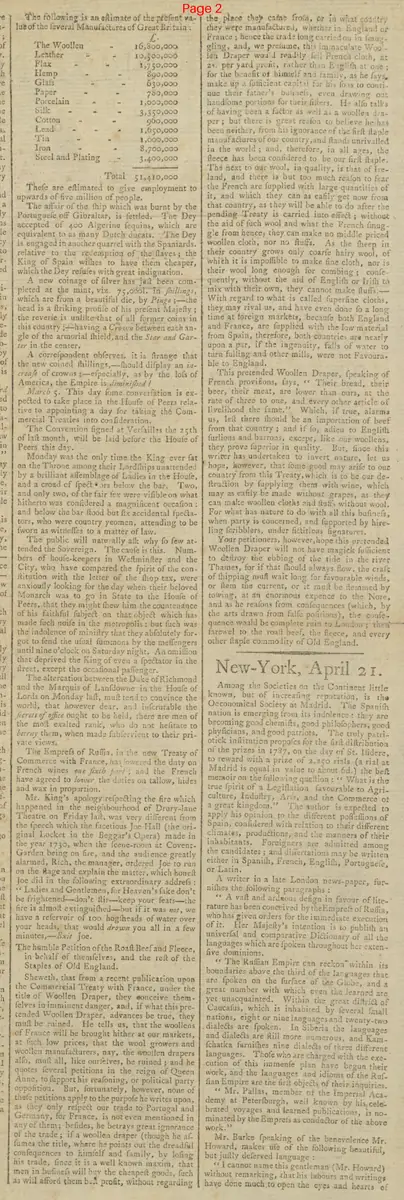
The humble Petition of the Roast Beef and Fleece, in behalf of themselves, and the rest of the Staples of Old England.
Sheweth, that from a recent publication upon the Commercial Treaty with France, under the title of Woollen Draper, they conceive themselves in imminent danger, and, if what this pretended Woollen Draper, advances be true, they must be ruined. He tells us, that the woollens of France will be brought hither at our markets, at such low prices, that the wool growers and woollen manufacturers, nay, the woollen drapers also, must all, like ourselves, be ruined; and he quotes several petitions in the reign of Queen Anne, to support his reasoning, or political party opposition. But, fortunately, however, none of these petitions apply to the purpose he writes upon, as they only respect our trade to Portugal and Germany, for France, is not even mentioned in any of them; besides, he betrays great ignorance of the trade; if a woollen draper (though he assumes the title, where he points out the dreadful consequences to himself and family, by losing his trade, since it is a well known maxim, that men in business will buy the cheapest goods, such as will afford them best profit, without regarding the place the cash comes from, or in what country they were manufactured, whether in England or France; hence the trade long carried on in smuggling, and, we presume, this immaculate Woollen Draper would readily sell French cloth, at 2s. per yard profit, rather than English at one; for the benefit of himself and family, as he says, make up a sufficient capital for his sons to continue their father's business, even drawing out handsome portions for their sisters. He also talks of having been a factor as well as a woollen draper; but there is great reason to believe he has been neither, from his ignorance of the first staple manufactures of our country, and stands unrivalled in the world; and, therefore, in all ages, the fleece has been considered to be our first staple.
The next to our wool, in quality, is that of Ireland. and there is but too much reason to fear the French are supplied with large quantities of it, and which they can as easily get now from that country, as they will be able to do after the pending Treaty is carried into effect; without the aid of such wool and what the French smuggle from hence, they can make no middle priced woollen cloth, nor no stuffs. As the sheep in their country grows only coarse hairy wool, of which it is impossible to make fine cloth, nor is their wool long enough for combing; consequently, without the aid of English or Irish to mix with their own, they cannot make stuffs.— With regard to what is called superfine cloths, they may rival us, and have even done so a long time at foreign markets, because both England and France, are supplied with the raw material from Spain, therefore, both countries are nearly upon a par, if the ingenuity, falls of water to turn fulling and other mills, were not Favourable to England.
This pretended Woollen Draper, speaking of French provisions, says, "Their bread, their beer, their meat, are lower than ours, at the rate of three to one, and every other article of livelihood the same." Which, if true, alarms us, lest there should be an importation of beef from that country; and if so, adieu to English bullocks and barons, except, like our woollens. they prove superior in quality. But, since this writer has undertaken to invert nature, let us hope, however, that some good may arise to our country from this Treaty, which is to be our destruction by supplying them with wine, which may as easily be made without grapes, as they can make woollen cloths and stuffs without wool.
For what has nature to do with all this business. when party is concerned, and supported by hireling scribblers, under fictitious signatures.
Your petitioners, however, hope this pretended Woollen Draper will not have magick sufficient to destroy the ebbing of the tide in the river Thames, for if that should always flow. the craft of shipping must wait long for favourable winds, or stem the current, or it must be stemmed by towing, at an enormous expence to the Nore, and as he reasons from consequences (which, by the arts drawn from false positions), the consequence would be complete ruin to London; then farewell to the roast beef, the fleece, and every other staple commodity of Old England.
Sheweth, that from a recent publication upon the Commercial Treaty with France, under the title of Woollen Draper, they conceive themselves in imminent danger, and, if what this pretended Woollen Draper, advances be true, they must be ruined. He tells us, that the woollens of France will be brought hither at our markets, at such low prices, that the wool growers and woollen manufacturers, nay, the woollen drapers also, must all, like ourselves, be ruined; and he quotes several petitions in the reign of Queen Anne, to support his reasoning, or political party opposition. But, fortunately, however, none of these petitions apply to the purpose he writes upon, as they only respect our trade to Portugal and Germany, for France, is not even mentioned in any of them; besides, he betrays great ignorance of the trade; if a woollen draper (though he assumes the title, where he points out the dreadful consequences to himself and family, by losing his trade, since it is a well known maxim, that men in business will buy the cheapest goods, such as will afford them best profit, without regarding the place the cash comes from, or in what country they were manufactured, whether in England or France; hence the trade long carried on in smuggling, and, we presume, this immaculate Woollen Draper would readily sell French cloth, at 2s. per yard profit, rather than English at one; for the benefit of himself and family, as he says, make up a sufficient capital for his sons to continue their father's business, even drawing out handsome portions for their sisters. He also talks of having been a factor as well as a woollen draper; but there is great reason to believe he has been neither, from his ignorance of the first staple manufactures of our country, and stands unrivalled in the world; and, therefore, in all ages, the fleece has been considered to be our first staple.
The next to our wool, in quality, is that of Ireland. and there is but too much reason to fear the French are supplied with large quantities of it, and which they can as easily get now from that country, as they will be able to do after the pending Treaty is carried into effect; without the aid of such wool and what the French smuggle from hence, they can make no middle priced woollen cloth, nor no stuffs. As the sheep in their country grows only coarse hairy wool, of which it is impossible to make fine cloth, nor is their wool long enough for combing; consequently, without the aid of English or Irish to mix with their own, they cannot make stuffs.— With regard to what is called superfine cloths, they may rival us, and have even done so a long time at foreign markets, because both England and France, are supplied with the raw material from Spain, therefore, both countries are nearly upon a par, if the ingenuity, falls of water to turn fulling and other mills, were not Favourable to England.
This pretended Woollen Draper, speaking of French provisions, says, "Their bread, their beer, their meat, are lower than ours, at the rate of three to one, and every other article of livelihood the same." Which, if true, alarms us, lest there should be an importation of beef from that country; and if so, adieu to English bullocks and barons, except, like our woollens. they prove superior in quality. But, since this writer has undertaken to invert nature, let us hope, however, that some good may arise to our country from this Treaty, which is to be our destruction by supplying them with wine, which may as easily be made without grapes, as they can make woollen cloths and stuffs without wool.
For what has nature to do with all this business. when party is concerned, and supported by hireling scribblers, under fictitious signatures.
Your petitioners, however, hope this pretended Woollen Draper will not have magick sufficient to destroy the ebbing of the tide in the river Thames, for if that should always flow. the craft of shipping must wait long for favourable winds, or stem the current, or it must be stemmed by towing, at an enormous expence to the Nore, and as he reasons from consequences (which, by the arts drawn from false positions), the consequence would be complete ruin to London; then farewell to the roast beef, the fleece, and every other staple commodity of Old England.
What sub-type of article is it?
Trade Or Commerce
Economic Policy
Foreign Affairs
What keywords are associated?
Commercial Treaty
France
Woollen Draper
English Wool
Irish Wool
Roast Beef
Smuggling
Queen Anne Petitions
What entities or persons were involved?
Roast Beef And Fleece
Woollen Draper
France
England
Ireland
Spain
Queen Anne
Editorial Details
Primary Topic
Defense Of English Wool And Beef Against Commercial Treaty With France
Stance / Tone
Mocking Opposition To Treaty, Supportive Of English Staples
Key Figures
Roast Beef And Fleece
Woollen Draper
France
England
Ireland
Spain
Queen Anne
Key Arguments
Woollen Draper's Petitions Do Not Apply To France
English And Irish Wool Essential For French Cloth Production
French Superfine Cloths Rely On Spanish Wool, Equal To England
French Provisions Cheaper But English Beef Superior
Smugglers Already Supply French With Wool
Treaty Won't Ruin English Staples
Party Politics Drives False Arguments