Thank you for visiting SNEWPapers!
Sign up free
Editorial
July 25, 1806
Norfolk Gazette And Publick Ledger
Norfolk, Virginia
What is this article about?
Editorial criticizes excessive fees (up to $60 per vessel) and unauthorized actions by US consuls abroad, such as taking charge of stranded vessels despite consignees. Publishes sections of the April 14, 1792 Act defining consuls' duties, fees (e.g., $2 for protests, 5% on estates), and bond requirements for accountability.
Clipping
OCR Quality
98%
Excellent
Full Text
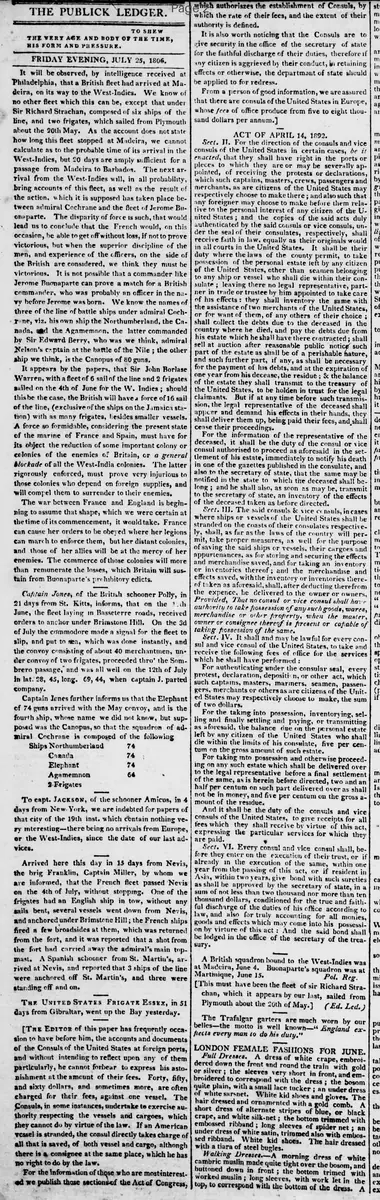
[The Editor of this paper has frequently occasion to have before him, the accounts and documents of the Consuls of the United States at foreign ports, and without intending to reflect upon any of them particularly, he cannot forbear to express his astonishment at the amount of their fees. Forty, fifty, and sixty dollars, and sometimes more, are often charged for their fees, against one vessel. The Consuls, in some instances, undertake to exercise authority respecting the vessels and cargoes, which they cannot do by virtue of the law. If an American vessel is stranded, the consul directly takes charge of all that is saved, of both vessel and cargo, although there is a consignee at the same place, which he has no right to do by the law.
For the information of those interested we publish those sections of the Act of Congress, which authorises the establishment of Consuls, by which the rate of their fees, and the extent of their authority is defined.
It is also worth noticing that the Consuls are to give security in the office of the secretary of state for the faithful discharge of their duties, therefore if any citizen is aggrieved by their conduct, in retaining effects or otherwise, the department of state should be applied to for redress.
From a person of good information, we are assured that there are consuls of the United States in Europe, whose fees of office produce from five to eight thousand dollars per annum.]
ACT OF APRIL 14, 1792.
Sect. II. For the direction of the consuls and vice consuls of the United States in certain cases, be it enacted, that they shall have right in the ports or places to which they are or may be severally appointed, of receiving the protests or declarations, which such captains, masters, crews, passengers and merchants, as are citizens of the United States may respectively choose to make there; and also such that any foreigner may choose to make before them relative to the personal interest of any citizen of the United States; and the copies of the said acts duly authenticated by the said consuls or vice consuls, under the seal of their consulates, respectively, shall receive faith in law, equally as their originals would in all courts in the United States. It shall be their duty where the laws of the country permit, to take possession of the personal estate left by any citizen of the United States, other than seamen belonging to any ship or vessel who shall die within their consulate; leaving there no legal representative, partner in trade or trustee by him appointed to take care of his effects: they shall inventory the same with the assistance of two merchants of the United States, or for want of them, of any others of their choice: shall collect the debts due to the deceased in the country where he died, and pay the debts due from his estate which he shall have there contracted; shall sell at auction after reasonable public notice such part of the estate as shall be of a perishable nature, and such further part, if any, as shall be necessary for the payment of his debts, and at the expiration of one year from his decease, the residue; & the balance of the estate they shall transmit to the treasury of the United States, to be holden in trust for the legal claimants. But if at any time before such transmission, the legal representative of the deceased shall appear and demand his effects in their hands, they shall deliver them up, being paid their fees, and shall cease their proceedings.
For the information of the representative of the deceased, it shall be the duty of the consul or vice consul authorised to proceed as aforesaid in the settlement of his estate, immediately to notify his death in one of the gazettes published in the consulate, and also to the secretary of state, that the same may be notified in the state to which the deceased shall belong; and he shall also, as soon as may be, transmit to the secretary of state, an inventory of the effects of the deceased taken as before directed.
Sect. III. The said consuls & vice consuls, in cases where ships or vessels of the United States shall be stranded on the coasts of their consulates respectively, shall, as far as the laws of the country will permit, take proper measures, as well for the purpose of saving the said ships or vessels, their cargoes and appurtenances, as for storing and securing the effects and merchandise saved, and for taking an inventory or inventories thereof; and the merchandise and effects saved, with the inventory or inventories thereof taken as aforesaid, shall, after deducting therefrom the expence, be delivered to the owner or owners, Provided, That no consul or vice consul shall have authority to take possession of any such goods, wares, merchandise or other property, when the master, owner or consignee thereof is present or capable of taking possession of the same.
Sect. IV. It shall and may be lawful for every consul and vice consul of the United States, to take and receive the following fees of office for the services which he shall have performed:
For authenticating under the consular seal, every protest, declaration, deposition, or other act, which such captains, masters, mariners, seamen, passengers, merchants or others as are citizens of the United States may respectively choose to make, the sum of two dollars.
For the taking into possession, inventorying, selling and finally settling and paying, or transmitting as aforesaid, the balance due on the personal estate left by any citizen of the United States who shall die within the limits of his consulate, five per centum on the gross amount of such estate.
For taking into possession and otherwise proceeding on any such estate which shall be delivered over to the legal representative before a final settlement of the same, as is herein before directed, two and a half per centum on such part delivered over as shall not be in money, and five per centum on the gross amount of the residue.
And it shall be the duty of the consuls and vice consuls of the United States, to give receipts for all fees which they shall receive by virtue of this act, expressing the particular services for which they are paid.
Sect. VI. Every consul and vice consul shall, before they enter on the execution of their trust, or if already in the execution of the same, within one year from the passing of this act, or if resident in Asia, within two years, give bond with such sureties as shall be approved by the secretary of state, in a sum of not less than two thousand nor more than ten thousand dollars, conditioned for the true and faithful discharge of the duties of his office according to law, and also for truly accounting for all monies, goods and effects which may come into his possession by virtue of this act: And the said bond shall be lodged in the office of the secretary of the treasury.
For the information of those interested we publish those sections of the Act of Congress, which authorises the establishment of Consuls, by which the rate of their fees, and the extent of their authority is defined.
It is also worth noticing that the Consuls are to give security in the office of the secretary of state for the faithful discharge of their duties, therefore if any citizen is aggrieved by their conduct, in retaining effects or otherwise, the department of state should be applied to for redress.
From a person of good information, we are assured that there are consuls of the United States in Europe, whose fees of office produce from five to eight thousand dollars per annum.]
ACT OF APRIL 14, 1792.
Sect. II. For the direction of the consuls and vice consuls of the United States in certain cases, be it enacted, that they shall have right in the ports or places to which they are or may be severally appointed, of receiving the protests or declarations, which such captains, masters, crews, passengers and merchants, as are citizens of the United States may respectively choose to make there; and also such that any foreigner may choose to make before them relative to the personal interest of any citizen of the United States; and the copies of the said acts duly authenticated by the said consuls or vice consuls, under the seal of their consulates, respectively, shall receive faith in law, equally as their originals would in all courts in the United States. It shall be their duty where the laws of the country permit, to take possession of the personal estate left by any citizen of the United States, other than seamen belonging to any ship or vessel who shall die within their consulate; leaving there no legal representative, partner in trade or trustee by him appointed to take care of his effects: they shall inventory the same with the assistance of two merchants of the United States, or for want of them, of any others of their choice: shall collect the debts due to the deceased in the country where he died, and pay the debts due from his estate which he shall have there contracted; shall sell at auction after reasonable public notice such part of the estate as shall be of a perishable nature, and such further part, if any, as shall be necessary for the payment of his debts, and at the expiration of one year from his decease, the residue; & the balance of the estate they shall transmit to the treasury of the United States, to be holden in trust for the legal claimants. But if at any time before such transmission, the legal representative of the deceased shall appear and demand his effects in their hands, they shall deliver them up, being paid their fees, and shall cease their proceedings.
For the information of the representative of the deceased, it shall be the duty of the consul or vice consul authorised to proceed as aforesaid in the settlement of his estate, immediately to notify his death in one of the gazettes published in the consulate, and also to the secretary of state, that the same may be notified in the state to which the deceased shall belong; and he shall also, as soon as may be, transmit to the secretary of state, an inventory of the effects of the deceased taken as before directed.
Sect. III. The said consuls & vice consuls, in cases where ships or vessels of the United States shall be stranded on the coasts of their consulates respectively, shall, as far as the laws of the country will permit, take proper measures, as well for the purpose of saving the said ships or vessels, their cargoes and appurtenances, as for storing and securing the effects and merchandise saved, and for taking an inventory or inventories thereof; and the merchandise and effects saved, with the inventory or inventories thereof taken as aforesaid, shall, after deducting therefrom the expence, be delivered to the owner or owners, Provided, That no consul or vice consul shall have authority to take possession of any such goods, wares, merchandise or other property, when the master, owner or consignee thereof is present or capable of taking possession of the same.
Sect. IV. It shall and may be lawful for every consul and vice consul of the United States, to take and receive the following fees of office for the services which he shall have performed:
For authenticating under the consular seal, every protest, declaration, deposition, or other act, which such captains, masters, mariners, seamen, passengers, merchants or others as are citizens of the United States may respectively choose to make, the sum of two dollars.
For the taking into possession, inventorying, selling and finally settling and paying, or transmitting as aforesaid, the balance due on the personal estate left by any citizen of the United States who shall die within the limits of his consulate, five per centum on the gross amount of such estate.
For taking into possession and otherwise proceeding on any such estate which shall be delivered over to the legal representative before a final settlement of the same, as is herein before directed, two and a half per centum on such part delivered over as shall not be in money, and five per centum on the gross amount of the residue.
And it shall be the duty of the consuls and vice consuls of the United States, to give receipts for all fees which they shall receive by virtue of this act, expressing the particular services for which they are paid.
Sect. VI. Every consul and vice consul shall, before they enter on the execution of their trust, or if already in the execution of the same, within one year from the passing of this act, or if resident in Asia, within two years, give bond with such sureties as shall be approved by the secretary of state, in a sum of not less than two thousand nor more than ten thousand dollars, conditioned for the true and faithful discharge of the duties of his office according to law, and also for truly accounting for all monies, goods and effects which may come into his possession by virtue of this act: And the said bond shall be lodged in the office of the secretary of the treasury.
What sub-type of article is it?
Foreign Affairs
Legal Reform
Trade Or Commerce
What keywords are associated?
Consular Fees
Us Consuls Authority
Act Of 1792
Stranded Vessels
Consular Bonds
Foreign Ports
What entities or persons were involved?
Consuls Of The United States
Secretary Of State
Congress
Editorial Details
Primary Topic
Critique Of Excessive Consular Fees And Unauthorized Authority
Stance / Tone
Critical And Informative
Key Figures
Consuls Of The United States
Secretary Of State
Congress
Key Arguments
Consuls Charge Exorbitant Fees Of $40 60 Or More Per Vessel
Consuls Exceed Authority By Taking Charge Of Stranded Vessels Despite Consignees
Act Of 1792 Limits Fees To $2 For Protests And 5% On Estates
Consuls Must Give Bonds For Faithful Duty
Redress For Grievances Via Department Of State
Some European Consuls Earn $5,000 8,000 Annually From Fees