Thank you for visiting SNEWPapers!
Sign up free
Editorial
December 29, 1796
Gazette Of The United States, & Philadelphia Daily Advertiser
Philadelphia, Philadelphia County, Pennsylvania
What is this article about?
This editorial compiles excerpts from the Aurora newspaper criticizing French influence and Democratic positions, while defending the federal government against Jacobin sympathies. It addresses issues like French decrees, presidential elections, British impressments, art plundering, and calls for national independence from foreign interference.
Clipping
OCR Quality
95%
Excellent
Full Text
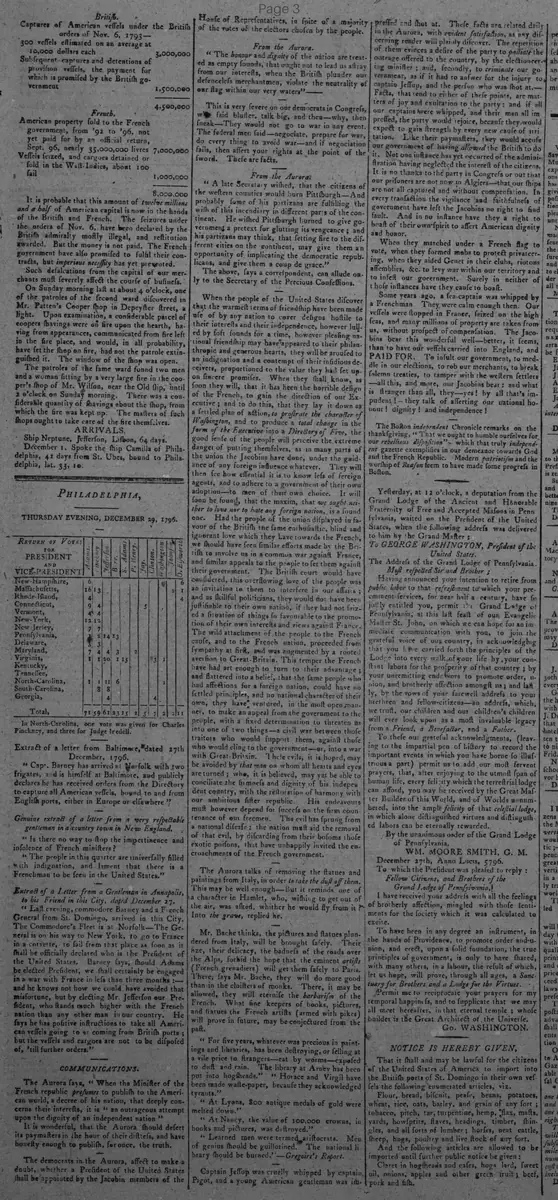
COMMUNICATIONS.
The Aurora says, "When the Minister of the French republic presumes to publish to the American world, a decree of his nation, that deeply concerns their interests, it is "an outrageous attempt upon the dignity of an independent nation"
It is wonderful, that the Aurora should desert its paymasters in the hour of their distresses, and have honesty enough to publish, for once, the truth.
The democrats in the Aurora, affect to make a doubt, whether a President of the United States shall be appointed by the Jacobin members of the House of Representatives. in spite of a majority of the votes of the electors chosen by the people.
From the Aurora.
The honour and dignity of the nation are treated as empty sounds, that ought not to lead us astray from our interests, when the British plunder our defenceless merchantmen, violate the neutrality of our flag within our very waters"
This is very severe on our democrats in Congress, who aid bluster, talk big, and then—why, then sneak—They would not go to war in any event.
The federal men say—negotiate, prepare for war, do every thing to avoid war—and if negotiation fails, then assert your rights at the point of the sword. These are facts.
From the Aurora.
"A late Secretary wished, that the citizens of the western counties would burn Pittsburgh—And probably some of his partizans are fulfilling the wish of this incendiary in different parts of the continent. He wished Pittsburgh burned to give government a pretext for glutting its vengeance; and his partizans may think, that setting fire to the different cities on the continent, may give them an opportunity of implicating the democratic republicans, and give them a coup de grace."
The above, says a correspondent, can allude only to the Secretary of the Precious. Confessions.
When the people of the United States discover that the warmest terms of friendship have been made use of by any nation to cover designs hostile to their interests and their independence, however lulled by soft sounds for a time, however pleasing national friendship may have appeared to their philanthropic and generous hearts, they will be aroused to an indignation and a contempt of their insidious deceivers, proportioned to the value they had set upon sincere promises. When they shall know, as soon they will, that it has been the horrible design of the French, to gain the direction of our Executive ; and to do this, that they lay it down as a settled plan of action, to prostrate the character of Washington, and to produce a total change in the form of the Executive into a Directory of Five, the good sense of the people will perceive the extreme danger of putting themselves, as in many parts of the union the Jacobins have done, under the guidance of any foreign influence whatever. They will then see how essential it is to know less of foreign agents, and to adhere to a government of their own adoption to men of their own choice. It will soon be found, that the maxim, that we ought neither to love nor to hate any foreign nation, is a sound one. Had the people of the union displayed in favour of the British the same enthusiastic, blind and ignorant love which they have towards the French, we should have seen similar efforts made by the British to involve us in a common war against France, and similar appeals to the people to set them against their government. The British court would have considered, this overflowing love of the people was an invitation to them to interfere in our affairs : and as skillful politicians, they would not have been justifiable to their own nation, if they had not seized a situation of things so favourable to the promotion of their own interests and views against France.
The wild attachment of the people to the French cause, and to the French nation, proceeded from sympathy at first, and was augmented by a rooted aversion to Great-Britain. This temper the French have had art enough to turn to their advantage ; and flattered into a belief, that the same people who had affections for a foreign nation, could have no settled principles, and no national character of their own, they have ventured, in the most open manner, to make an appeal from the government to the people, with a fixed determination to threaten us into one of two things—a civil war between those traitors who would support them, against those who would cling to the government—or, into a war with Great-Britain. These evils, it is hoped, may be avoided by that man on whom all hearts and eyes are turned ; who, it is believed, may yet be able to conciliate the interests and dignity of his independent country, with the restoration of harmony with our ambitious sister republic. His endeavours must however depend for success on the firm countenance of our freemen. The evil has sprung from a national disease : the nation must aid the removal of that evil, by discarding from their bosoms those exotic poisons, that have unhappily invited the encroachments of the French government.
The Aurora talks of removing the statues and paintings from Italy, in order to take the dust off them. This may be well enough—But it reminds one of a character in Hamlet, who, wishing to get out of the air, was asked, whither he would fly from it ? Into the grave, replied he.
Mr. Bache thinks, the pictures and statues plundered from Italy, will be brought safely. Their size, their delicacy, the badness of the roads over the Alps, forbid the hope that the eminent artists (French grenadiers) will get them safely to Paris. There, says Mr. Bache, they will do more good than in the cloisters of monks. There, it may be allowed, they will eternize the barbarism of the French. What fine keepers of books, pictures, and statues the French artists (armed with pikes) will prove in future, may be conjectured from the past.
"For five years, whatever was precious in paintings and libraries, has been destroying, or selling at a vile price to strangers—eaten by worms—exposed to dust and rain. The library at Arney has been put into hogsheads." "Horace and Virgil have been made waste-paper, because they acknowledged tyrants."
"At Lyons, 500 antique medals of gold were melted down."
"At Nancy, the value of 100,000 crowns, in books and pictures, was destroyed."
"Learned men were termed aristocrats. Men of genius should be guillotined. The national library should be burned." Gregoire's Report.
Captain Jump was cruelly whipped by captain Pigot, and a young American gentleman was impressed and shot at. These, facts are related daily in the Aurora, with evident satisfaction, as any discerning reader will plainly discover. The repetition of them evinces a desire of the party to palliate the outrage offered to the country, by the electioneering minister ; and, secondly, to criminate our government, as if it had to answer for the injury to captain Jump, and the person who was shot at.—
Facts, that tend to either of these points, are matters of joy and exultation to the party: and if all our captains were whipped, and their men all impressed, the party would rejoice, because they would expect to gain strength by every new cause of irritation. Like their paymasters, they would accuse our government of having allowed the British to do it. Not one instance has yet occurred of the administration having neglected the interest of the citizens. It is no thanks to the party in Congress or out that our prisoners are not now in Algiers—that our ships are not all captured and without compensation. In every transaction the vigilance and faithfulness of government have left the Jacobins no right to find fault. And in no instance have they a right to boast of their own spirit to assert American dignity and honor.
When they marched under a French flag to vote, when they formed mobs to protect privateering, when they aided Genet in their clubs, riotous assemblies, &c. to levy war within our territory and to insult our government. Surely in neither of those instances have they cause to boast.
Some years ago, a sea-captain was whipped by a Frenchman They were calm enough then. Our vessels were stopped in France, seized on the high seas, and many millions of property are taken from us, without prospect of compensation. The Jacobins bear this wonderfully well—better, it seems, than to have our vessels carried into England, and PAID FOR. To insult our government, to meddle in our elections, to rob our merchants, to break solemn treaties, to tamper with the western settlers—all this, and more, our Jacobins bear: and what is stranger than all, they—yes! by all that's impertinent !— they talk of asserting our national honour! dignity! and independence!
The Boston independent Chronicle remarks on the thanksgiving, "That we ought to humble ourselves for our rebellious disposition"— which that truly independent gazette exemplifies in our demeanor towards God and the French Republic. Modern patriotism and the worship of Reason seem to have made some progress in Boston.
The Aurora says, "When the Minister of the French republic presumes to publish to the American world, a decree of his nation, that deeply concerns their interests, it is "an outrageous attempt upon the dignity of an independent nation"
It is wonderful, that the Aurora should desert its paymasters in the hour of their distresses, and have honesty enough to publish, for once, the truth.
The democrats in the Aurora, affect to make a doubt, whether a President of the United States shall be appointed by the Jacobin members of the House of Representatives. in spite of a majority of the votes of the electors chosen by the people.
From the Aurora.
The honour and dignity of the nation are treated as empty sounds, that ought not to lead us astray from our interests, when the British plunder our defenceless merchantmen, violate the neutrality of our flag within our very waters"
This is very severe on our democrats in Congress, who aid bluster, talk big, and then—why, then sneak—They would not go to war in any event.
The federal men say—negotiate, prepare for war, do every thing to avoid war—and if negotiation fails, then assert your rights at the point of the sword. These are facts.
From the Aurora.
"A late Secretary wished, that the citizens of the western counties would burn Pittsburgh—And probably some of his partizans are fulfilling the wish of this incendiary in different parts of the continent. He wished Pittsburgh burned to give government a pretext for glutting its vengeance; and his partizans may think, that setting fire to the different cities on the continent, may give them an opportunity of implicating the democratic republicans, and give them a coup de grace."
The above, says a correspondent, can allude only to the Secretary of the Precious. Confessions.
When the people of the United States discover that the warmest terms of friendship have been made use of by any nation to cover designs hostile to their interests and their independence, however lulled by soft sounds for a time, however pleasing national friendship may have appeared to their philanthropic and generous hearts, they will be aroused to an indignation and a contempt of their insidious deceivers, proportioned to the value they had set upon sincere promises. When they shall know, as soon they will, that it has been the horrible design of the French, to gain the direction of our Executive ; and to do this, that they lay it down as a settled plan of action, to prostrate the character of Washington, and to produce a total change in the form of the Executive into a Directory of Five, the good sense of the people will perceive the extreme danger of putting themselves, as in many parts of the union the Jacobins have done, under the guidance of any foreign influence whatever. They will then see how essential it is to know less of foreign agents, and to adhere to a government of their own adoption to men of their own choice. It will soon be found, that the maxim, that we ought neither to love nor to hate any foreign nation, is a sound one. Had the people of the union displayed in favour of the British the same enthusiastic, blind and ignorant love which they have towards the French, we should have seen similar efforts made by the British to involve us in a common war against France, and similar appeals to the people to set them against their government. The British court would have considered, this overflowing love of the people was an invitation to them to interfere in our affairs : and as skillful politicians, they would not have been justifiable to their own nation, if they had not seized a situation of things so favourable to the promotion of their own interests and views against France.
The wild attachment of the people to the French cause, and to the French nation, proceeded from sympathy at first, and was augmented by a rooted aversion to Great-Britain. This temper the French have had art enough to turn to their advantage ; and flattered into a belief, that the same people who had affections for a foreign nation, could have no settled principles, and no national character of their own, they have ventured, in the most open manner, to make an appeal from the government to the people, with a fixed determination to threaten us into one of two things—a civil war between those traitors who would support them, against those who would cling to the government—or, into a war with Great-Britain. These evils, it is hoped, may be avoided by that man on whom all hearts and eyes are turned ; who, it is believed, may yet be able to conciliate the interests and dignity of his independent country, with the restoration of harmony with our ambitious sister republic. His endeavours must however depend for success on the firm countenance of our freemen. The evil has sprung from a national disease : the nation must aid the removal of that evil, by discarding from their bosoms those exotic poisons, that have unhappily invited the encroachments of the French government.
The Aurora talks of removing the statues and paintings from Italy, in order to take the dust off them. This may be well enough—But it reminds one of a character in Hamlet, who, wishing to get out of the air, was asked, whither he would fly from it ? Into the grave, replied he.
Mr. Bache thinks, the pictures and statues plundered from Italy, will be brought safely. Their size, their delicacy, the badness of the roads over the Alps, forbid the hope that the eminent artists (French grenadiers) will get them safely to Paris. There, says Mr. Bache, they will do more good than in the cloisters of monks. There, it may be allowed, they will eternize the barbarism of the French. What fine keepers of books, pictures, and statues the French artists (armed with pikes) will prove in future, may be conjectured from the past.
"For five years, whatever was precious in paintings and libraries, has been destroying, or selling at a vile price to strangers—eaten by worms—exposed to dust and rain. The library at Arney has been put into hogsheads." "Horace and Virgil have been made waste-paper, because they acknowledged tyrants."
"At Lyons, 500 antique medals of gold were melted down."
"At Nancy, the value of 100,000 crowns, in books and pictures, was destroyed."
"Learned men were termed aristocrats. Men of genius should be guillotined. The national library should be burned." Gregoire's Report.
Captain Jump was cruelly whipped by captain Pigot, and a young American gentleman was impressed and shot at. These, facts are related daily in the Aurora, with evident satisfaction, as any discerning reader will plainly discover. The repetition of them evinces a desire of the party to palliate the outrage offered to the country, by the electioneering minister ; and, secondly, to criminate our government, as if it had to answer for the injury to captain Jump, and the person who was shot at.—
Facts, that tend to either of these points, are matters of joy and exultation to the party: and if all our captains were whipped, and their men all impressed, the party would rejoice, because they would expect to gain strength by every new cause of irritation. Like their paymasters, they would accuse our government of having allowed the British to do it. Not one instance has yet occurred of the administration having neglected the interest of the citizens. It is no thanks to the party in Congress or out that our prisoners are not now in Algiers—that our ships are not all captured and without compensation. In every transaction the vigilance and faithfulness of government have left the Jacobins no right to find fault. And in no instance have they a right to boast of their own spirit to assert American dignity and honor.
When they marched under a French flag to vote, when they formed mobs to protect privateering, when they aided Genet in their clubs, riotous assemblies, &c. to levy war within our territory and to insult our government. Surely in neither of those instances have they cause to boast.
Some years ago, a sea-captain was whipped by a Frenchman They were calm enough then. Our vessels were stopped in France, seized on the high seas, and many millions of property are taken from us, without prospect of compensation. The Jacobins bear this wonderfully well—better, it seems, than to have our vessels carried into England, and PAID FOR. To insult our government, to meddle in our elections, to rob our merchants, to break solemn treaties, to tamper with the western settlers—all this, and more, our Jacobins bear: and what is stranger than all, they—yes! by all that's impertinent !— they talk of asserting our national honour! dignity! and independence!
The Boston independent Chronicle remarks on the thanksgiving, "That we ought to humble ourselves for our rebellious disposition"— which that truly independent gazette exemplifies in our demeanor towards God and the French Republic. Modern patriotism and the worship of Reason seem to have made some progress in Boston.
What sub-type of article is it?
Partisan Politics
Foreign Affairs
War Or Peace
What keywords are associated?
Aurora Criticism
French Influence
Jacobin Sympathies
National Dignity
British Impressment
Art Plundering
Partisan Politics
Foreign Affairs
What entities or persons were involved?
Aurora
French Republic
Washington
Jacobins
Democrats
British
Mr. Bache
Genet
Captain Jump
Captain Pigot
Editorial Details
Primary Topic
Critique Of Pro French Jacobin Influence And Aurora Newspaper Positions
Stance / Tone
Strongly Anti French Intervention And Pro Federal Government
Key Figures
Aurora
French Republic
Washington
Jacobins
Democrats
British
Mr. Bache
Genet
Captain Jump
Captain Pigot
Key Arguments
Aurora Hypocritically Criticizes French Actions While Supporting Them
French Seek To Control Us Executive And Undermine Washington
Democrats Prioritize Interests Over National Dignity Against British
Federal Approach: Negotiate First, Fight If Necessary
French Plundering Of Art Reveals Barbarism
Jacobins Excuse French Outrages But Decry British
People Must Reject Foreign Influence To Preserve Independence