Thank you for visiting SNEWPapers!
Sign up free
Literary
June 1, 1839
The Madisonian
Washington, District Of Columbia
What is this article about?
Article discussing Shakespeare's close reading of the Bible, providing examples of biblical verses paralleled in his plays like Othello, Macbeth, Merchant of Venice, and Hamlet.
Clipping
OCR Quality
95%
Excellent
Full Text
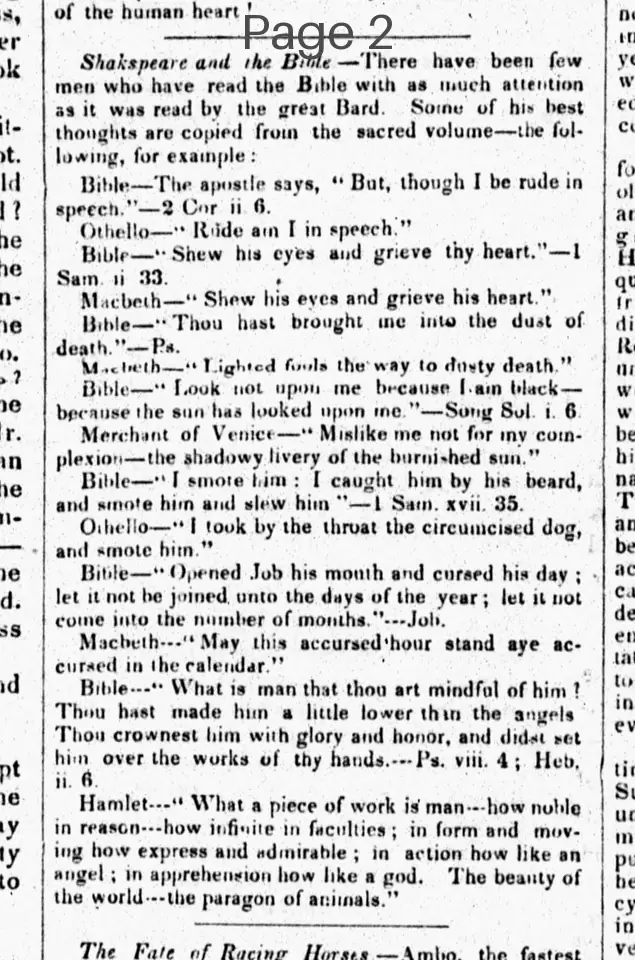
Shakspeare and the Bible—There have been few
men who have read the Bible with as much attention
as it was read by the great Bard. Some of his best
thoughts are copied from the sacred volume—the fol-
lowing, for example:
Bible—The apostle says, "But, though I be rude in
speech."—2 Cor. ii. 6.
Othello—"Rude am I in speech."
Bible—"Shew his eyes and grieve thy heart."—I
Sam. i. 33.
Macbeth—"Shew his eyes and grieve his heart."
Bible—"Thou hast brought me into the dust of
death."—Ps.
Macbeth—"Lighted fools the way to dusty death."
Bible—"Look not upon me because I am black—
because the sun has looked upon me." Song Sol. i. 6.
Merchant of Venice—"Mislike me not for my com-
plexion—the shadowy livery of the burnished sun."
Bible—"I smote him: I caught him by his beard,
and smote him and slew him"—1 Sam. xvii. 35.
Othello—"I took by the throat the circumcised dog,
and smote him."
Bible—"Opened Job his mouth and cursed his day:
let it not be joined unto the days of the year; let it not
come into the number of months."—Job.
Macbeth—"May this accursed hour stand
accursed in the calendar."
Bible—"What is man that thou art mindful of him?
Thou hast made him a little lower than the angels.
Thou crownest him with glory and honor, and didst set
him over the works of thy hands."—Ps. viii. 4; Heb.
ii. 6.
Hamlet—"What a piece of work is man.—how noble
in reason—how infinite in faculties; in form and mov-
ing how express and admirable; in action how like an
angel; in apprehension how like a god. The beauty of
the world.—the paragon of animals."
men who have read the Bible with as much attention
as it was read by the great Bard. Some of his best
thoughts are copied from the sacred volume—the fol-
lowing, for example:
Bible—The apostle says, "But, though I be rude in
speech."—2 Cor. ii. 6.
Othello—"Rude am I in speech."
Bible—"Shew his eyes and grieve thy heart."—I
Sam. i. 33.
Macbeth—"Shew his eyes and grieve his heart."
Bible—"Thou hast brought me into the dust of
death."—Ps.
Macbeth—"Lighted fools the way to dusty death."
Bible—"Look not upon me because I am black—
because the sun has looked upon me." Song Sol. i. 6.
Merchant of Venice—"Mislike me not for my com-
plexion—the shadowy livery of the burnished sun."
Bible—"I smote him: I caught him by his beard,
and smote him and slew him"—1 Sam. xvii. 35.
Othello—"I took by the throat the circumcised dog,
and smote him."
Bible—"Opened Job his mouth and cursed his day:
let it not be joined unto the days of the year; let it not
come into the number of months."—Job.
Macbeth—"May this accursed hour stand
accursed in the calendar."
Bible—"What is man that thou art mindful of him?
Thou hast made him a little lower than the angels.
Thou crownest him with glory and honor, and didst set
him over the works of thy hands."—Ps. viii. 4; Heb.
ii. 6.
Hamlet—"What a piece of work is man.—how noble
in reason—how infinite in faculties; in form and mov-
ing how express and admirable; in action how like an
angel; in apprehension how like a god. The beauty of
the world.—the paragon of animals."
What sub-type of article is it?
Essay
What themes does it cover?
Religious
What keywords are associated?
Shakespeare
Bible
Parallels
Quotations
Influence
Literary Details
Title
Shakspeare And The Bible
Subject
Parallels Between Shakespeare And The Bible
Key Lines
Bible—The Apostle Says, "But, Though I Be Rude In Speech."—2 Cor. Ii. 6.
Othello—"Rude Am I In Speech."
Bible—"What Is Man That Thou Art Mindful Of Him?
Thou Hast Made Him A Little Lower Than The Angels.
Thou Crownest Him With Glory And Honor, And Didst Set
Him Over The Works Of Thy Hands."—Ps. Viii. 4; Heb.
Ii. 6.
Hamlet—"What A Piece Of Work Is Man.—How Noble
In Reason—How Infinite In Faculties; In Form And Mov
Ing How Express And Admirable; In Action How Like An
Angel; In Apprehension How Like A God. The Beauty Of
The World.—The Paragon Of Animals."