Thank you for visiting SNEWPapers!
Sign up free
Gazette Of The United States & Evening Advertiser
Philadelphia, Philadelphia County, Pennsylvania
What is this article about?
Report from the French National Convention on January 26: American deputation demands pardon for Thomas Paine; Republicans from Dunkirk donate spoils and request city name change; Barère discusses military campaigns, rejects enemy peace proposals, and highlights arms production; Jambon Saint-André announces 15 naval prizes captured off Ireland.
Clipping
OCR Quality
Full Text
January 26.
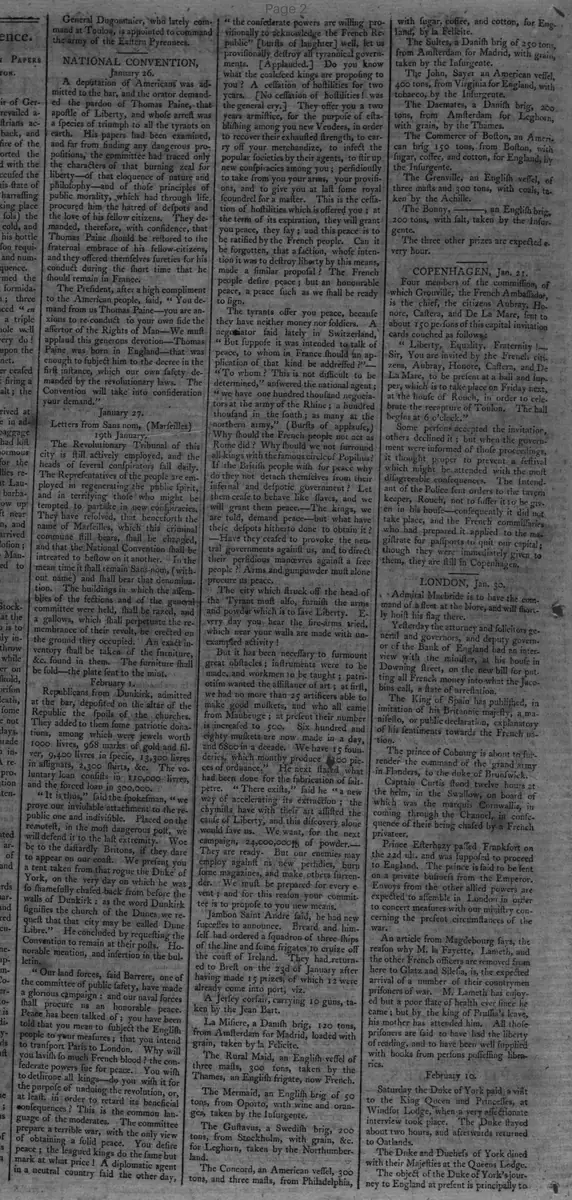
A deputation of Americans was admitted to the bar, and the orator demanded the pardon of Thomas Paine, that apostle of Liberty, and whose arrest was a species of triumph to all the tyrants on earth. His papers had been examined, and far from finding any dangerous propositions, the committee had traced only the characters of that burning zeal for liberty—of that eloquence of nature and philosophy—and of those principles of public morality, which had through life procured him the hatred of despots and the love of his fellow citizens. They demanded, therefore, with confidence, that Thomas Paine should be restored to the fraternal embrace of his fellow-citizens, and they offered themselves sureties for his conduct during the short time that he should remain in France.
The President, after a high compliment to the American people, said, "You demand from us Thomas Paine—you are anxious to re-conduct to your own side the assertor of the Rights of Man—We must applaud this generous devotion—Thomas Paine was born in England that was enough to subject him to the decree in the first instance, which our own safety demanded by the revolutionary laws. The Convention will take into consideration your demand."
Republicans from Dunkirk, admitted at the bar, deposited on the altar of the Republic the spoils of the churches.
They added to them some patriotic donations, among which were jewels worth 1000 livres, 968 marks of gold and silver, 9,400 livres in specie, 13,300 livres in assignats, 2,300 shirts, &c. The voluntary loan consists in 110,000 livres, and the forced loan in 300,000.
"It is thus," said the spokesman, "we prove our inviolable attachment to the republic one and indivisible. Placed on the remotest, in the most dangerous post, we will defend it to the last extremity. Woe be to the dastardly Britons, if they dare to appear on our coast. We present you a tent taken from that rogue the Duke of York, on the very day on which he was so shamefully chased back from before the walls of Dunkirk: as the word Dunkirk signifies the church of the Dunes we request that that city may be called Dune Libre." He concluded by requesting the Convention to remain at their posts. Honorable mention, and insertion in the bulletin.
"Our land forces," said Barrere, one of the committee of public safety, "have made a glorious campaign: and our naval forces shall procure us an honorable peace.
Peace has been talked of; you have been told that you mean to subject the English people to your measures; that you intend to transport Paris to London. Why will you lavish so much French blood? the confederate powers sue for peace. You wish to dethrone all kings—do you wish it for the purpose of undoing the revolution, or, at least, in order to retard its beneficial consequences? This is the common language of the moderates. The committee prepare a terrible war, with the only view of obtaining a solid peace. You desire peace; the leagued kings do the same but mark at what price! A diplomatic agent in a neutral country said the other day,
"the confederate powers are willing provisionally to acknowledge the French Republic" [bursts of laughter] well, let us provisionally, destroy all tyrannical governments. [Applauded.] Do you know what the coalesced kings are proposing to you? A cessation of hostilities for two years. [No cessation of hostilities! was the general cry.]— They offer you a two years armistice, for the purpose of establishing among you new Vendées, in order to recover their exhausted strength, to carry off your merchandise, to infect the popular societies by their agents, to stir up new conspiracies among you; perfidiously to take from you your arms, your provisions, and to give you at last some royal scoundrel for a master. This is the cessation of hostilities which is offered you; at the term of its expiration, they will grant you peace, they say; and this peace is to be ratified by the French people. Can it be forgotten, that a faction, whose intention it was to destroy liberty by this means, made a similar proposal? The French people desire peace; but an honourable peace, a peace such as we shall be ready to sign.
The tyrants offer you peace, because they have neither money nor soldiers. A negotiator said lately in Switzerland,
"But suppose it was intended to talk of peace, to whom in France should an application of that kind be addressed?"
"To whom? This is not difficult to be determined," answered the national agent; "we have one hundred thousand negotiators at the army of the Rhine; a hundred thousand in the south; as many at the northern army," (Bursts of applause,)
Why should the French people not act as Rome did? Why should we not surround all kings with the famous circle of Popilius?
If the British people wish for peace why do they not detach themselves from their infernal and despotic government? Let them cease to behave like slaves, and we will grant them peace.—The kings, we are told, demand peace—but what have these despots hitherto done to obtain it?
—Have they ceased to provoke the neutral governments against us, and to direct their perfidious manoeuvres against a free people? Arms and gunpowder must alone procure us peace.
The city which struck off the head of the Tyrant must also, furnish the arms and powder which is to save Liberty. Every day you hear the fire-arms tried, which near your walls are made with unexampled activity!
But it has been necessary to surmount great obstacles; instruments were to be made, and workmen to be taught; patriotism wanted the assistance of art; at first we had no more than 25 artificers able to make good muskets, and who all came from Maubeuge; at present their number is increased to 500. Six hundred and eighty muskets are now made in a day, and 6800 in a decade. We have 15 foundries, which monthly produce 200 pieces of ordnance." He next stated what had been done for the fabrication of saltpetre. "There exists," said he "a new way of accelerating its extraction; the chemists have with their art assisted the cause of Liberty, and this discovery alone would save us. We want, for the next campaign, 24,000,000 lbs of powder.
They are ready— But our enemies may employ against us new perfidies, burn some magazines, and make others surrender. We must be prepared for every event; and for this reason your committee is to propose to you new means.
Jambon Saint Andre said, he had new successes to announce. Breard and himself had ordered a squadron of three ships of the line and some frigates to cruise off the coast of Ireland. They had returned to Brest on the 23d of January after having made 15 prizes, of which 12 were already come into port, viz.
A Jersey corsair, carrying 10 guns, taken by the Jean Bart.
La Minerve, a Danish brig, 120 tons, from Amsterdam for Madrid, loaded with grain, taken by la Felicite.
The Rural Maid, an English vessel of three masts, 300 tons, taken by the Thames, an English frigate, now French.
The Mermaid, an English brig of 50 tons, from Oporto, with wine and oranges, taken by the Insurgente.
The Gustavus, a Swedish brig, 200 tons, from Stockholm, with grain, &c. for Leghorn, taken by the Northumberland.
The Concord, an American vessel, 300 tons, and three masts, from Philadelphia,
with sugar, coffee, and cotton, for England, by la Felicite.
The Sultana, a Danish brig of 250 tons, from Amsterdam for Madrid, with grain, taken by the Insurgente.
The John Sayer an American vessel, 400 tons, from Virginia for England, with tobacco, by the Insurgente.
The Dramantes, a Danish brig, 200 tons, from Amsterdam for Leghorn, with grain, by the Thames.
The Commerce of Boston, an American brig 150 tons, from Boston, with sugar, coffee, and cotton, for England, by the Insurgente.
The Grenville, an English vessel, of three masts and 300 tons, with coals, taken by the Achille.
The Bonny, an English brig, 200 tons, with salt, taken by the Insurgente.
The three other prizes are expected every hour.
What sub-type of article is it?
What keywords are associated?
What entities or persons were involved?
Where did it happen?
Foreign News Details
Primary Location
Paris
Event Date
January 26
Key Persons
Outcome
demand for pardon of thomas paine considered; donations from dunkirk including jewels, gold, silver, specie, assignats, shirts, voluntary loan of 110,000 livres, forced loan of 300,000 livres; 15 naval prizes captured, 12 in port; muskets production increased to 680 per day; 15 foundries producing 200 pieces of ordnance monthly; new method for saltpetre extraction; preparation for 24,000,000 lbs of powder.
Event Details
American deputation demands pardon for Thomas Paine based on examination of his papers showing zeal for liberty; President compliments Americans and agrees to consider demand. Republicans from Dunkirk deposit church spoils and patriotic donations, present tent taken from Duke of York, request city name change to Dune Libre. Barère reports on land and naval forces, rejects enemy peace proposals including provisional acknowledgment of Republic and two-year armistice, emphasizes need for honorable peace through arms and gunpowder, details arms production progress from 25 to 500 artificers, musket output, foundries, saltpetre fabrication. Jambon Saint André announces squadron's return to Brest on January 23 after capturing 15 prizes off Ireland, lists 12 prizes including vessels from Jersey, Denmark, England, Sweden, America with various cargoes.