Thank you for visiting SNEWPapers!
Sign up free
National Gazette
Philadelphia, Philadelphia County, Pennsylvania
What is this article about?
On January 5, the U.S. House of Representatives concluded debate on reducing the army's military establishment. Mr. Williamson advocated amending the motion to stop recruiting and discharge excess officers, favoring militia volunteers for Indian conflicts over regulars. Mr. Wadsworth defended his prior statements on appropriations and praised regular forces.
Clipping
OCR Quality
Full Text
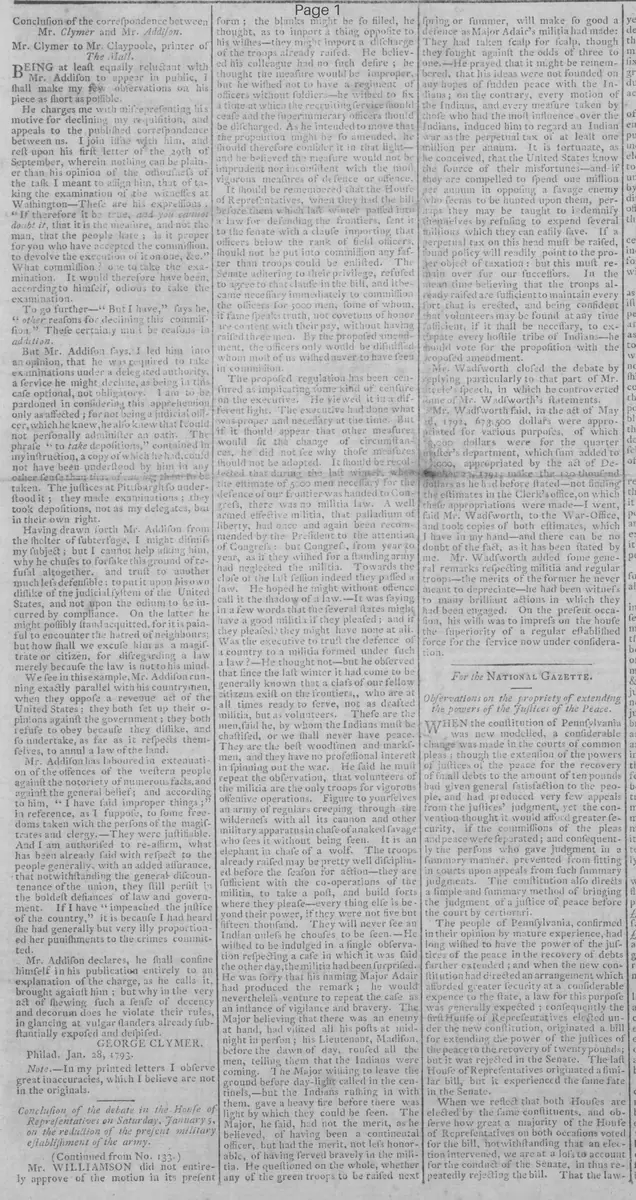
(Continued from No. 133.)
Mr. WILLIAMSON did not entirely approve of the motion in its present form; the blanks might be so filled, he thought, as to import a thing opposite to his wishes—they might import a discharge of the troops already raised. He believed his colleague had no such desire; he thought the measure would be improper, but he wished not to have a regiment of officers without soldiers—he wished to fix a time at which the recruiting service should cease and the supernumerary officers should be discharged. As he intended to move that the proposition might be so amended, he should therefore consider it in that light—and he believed the measure would not be imprudent nor inconsistent with the most vigorous measures of defence or offence.
It should be remembered that the House of Representatives, when they had the bill before them which last winter passed into a law for defending the frontiers, sent it to the senate with a clause importing, that officers below the rank of field officers, should not be put into commission any faster than troops could be enlisted. The Senate adhering to their privilege, refused to agree to that clause in the bill, and it became necessary immediately to commission the officers for 3000 men, some of whom, if fame speaks truth, not covetous of honor were content with their pay, without having raised three men. By the proposed amendment, the officers only would be dismissed whom most of us wished never to have seen in commission.
The proposed regulation has been censured as implicating some kind of censure on the executive. He viewed it in a different light. The executive had done what was proper and necessary at the time. But if it should appear that other measures would suit the change of circumstances, he did not see why those measures should not be adopted. It should be recollected that during the last winter, when the estimate of 3000 men necessary for the defence of our frontier was handed to Congress, there was no militia law. A well armed effective militia, that palladium of liberty, had once and again been recommended by the President to the attention of Congress: but Congress, from year to year, as if they wished for a standing army had neglected the militia. Towards the close of the last session indeed they passed a law. He hoped he might without offence call it the shadow of a law.—It was saying in a few words that the several states might have a good militia if they pleased; and if they pleased, they might have none at all.
Was the executive to trust the defence of a country to a militia formed under such a law?—He thought not—but he observed that since the last winter it had come to be generally known that a class of our fellow citizens exist on the frontiers, who are at all times ready to serve, not as drafted militia, but as volunteers. These are the men, said he, by whom the Indians must be chastised, or we shall never have peace. They are the best woodsmen and marksmen, and they have no professional interest in spinning out the war. He said he must repeat the observation, that volunteers of the militia are the only troops for vigorous offensive operations. Figure to yourselves an army of regulars creeping through the wilderness with all its cannon and other military apparatus in chase of a naked savage who sees it without being seen. It is an elephant in chase of a wolf. The troops already raised may be pretty well disciplined before the season for action they are sufficient with the co-operations of the militia, to take a post, and build forts where they please—every thing else is beyond their power, if they were not five but fifteen thousand. They will never see an Indian unless he chooses to be seen.—He wished to be indulged in a single observation respecting a case in which it was said the other day, the militia had been surprised.
He was sorry that his naming Major Adair had produced the remark; he would nevertheless venture to repeat the case as an instance of vigilance and bravery. The Major believing that there was an enemy at hand, had visited all his posts at midnight in person; his Lieutenant, Madison, before the dawn of day, roused all the men, telling them that the Indians were coming. The Major wishing to leave the ground before day-light called in the sentinels,—but the Indians rushing in with them, gave a heavy fire before there was light by which they could be seen. The Major, he said, had not the merit, as he believed, of having been a continental officer, but had the merit, not less honorable, of having served bravely in the militia. He questioned on the whole, whether any of the green troops to be raised next spring or summer, will make so good a defence as Major Adair's militia had made: They had taken scalp for scalp, though they fought against the odds of three to one.—He prayed that it might be remembered, that his ideas were not founded on any hopes of sudden peace with the Indians; on the contrary, every motion of the Indians, and every measure taken by those who had the most influence over the Indians, induced him to regard an Indian war as the perpetual tax of at least one million per annum. It is fortunate, as he conceived, that the United States know the source of their misfortunes—and if they are compelled to spend one million per annum in opposing a savage enemy who seems to be hunted upon them, perhaps they may be taught to indemnify themselves by refusing to expend several millions which they can easily save. If a perpetual tax on this head must be raised, sound policy will readily point to the proper object of taxation: but this must remain over for our successors. In the mean time believing that the troops already raised are sufficient to maintain every fort that is erected, and being confident that volunteers may be found at any time sufficient, if it shall be necessary, to extirpate every hostile tribe of Indians—he should vote for the proposition with the proposed amendment.
Mr. Wadsworth closed the debate by replying particularly to that part of Mr. Steele's speech, in which he controverted some of Mr. Wadsworth's statements.
Mr. Wadsworth said, in the act of May 8, 1792, 673,500 dollars were appropriated for various purposes, of which 100,000 dollars were for the quarter master's department, which sum added to 20,000, appropriated by the act of December 1791 make the 120 thousand dollars as he had before stated—not finding the estimates in the Clerk's office, on which these appropriations were made—I went, said Mr. Wadsworth, to the War-Office, and took copies of both estimates, which I have in my hand—and there can be no doubt of the fact, as it has been stated by me. Mr. Wadsworth added some general remarks respecting militia and regular troops—the merits of the former he never meant to depreciate—he had been witness to many brilliant actions in which they had been engaged. On the present occasion, his wish was to impress on the house the superiority of a regular established force for the service now under consideration.
What sub-type of article is it?
What keywords are associated?
What entities or persons were involved?
Where did it happen?
Domestic News Details
Primary Location
House Of Representatives
Event Date
Saturday, January 5
Key Persons
Outcome
debate concluded with mr. williamson supporting an amendment to cease recruiting and discharge supernumerary officers; mr. wadsworth defended appropriations and regular troops' superiority.
Event Details
Mr. Williamson argued for amending the motion to stop recruiting service and discharge excess officers, criticizing past commissioning practices and advocating reliance on frontier volunteers and militia for Indian conflicts over regular army expansion. He cited Major Adair's militia defense as exemplary. Mr. Wadsworth replied, verifying appropriation figures and emphasizing regular forces' value.