Thank you for visiting SNEWPapers!
Sign up free
Story
December 17, 1807
Alexandria Daily Advertiser
Alexandria, Virginia
What is this article about?
Continuation of examination in Aaron Burr's 1807 treason trial: Captain Bissell testifies on Major Bruff's disrepute, healthy cantonment at Cold Water, his barge lent to Burr without Wilkinson's orders, and reads Wilkinson's past laudatory letters to Bruff. (187 characters)
Clipping
OCR Quality
95%
Excellent
Full Text
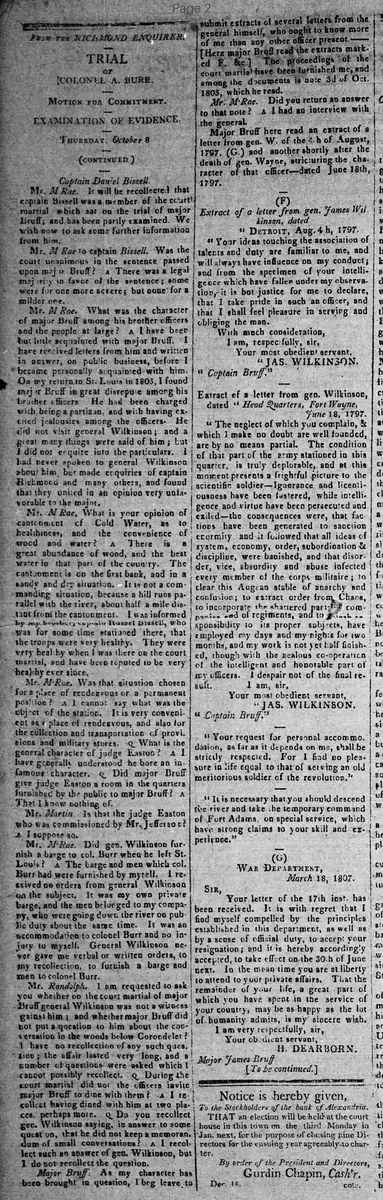
FROM THE RICHMOND ENQUIRER
TRIAL
OF COLONEL A. BURR
MOTION FOR COMMITMENT
EXAMINATION OF EVIDENCE
THURSDAY, October 8
(CONTINUED)
Captain Daniel Bissell
Mr. M. Rae. It will be recollected that Captain Bissell was a member of the court martial which sat on the trial of Major Bruff; and has been partly examined. We wish now to ask some further information from him.
Mr. M. Rae to Captain Bissell. Was the court unanimous in the sentence passed upon Major Bruff? A. There was a legal majority in favor of the sentence; some were for one more severe; but none for a milder one.
Mr. M. Rae. What was the character of Major Bruff among his brother officers and the people at large? A. I have been but little acquainted with Major Bruff. I have received letters from him and written in answer, on public business, before I became personally acquainted with him. On my return to St. Louis in 1804, I found Major Bruff in great disrepute among his brother officers. He had been charged with being a partisan, and with having excited jealousies among the officers. He did not visit General Wilkinson; and a great many things were said of him; but I did not enquire into the particulars. I had never spoken to General Wilkinson about him but made enquiries of Captain Richmond and many others, and found that they united in an opinion very unfavorable to the Major.
Mr. M. Rae. What is your opinion of cantonment at Cold Water, as to healthiness, and the convenience of wood and water? A. There is a great abundance of wood, and the best water in that part of the country. The cantonment is on the first bank, and in a sandy and dry situation. It is not a commanding situation, because a hill runs parallel with the river, about half a mile distant from the cantonment. I was informed by my brother, Captain Russell Bissell, who was for some time stationed there, that the troops were very healthy. They were very healthy when I was there on the court martial, and have been reputed to be very healthy ever since.
Mr. M. Rae. Was that situation chosen as a place of rendezvous or a permanent position? A. I cannot say what was the object of the station. It is very convenient as a place of rendezvous, and also for the collection and transportation of provisions and military stores. Q. What is the general character of Judge Easton? A. I have generally understood he bore an infamous character. Q. Did Major Bruff give Judge Easton a room in the quarters furnished by the public to Major Bruff? A. That I know nothing of.
Mr. Martin. Is that the Judge Easton who was commissioned by Mr. Jefferson? A. I suppose so.
Mr. M. Rae. Did Gen. Wilkinson furnish a barge to Col. Burr when he left St. Louis? A. The barge and men which Col. Burr had were furnished by myself. I received no orders from General Wilkinson on the subject. It was my own private barge, and the men belonged to my company, who were going down the river on public duty about the same time. It was an accommodation to Colonel Burr and no injury to myself. General Wilkinson never gave me verbal or written orders, to my recollection, to furnish a barge and men to Colonel Burr.
Mr. Randolph. I am requested to ask you whether on the court martial of Major Bruff General Wilkinson was not a witness against him; and whether Major Bruff did not put a question to him about the conversation in the woods below Carondelet? A. I have no recollection of any such question; the affair lasted very long, and a number of questions were asked which I cannot possibly recollect. Q. During the court martial did not the officers invite Major Bruff to dine with them? A. I recollect having dined with him at two places, perhaps more. Q. Do you recollect Gen. Wilkinson saying, in answer to some question, that he did not keep a memorandum of small conversations? A. I recollect such an answer of Gen. Wilkinson, but I do not recollect the question.
Major Bruff. As my character has been brought in question, I beg leave to submit extracts of several letters from the general himself who ought to know more of me than any other officer present.
[Here major Bruff read the extracts marked (F) &c.] The proceedings of the court martial have been furnished me and among the documents is note 3d of Oct. 1805 which he read.
Mr. M. Rae. Did you return an answer to that note? A. I had an interview with the general.
Major Bruff here read an extract of a letter from Gen. W. of the 4th of August, 1797, (G.) and another shortly after the death of Gen. Wayne, stricturing the character of that officer dated June 18th, 1797.
(F)
Extract of a letter from Gen. James Wilkinson, dated
Detroit, Aug. 4th, 1797.
Your ideas touching the association of talents and duty are familiar to me, and will always have influence on my conduct; and from the specimen of your intelligence which have fallen under my observation, it is but justice for me to declare, that I take pride in such an officer, and that I shall feel pleasure in serving and obliging the man.
With much consideration,
I am, respectfully, sir,
Your most obedient servant,
JAS. WILKINSON
Captain Bruff.
Extract of a letter from Gen. Wilkinson,
dated "Head Quarters, Fort Wayne,
June 18, 1797.
The neglect of which you complain, &c. which I make no doubt are well founded, are by no means partial. The condition of that part of the army stationed in this quarter, is truly deplorable, and at this moment presents a frightful picture to the scientific soldier--Ignorance and licentiousness have been fostered, while intelligence and virtue have been persecuted and exiled--the consequences were, that factions have been generated to sanction enormity, and it followed that all ideas of system, economy, order, subordination & discipline, were banished, and that disorder, vice, absurdity and abuse infected every member of the corps militaire; to clear this Augean stable of anarchy and confusion; to extract order from Chaos, to incorporate the shattered parts--the companies and of regiments, and to join responsibility to its proper subjects, have employed my days and my nights for two months, and my work is not yet half finished, though with the zealous co-operation of the intelligent and honorable part of my officers. I despair not of the final result.
I am, sir,
Your most obedient servant,
JAS. WILKINSON.
Captain Bruff.
Your request for personal accommodation, as far as it depends on me, shall be strictly respected. For I find no pleasure in life equal to that of serving an old meritorious soldier of the revolution."
It is necessary that you should descend the river and take the temporary command of Fort Adams, on special service, which has strong claims to your skill and experience."
(G)
War Department,
March 18, 1807.
SIR,
Your letter of the 17th inst. has been received. It is with regret that I find myself compelled by the principles established in this department, as well as by a sense of official duty, to accept your resignation; and it is hereby accordingly accepted, to take effect on the 30th of June next. In the mean time you are at liberty to attend to your private affairs. That the remainder of your life, a great part of which you have spent in the service of your country, may be as happy as the lot of humanity admits, is my sincere wish.
I am very respectfully, sir,
Your obedient servant,
H. DEARBORN.
Major James Bruff
[To be continued.]
TRIAL
OF COLONEL A. BURR
MOTION FOR COMMITMENT
EXAMINATION OF EVIDENCE
THURSDAY, October 8
(CONTINUED)
Captain Daniel Bissell
Mr. M. Rae. It will be recollected that Captain Bissell was a member of the court martial which sat on the trial of Major Bruff; and has been partly examined. We wish now to ask some further information from him.
Mr. M. Rae to Captain Bissell. Was the court unanimous in the sentence passed upon Major Bruff? A. There was a legal majority in favor of the sentence; some were for one more severe; but none for a milder one.
Mr. M. Rae. What was the character of Major Bruff among his brother officers and the people at large? A. I have been but little acquainted with Major Bruff. I have received letters from him and written in answer, on public business, before I became personally acquainted with him. On my return to St. Louis in 1804, I found Major Bruff in great disrepute among his brother officers. He had been charged with being a partisan, and with having excited jealousies among the officers. He did not visit General Wilkinson; and a great many things were said of him; but I did not enquire into the particulars. I had never spoken to General Wilkinson about him but made enquiries of Captain Richmond and many others, and found that they united in an opinion very unfavorable to the Major.
Mr. M. Rae. What is your opinion of cantonment at Cold Water, as to healthiness, and the convenience of wood and water? A. There is a great abundance of wood, and the best water in that part of the country. The cantonment is on the first bank, and in a sandy and dry situation. It is not a commanding situation, because a hill runs parallel with the river, about half a mile distant from the cantonment. I was informed by my brother, Captain Russell Bissell, who was for some time stationed there, that the troops were very healthy. They were very healthy when I was there on the court martial, and have been reputed to be very healthy ever since.
Mr. M. Rae. Was that situation chosen as a place of rendezvous or a permanent position? A. I cannot say what was the object of the station. It is very convenient as a place of rendezvous, and also for the collection and transportation of provisions and military stores. Q. What is the general character of Judge Easton? A. I have generally understood he bore an infamous character. Q. Did Major Bruff give Judge Easton a room in the quarters furnished by the public to Major Bruff? A. That I know nothing of.
Mr. Martin. Is that the Judge Easton who was commissioned by Mr. Jefferson? A. I suppose so.
Mr. M. Rae. Did Gen. Wilkinson furnish a barge to Col. Burr when he left St. Louis? A. The barge and men which Col. Burr had were furnished by myself. I received no orders from General Wilkinson on the subject. It was my own private barge, and the men belonged to my company, who were going down the river on public duty about the same time. It was an accommodation to Colonel Burr and no injury to myself. General Wilkinson never gave me verbal or written orders, to my recollection, to furnish a barge and men to Colonel Burr.
Mr. Randolph. I am requested to ask you whether on the court martial of Major Bruff General Wilkinson was not a witness against him; and whether Major Bruff did not put a question to him about the conversation in the woods below Carondelet? A. I have no recollection of any such question; the affair lasted very long, and a number of questions were asked which I cannot possibly recollect. Q. During the court martial did not the officers invite Major Bruff to dine with them? A. I recollect having dined with him at two places, perhaps more. Q. Do you recollect Gen. Wilkinson saying, in answer to some question, that he did not keep a memorandum of small conversations? A. I recollect such an answer of Gen. Wilkinson, but I do not recollect the question.
Major Bruff. As my character has been brought in question, I beg leave to submit extracts of several letters from the general himself who ought to know more of me than any other officer present.
[Here major Bruff read the extracts marked (F) &c.] The proceedings of the court martial have been furnished me and among the documents is note 3d of Oct. 1805 which he read.
Mr. M. Rae. Did you return an answer to that note? A. I had an interview with the general.
Major Bruff here read an extract of a letter from Gen. W. of the 4th of August, 1797, (G.) and another shortly after the death of Gen. Wayne, stricturing the character of that officer dated June 18th, 1797.
(F)
Extract of a letter from Gen. James Wilkinson, dated
Detroit, Aug. 4th, 1797.
Your ideas touching the association of talents and duty are familiar to me, and will always have influence on my conduct; and from the specimen of your intelligence which have fallen under my observation, it is but justice for me to declare, that I take pride in such an officer, and that I shall feel pleasure in serving and obliging the man.
With much consideration,
I am, respectfully, sir,
Your most obedient servant,
JAS. WILKINSON
Captain Bruff.
Extract of a letter from Gen. Wilkinson,
dated "Head Quarters, Fort Wayne,
June 18, 1797.
The neglect of which you complain, &c. which I make no doubt are well founded, are by no means partial. The condition of that part of the army stationed in this quarter, is truly deplorable, and at this moment presents a frightful picture to the scientific soldier--Ignorance and licentiousness have been fostered, while intelligence and virtue have been persecuted and exiled--the consequences were, that factions have been generated to sanction enormity, and it followed that all ideas of system, economy, order, subordination & discipline, were banished, and that disorder, vice, absurdity and abuse infected every member of the corps militaire; to clear this Augean stable of anarchy and confusion; to extract order from Chaos, to incorporate the shattered parts--the companies and of regiments, and to join responsibility to its proper subjects, have employed my days and my nights for two months, and my work is not yet half finished, though with the zealous co-operation of the intelligent and honorable part of my officers. I despair not of the final result.
I am, sir,
Your most obedient servant,
JAS. WILKINSON.
Captain Bruff.
Your request for personal accommodation, as far as it depends on me, shall be strictly respected. For I find no pleasure in life equal to that of serving an old meritorious soldier of the revolution."
It is necessary that you should descend the river and take the temporary command of Fort Adams, on special service, which has strong claims to your skill and experience."
(G)
War Department,
March 18, 1807.
SIR,
Your letter of the 17th inst. has been received. It is with regret that I find myself compelled by the principles established in this department, as well as by a sense of official duty, to accept your resignation; and it is hereby accordingly accepted, to take effect on the 30th of June next. In the mean time you are at liberty to attend to your private affairs. That the remainder of your life, a great part of which you have spent in the service of your country, may be as happy as the lot of humanity admits, is my sincere wish.
I am very respectfully, sir,
Your obedient servant,
H. DEARBORN.
Major James Bruff
[To be continued.]
What sub-type of article is it?
Historical Event
Crime Story
What themes does it cover?
Justice
Crime Punishment
What keywords are associated?
Burr Trial
Major Bruff
General Wilkinson
Court Martial
Testimony
St Louis
Barge Provision
What entities or persons were involved?
Colonel A. Burr
Captain Daniel Bissell
Major Bruff
General Wilkinson
Mr. M. Rae
Mr. Martin
Mr. Randolph
Judge Easton
Captain Richmond
Captain Russell Bissell
Where did it happen?
St. Louis
Story Details
Key Persons
Colonel A. Burr
Captain Daniel Bissell
Major Bruff
General Wilkinson
Mr. M. Rae
Mr. Martin
Mr. Randolph
Judge Easton
Captain Richmond
Captain Russell Bissell
Location
St. Louis
Event Date
Thursday, October 8
Story Details
Testimony of Captain Daniel Bissell in Colonel Burr's trial regarding Major Bruff's court martial, character among officers, cantonment at Cold Water, provision of barge to Burr, and extracts of letters from General Wilkinson praising Bruff.