Thank you for visiting SNEWPapers!
Sign up free
Fisherman & Farmer
Elizabeth City, Edenton, Pasquotank County, Chowan County, North Carolina
What is this article about?
The US-UK Fisheries Treaty was signed in Washington on Wednesday evening after three months of talks, granting reciprocal touch-and-trade rights to American and Canadian fishermen, with a tonnage tax license for US vessels in Canadian ports.
Clipping
OCR Quality
Full Text
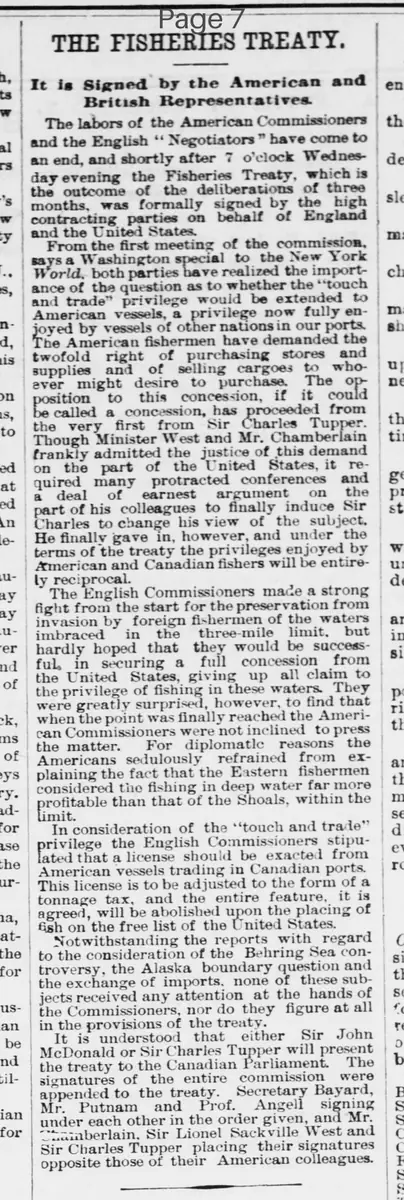
It is Signed by the American and British Representatives.
The labors of the American Commissioners and the English "Negotiators" have come to an end, and shortly after 7 o'clock Wednesday evening the Fisheries Treaty, which is the outcome of the deliberations of three months, was formally signed by the high contracting parties on behalf of England and the United States.
From the first meeting of the commission, says a Washington special to the New York World, both parties have realized the importance of the question as to whether the "touch and trade" privilege would be extended to American vessels, a privilege now fully enjoyed by vessels of other nations in our ports.
The American fishermen have demanded the twofold right of purchasing stores and supplies and of selling cargoes to whoever might desire to purchase. The opposition to this concession, if it could be called a concession, has proceeded from the very first from Sir Charles Tupper. Though Minister West and Mr. Chamberlain frankly admitted the justice of this demand on the part of the United States, it required many protracted conferences and a deal of earnest argument on the part of his colleagues to finally induce Sir Charles to change his view of the subject.
He finally gave in, however, and under the terms of the treaty the privileges enjoyed by American and Canadian fishers will be entirely reciprocal.
The English Commissioners made a strong fight from the start for the preservation from invasion by foreign fishermen of the waters embraced in the three-mile limit, but hardly hoped that they would be successful in securing a full concession from the United States, giving up all claim to the privilege of fishing in these waters. They were greatly surprised, however, to find that when the point was finally reached the American Commissioners were not inclined to press the matter. For diplomatic reasons the Americans sedulously refrained from explaining the fact that the Eastern fishermen considered the fishing in deep water far more profitable than that of the Shoals, within the limit.
In consideration of the "touch and trade" privilege the English Commissioners stipulated that a license should be exacted from American vessels trading in Canadian ports. This license is to be adjusted to the form of a tonnage tax, and the entire feature, it is agreed, will be abolished upon the placing of fish on the free list of the United States.
Notwithstanding the reports with regard to the consideration of the Behring Sea controversy, the Alaska boundary question and the exchange of imports, none of these subjects received any attention at the hands of the Commissioners, nor do they figure at all in the provisions of the treaty.
It is understood that either Sir John McDonald or Sir Charles Tupper will present the treaty to the Canadian Parliament. The signatures of the entire commission were appended to the treaty. Secretary Bayard, Mr. Putnam and Prof. Angell signing under each other in the order given, and Mr. Chamberlain, Sir Lionel Sackville West and Sir Charles Tupper placing their signatures opposite those of their American colleagues.
What sub-type of article is it?
What keywords are associated?
What entities or persons were involved?
Where did it happen?
Foreign News Details
Primary Location
Washington
Event Date
Wednesday Evening
Key Persons
Outcome
treaty signed providing reciprocal touch and trade privileges for american and canadian fishermen; license as tonnage tax for american vessels in canadian ports, to be abolished if fish placed on us free list; no provisions on behring sea, alaska boundary, or exchange of imports
Event Details
The Fisheries Treaty was signed by American Commissioners (Secretary Bayard, Mr. Putnam, Prof. Angell) and English Negotiators (Mr. Chamberlain, Sir Lionel Sackville West, Sir Charles Tupper) after three months of deliberations. Key issues included reciprocal touch and trade privileges, opposition from Sir Charles Tupper overcome through conferences; English secured three-mile limit preservation; Americans did not press for fishing rights within limit due to profitability of deep water fishing. Treaty to be presented to Canadian Parliament by Sir John McDonald or Sir Charles Tupper.