Thank you for visiting SNEWPapers!
Sign up free
Richmond Enquirer
Richmond, Richmond County, Virginia
What is this article about?
Report of US Congress proceedings in Senate and House from February 23-27, 1818, including discussions on fishing vessel captures, pension lists, revolutionary patriots' relief, death of Rep. Peterson Goodwyn, land bills, Georgia provisions, arms manufacturing, Alabama territory, navy appropriations, useful arts, paper duties, unfavorable petition reports, introductions of bills on seamen, lands, invalids, cadets, widows, Beaumarchais claim, bankrupt law debates and rejection, expatriation bill, Irish emigrants' land petition denial.
Merged-components note: These components form a single continuous article on U.S. Congress proceedings, split due to parsing boundaries but sequential in reading order and topic.
Clippings
1 of 2
OCR Quality
Full Text
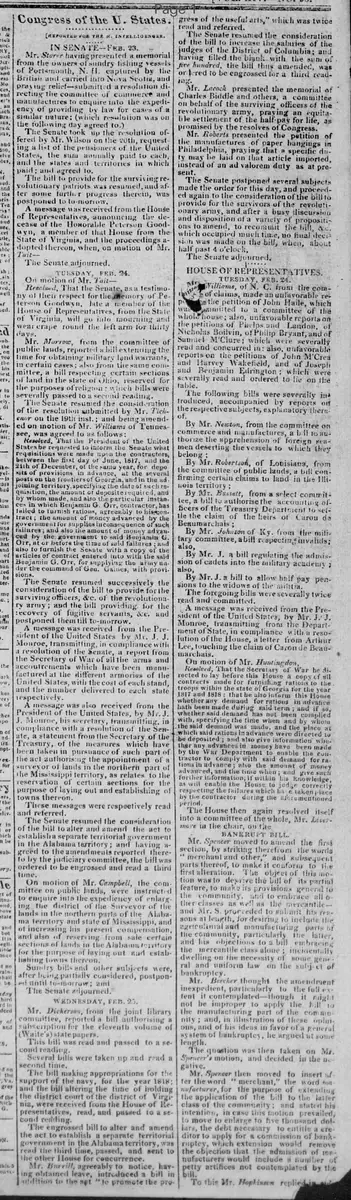
[REPORTED FOR THE N. INTELLIGENCER.]
IN SENATE—FEB. 23.
Mr. Sturzer having presented a memorial from the owners of sundry fishing vessels of Portsmouth, N. H. captured by the British and carried into Nova Scotia, and praying relief—submitted a resolution directing the committee of commerce and manufactures to enquire into the expediency of providing by law for cases of a similar nature; (which resolution was on the following day agreed to.)
The Senate took up the resolution offered by Mr. Wilson on the 20th, requesting a list of the pensioners of the United States, the sum annually paid to each, and the states and territories in which paid: and agreed to.
The bill to provide for the surviving revolutionary patriots was resumed, and after some further progress therein, was postponed to to-morrow.
A message was received from the House of Representatives, announcing the decease of the Honorable Peterson Goodwyn, a member of that House from the State of Virginia, and the proceedings adopted thereon, when, on motion of Mr. Tait—
The Senate adjourned.
TUESDAY, FEB. 24.
On motion of Mr. Tait—
Resolved, That the Senate, as a testimony of their respect for the memory of Peterson Goodwyn, late a member of the House of Representatives, from the State of Virginia, will go into mourning and wear crape round the left arm for thirty days.
Mr. Monroe, from the committee of public lands, reported a bill extending the time for obtaining military land warrants, in certain cases; also from the same committee, a bill respecting certain sections of land in the state of Ohio, reserved for the purposes of religion; which bills were severally passed to a second reading.
The Senate resumed the consideration of the resolution submitted by Mr. Tichenor on the 19th inst.: and being amended on motion of Mr. Williams of Tennessee, was agreed to as follows:
Resolved, That the President of the United States be requested to inform the Senate what requisitions were made upon the contractors, between the first day of June, 1817, and the 25th of December, of the same year, for deposits of provisions in advance, at the several posts on the frontiers of Georgia, and in the adjoining territory, specifying the date of such requisition, the amount of deposit required, and by whom made, and also the particular instances in which Benjamin G. Orr, contractor, has failed to furnish rations, agreeably to his contract; the amount of money advanced by the government for supplies in consequence of such failures; and also the amount of money advanced by the government to said Benjamin G. Orr, at or before the time of said failures; and also to furnish the Senate with a copy of the articles of contract entered into with the said Benjamin G. Orr, for supplying the army under the command of Gen. Gaines, with provisions.
The Senate resumed successively the consideration of the bill to provide for the surviving officers, &c. of the revolutionary army; and the bill providing for the recovery of fugitive servants, &c. and postponed them till to-morrow.
A message was received from the President of the United States by Mr. J. J. Monroe, transmitting, in compliance with a resolution of the Senate, a report from the Secretary of War of all the arms and accoutrements which have been manufactured at the different armories of the United States, with the cost of each stand. and the number delivered to each state respectively.
A message was also received from the President of the United States. by Mr. J. J. Monroe, his secretary, transmitting, in compliance with a resolution of the Senate, a statement from the Secretary of the Treasury, of the measures which have been taken in pursuance of such part of the act authorising the appointment of a surveyor of lands in the northern part of the Mississippi territory. as relates to the reservation of certain sections for the purpose of laying out and establishing of towns thereon.
These messages were respectively read and referred.
The Senate resumed the consideration of the bill to alter and amend the act to establish a separate territorial government in the Alabama territory; and having agreed to the amendments reported there to by the judiciary committee, the bill was ordered to be engrossed and read a third time.
On motion of Mr. Campbell, the committee on public lands. were instructed to enquire into the expediency of enlarging the district of the Surveyor of the lands in the northern parts of the Alabama territory and state of Mississippi, and of increasing his present compensation, and also of reserving from sale certain sections of lands in the Alabama territory for the purpose of laying out and establishing towns thereon.
Sundry bills—and other subjects were, after being partially considered, postponed until to-morrow; and
The Senate adjourned.
WEDNESDAY, FEB. 25.
Mr. Dickerson, from the joint library committee, reported a bill authorising a subscription for the eleventh volume of (Waite's) state papers.
This bill was read and passed to a second reading.
Several bills were taken up and read a second time.
The bill making appropriations for the support of the navy, for the year 1818; and the bill altering the time of holding the district court of the district of Virginia, were received from the House of Representatives, read, and passed to a second reading.
The engrossed bill to alter and amend the act to establish a separate territorial government in the Alabama territory, was read the third time, passed, and sent to the other House for concurrence.
Mr. Burrill, agreeably to notice, having obtained leave, introduced a bill in addition to the act "to promote the progress of the useful arts," which was twice read and referred.
The Senate resumed the consideration of the bill to increase the salaries of the judges of the District of Columbia; and having filled the blank with the sum of five hundred, the bill thus amended, was ordered to be engrossed for a third reading.
Mr. Lacock presented the memorial of Charles Biddle and others, a committee on behalf of the surviving officers of the revolutionary army, praying an equitable settlement of the half-pay for life, as promised by the resolves of Congress.
Mr. Roberts presented the petition of the manufacturers of paper hangings in Philadelphia, praying that a specific duty may be laid on that article imported. instead of an ad valorem duty as at present.
The Senate postponed several subjects made the order for this day, and proceeded again to the consideration of the bill to provide for the survivors of the revolutionary army, and after a busy discussion and disposition of a variety of propositions to amend, to recommit the bill, &c. which occupied much time, no final decision was made on the bill, when, about half past 4 o'clock,
The Senate adjourned.
HOUSE OF REPRESENTATIVES.
TUESDAY, FEB. 24.
Williams, of N. C. from the committee of claims, made an unfavorable report on the petition of John Haile, which was committed to a committee of the whole house; also, unfavorable reports on the petitions of Phelps and Landon, of Nicholas Boilvin, of Philip Bryant, and of Samuel M'Clure; which were severally read and concurred in: also, unfavorable reports on the petitions of John M'Crea and Harvey Wakefield, and of Joseph and Benjamin Edrington; which were severally read and ordered to lie on the table.
The following bills were severally introduced, accompanied by reports on the respective subjects, explanatory thereof.
By Mr. Newton, from the committee on commerce and manufactures, a bill to authorize the apprehension of foreign seamen deserting the vessels to which they belong :
By Mr. Robertson, of Louisiana, from the committee of public lands, a bill confirming certain claims to land in the Illinois territory;
By Mr. Bassett, from a select committee, a bill to authorize the accounting officers of the Treasury Department to settle the claim of the heirs of Caron de Beaumarchais;
By Mr. Johnson of Ky. from the military committee, a bill respecting invalids; also,
By Mr. J. a bill regulating the admission of cadets into the military academy also,
By Mr. J. a bill to allow half pay pensions to the widows of the militia.
The foregoing bills were severally twice read and committed.
A message was received from the President of the United States. by Mr. J. J. Monroe, transmitting from the Department of State, in compliance with a resolution of the House, a letter from Arthur Lee, touching the claim of Caron de Beaumarchais.
On motion of Mr. Huntington,
Resolved, That the Secretary of War be directed to lay before this House a copy of all contracts made for furnishing rations to the troops within the state of Georgia for the year 1817 and 1818 : that he also inform this House whether any demand for rations in advance hath been made during said term ; and if so, whether said demand has not been complied with, specifying the time when and by whom the said demand was made, and the place at which said rations in advance were directed to be deposited; and also give information whether any advances in money have been made by the War Department to enable the Contractor to comply with said demand for rations in advance; also the amount of money advanced, and the time when; and give such further information, if within his knowledge, as will enable the House to judge correctly respecting the failures which have taken place by the contractor during the aforementioned period.
The House then again resolved itself into a committee of the whole, Mr. Livermore in the chair, on the
BANKRUPT BILL.
Mr. Spencer moved to amend the first section, by striking therefrom the words "merchant and other." and subsequent parts thereof, to make it conform to the first alteration. The object of this motion was to deprive the bill of its partial feature, to make its provisions general to the community. and to embrace all other classes as well as the mercantile— and Mr. S. proceeded to submit his reasons at length, for desiring to include the agricultural and manufacturing parts of the community, particularly the latter, and his objections to a bill embracing the mercantile class alone; incidentally dwelling on the necessity of some general and uniform law on the subject of bankruptcy.
Mr. Beecher thought the amendment inexpedient, particularly to the full extent it contemplated—though it might not be improper to apply the bill to the manufacturing part of the community : and, in illustration of these opinions, and of his ideas in favor of a general system of bankruptcy, he argued at some length.
The question was then taken on Mr. Spencer's motion, and decided in the negative.
Mr. Spencer then moved to insert after the word "merchant," the word "manufacturer," for the purpose of extending the application of the bill to the latter class of the community: and stated his intention, in case this motion prevailed, to move to enlarge to five thousand dollars, the debt necessary to entitle a creditor to apply for a commission of bankruptcy, which extension would remove the objection that the admission of manufacturers would include a number of petty artificers not contemplated by the bill.
To this Mr. Hopkinson
Instance, that this extension of the debt, to include manufacturers, would exclude many traders whom it was the object of the bill to relieve.
The question was then taken and the motion negatived, without a division.
Mr. Clay rose and observed that he had on Friday last voted against striking out the first section of the bill, and if he now supposed that by one or two weeks' discussion the House could agree on a bill useful to the country, he should be willing to proceed, and devote that time to the measure. But, after the experience of Friday last, Mr. C. confessed that he feared all the labor which could be bestowed on the bill would be thrown away, particularly since the decisions which had just taken place on the modifications proposed by Mr. Spencer. This opinion he offered as an apology for the motion he rose to make, which was to re-consider the vote on striking out the first section, that the sense of the committee might be ascertained on the principle of the bill, after it had decided to retain the feature just moved to be expunged.
The motion to re-consider the vote of Friday was agreed to—ayes 69, noes 58; when Mr. Clay, for the reasons before stated, renewed the motion to strike out the first section of the bill.
This motion was decided, without debate, in the negative—ayes 63, noes 66—by a second count, the ayes were 68, noes 71.
Mr. Williams, of North Carolina, believing, notwithstanding the vote just taken on the first section, that there would ultimately be a majority of the House against the bill, and for the purpose of ascertaining by the yeas and nays the true sense of the House at once; he moved that the committee rise, that it might be refused leave to sit again, and the question then decided in the House.
Mr. Mercer opposed this motion: and took occasion to express his disapprobation of the course pursued on this subject, in aiming to destroy the bill in the outset, by moving to strike out the first section. It was always allowed by parliamentary justice and parliamentary courtesy to the friends of a measure to bring it as perfect as they could, before the sense of the House should be taken on the principle of the proposition. On this occasion he had believed that there was a majority of the House against the bill, and he was therefore surprised to learn the result of the vote on Friday on striking out the first section. For his own part, he was not ashamed to confess that his opinion had been changed on this subject by the able and conclusive arguments which had been urged by his friend (Mr. Hopkinson) in its favor. The friends of the bill ought not to despair, therefore, and he hoped they would be permitted to proceed in maturing the measure.
Mr. Clay remarked, that his object in the course which he had taken was the economy of the time of the House. It was true that all the indications disclosed of the sense of the House were in favor of the bill, but if any course could be adopted to save materially the time of the House, it was fair to try it on this measure; because if it were taken up regularly, and the whole 61 sections discussed, which would consume one or two weeks, it was very probable that the bill would be lost by the variance of opinion on some of its important details. Mr. C. enumerated some of the provisions on which probably an invincible difference of opinion would exist; and particularized the feature which requires the consent of two-thirds of the creditors, which he thought incompatible with the only principle that justified the passage of a bankrupt law at all, which was to relieve a man from his creditors, on his surrendering all his property, and restoring him to society. This, and other provisions would, he was confident, consume much time, which, after all, he expected, would be to no purpose; and for this reason he had endeavored at once to anticipate the final decision.
Mr. Hopkinson said, the bill had stood the shock of the vote to strike out the first section, and the committee had decided to go on, and see if they could not agree on some system for this important object. He was as unwilling as any one to consume uselessly the time of the House, but he was opposed to a premature rejection of the measure, particularly after the repeated refusal of the committee of the whole to strike out the first section. As to the provisions which had been referred to, it would be time enough when those features were acted on, to see whether the committee could agree on them to any practicable purpose, and then act accordingly. He suggested, therefore, the propriety, if it could be done, of first bringing up the provisions alluded to, that the sense of the committee might be obtained, and see whether it would be worth while to proceed with the other details.
Mr. Williams having previously withdrawn his motion for that purpose; Mr. Tucker, of Va. in accordance with the suggestion of Mr. Hopkinson, moved that the committee, by general consent, agree to take up first for consideration the 36th section of the bill, (which provides for the permanent discharge of a bankrupt from all debts contracted previously to his bankruptcy, having surrendered all his property to his creditors, &c.)
Mr. Barbour having intended when this feature of the bill should come up for discussion, to offer some remarks on it, but not willing to trouble the committee at so late an hour of the day, hoped (if it was the intention of the friends of the bill to argue this provision at all) that the committee would now rise.
The committee, on motion of Mr. Terry, then rose, reported progress, and after some opposition thereto, obtained leave to sit again.
Mr. Edwards, then, for the purpose of trying conclusively the sense of the House on this subject, moved that the committee of the whole be discharged from the further consideration of the bill, and that it be indefinitely postponed.
Before this question was put, a motion to adjourn prevailed, and The House adjourned.
WEDNESDAY, FEB. 25.
Mr. Little laid before the House certain resolutions of the Legislature of Maryland, requesting the attention of Congress to the defenceless state of the Chesapeake Bay, the expediency of a naval depot on its waters, &c. which were read and ordered to lie on the table.
Mr. Nelson, from the committee on the Judiciary, reported a bill more effectually to provide for the punishment of certain crimes against the United States, and for other purposes.
Mr. Lowndes, from the committee of ways and means, reported a bill supplementary to the act of 1809, to regulate the collection of the duties on imports and tonnage: and also from the same committee a bill for the relief of Benjamin Pool.
Mr. Robertson, from the committee on the Public Lands, made a report, accompanied by a bill, for the relief of the inhabitants of Prairie du Chien: and from the same committee a report, accompanied by a bill, for the relief of Wm. Barton.
These bills were severally twice read and committed.
Mr. Williams, of North-Carolina, from the committee of claims, made unfavorable reports on the petitions of John Chalmers and of Lawrence Muse and William Gordon, which were read, and the first ordered to lie on the table, and the second committed to a committee of the whole House.
After referring to the inconvenience often experienced by committees of the House, particularly that of elections, from a want of the statutes of the respective states, Mr. Taylor, of New York, moved the following resolution, which was agreed to:
Resolved, That the Clerk of the House procure a copy of the last edition of the statutes of the several states, to be kept in his office for the use of the members.
The bill from the Senate to alter and amend the act establishing a separate territorial government in the territory of Alabama, was twice read and referred.
The Speaker laid before the House a letter from the Comptroller of the Treasury, transmitting the annual list rendered to him by the Register of the Treasury, of balances on his books due more than 3 years, and remaining unsettled on the 30th Sept. last.
The Speaker also laid before the House a letter from the Secretary of War, transmitting a report of the commissioner of claims, in answer to the resolution of the House of the 13th inst.
The House then again proceeded to the consideration of the BANKRUPT BILL.
The question being on Mr. Edwards' motion to discharge the committee of the whole House from the further consideration of the bill and to postpone it indefinitely—
Mr. Whitman, of Mass. delivered a speech of about an hour in length against the motion, and in favor of the system.
Mr. Barbour next took the floor, in favor of the postponement, and decidedly against the bill.
Mr. Livermore, Mr. Baldwin and Mr. Beecher then spoke in opposition to the motion to postpone the further consideration of the bill.
The House having refused to agree to a motion for adjournment,
The question on the motion to postpone the bill indefinitely, was taken by yeas and nays, as follows:
YEAS—Messrs. Abbott, Anderson, Ky. Austin, Ball, Barbour, Va. Bassett, Bateman, Bellinger, Bennett, Blount, Boden, Bryan, Burwell, Butler, Campbell, Clagett, Claiborne, Cobb, Comstock, Cook, Crafts, Crawford, De. sha, Earle, Edwards, Floyd, Forney, Garnett, Hale, Hall, N.C. Hendricks, Herrick, Holmes, Mass. Johnson, Va. Johnson, Ky. Jones, Kin. sev, W. Maclay, W. P. Maclay, M'Coy, Marr. Merrill, Morton, Mumford, Murray, H. Nel son, Nesbitt, Newton, Owen, Patterson, Pin dall, Pleasants, Quarles, Rhea, Richards, Ring gold, Robertson, Lou. Sampson, Savage, Scud. der, Settle, Shaw, Sinkins, Slocumb, Bal. Smith, Alex. Smyth, J. S. Smith, Spencer, Stewart, N. C. Strother, Tarr, Terrill, Trimble, Tncker, Va. Tucker, S. C. Tyler, Upham, Walker, Ky. Wallace, Williams, N.Y. Williams, N.C. Wilson, Pen.—82.
NAYS—Messrs. Adams, Allen, Mass. Allen, Vt. Anderson, Pen. Baldwin, Bayley, Beecher, Boss, Calston, Cruger, Cushman, Darlington, Ellicott, Ervin, S. C. Folger, Forsyth, Fuller. Hall, Del. Harrison, Hasbrouck, Herbert, Hler kimer, Heister, Hitchcock, Holmes, Con. Hopkinson, Hubbard, Huntington, Kentland, Lawyer, Little, Livermore, Lowndes, M'Lane, Ma son, Mass. Mason, R. I. Mercer, Middleton, Mills, Moore, Moseley, Jer. Nelson, Ogden, Ogle, Orr, Palmer, Parrott, Peter, Poindexter, Porter, Reed, Rich, Robertson, Ky. Rug gles, Sawyer, Schuyler, Sergeant, Seybert, Sherwood, Tallmadge, Taylor, Terry, Tompkins, Wendover, Westerlo, Whiteside, Whitman, Williams, Conn. Wilkin, Wilson, Mass. —70.
So the House determined that the bill be indefinitely postponed; that is, rejected.
The following report was made by Mr. Robertson, of Lou. from the committee of Public Lands, and was ordered to lie on the table:
The committee on Public Lands, to whom was referred the petition of the Irish emigrant associations of New York, Philadelphia, Baltimore and Pittsburgh, have had the same under consideration, and report: That the petitioners ask that a portion of the public land lying in the Illinois territory, may be set apart for the purpose of being settled by emigrants from Ireland, to whom it is requested the lands may be sold on an extended credit. For the reasons urged in favor of this application, the committee refer the House to the petitions themselves.
The following specific propositions were also submitted to the consideration of the committee by the agents of the petitioners, viz.
1. That the Secretary of the Treasury should be authorized to designate and set apart two townships, each of six miles square, in the Illinois territory, east of the military bounty lands, each alternate section thereof to be settled by emigrants from Ireland, and sold to them at two dollars per acre, on a credit of four years for one-third, eight years for one-third, and twelve years for the last instalment, with interest upon the several sums.
2. That the Secretary of the Treasury should be at liberty to reject applications, unless the applicant emigrants should be satisfactorily recommended to some of the Irish Emigrant Associations, as moral and industrious men.
3. That no contract should be made with any emigrant, unless he would engage to improve at least twenty, of each one hundred acres, and erect a tenement suitable for his abode.
4. That no contract should be binding upon the United States, nor title vest in any emigrant settler, unless he had made the improvement and settlement abovementioned, and fully paid for the land contracted for.
5. That no contract should be made, or patent issued, to any settler or his heirs, for more than six hundred and forty acres.
6. That in every instance in which the conditions of improvement, settlement, and payment should not be complied with at the expiration of the term of twelve years, the Secretary of the Treasury should cause the lands so forfeited to be sold, for the benefit of the United States: provided, that in every case in which payment in part had been made, the sum or sums paid should be refunded to the emigrant settler or his heirs.
The committee refer to their reports on several analogous cases, some of which have been sanctioned by the House, and others which still lie on the table, for the reasons that induce them to recommend the following resolution:
Resolved, That the prayer of the petitioners ought not to be granted.
THURSDAY, FEB. 26.
Mr. Williams, of North Carolina, from the committee of claims, made an unfavorable report on the petition of Ebenezer Knox; which was read and agreed to.
On motion of Mr. Johnson, of Va. it was Resolved, That the Secretary of the Navy be directed to report to this House the Proceedings of the Court Martial ordered by Commodore Isaac Chauncey, at the instance of Acting Captain Marston, for the trial of John Orde Creighton, and that he be also directed to lay before this House the Memorial of the Midshipmen and other officers in the Mediterranean squadron, forwarded to that Department, and emanating from the proceedings to the Court Martial held for the trial of the said Captain John Orde Creighton.
It was also ordered that the letter from the Secretary of the Navy, transmitting copies of the proceedings of the courts martial for the trials of Capt. Perry and Capt. Heath, be referred to the committee on naval affairs.
On motion of Mr. Southard, of N. J. the proper committee were instructed to enquire into the expediency of establishing a post route from Mason Hall, in Orange county, in North Carolina, to Cannon's Mill, the Shallow-ford on Haw River, to Martinsville, in the county of Guilford.
At the instance of Mr. Anderson, of Ky. the House proceeded to the consideration of the report of the committee of pensions on the petition of Henry King, for the payment of monies due to him for revolutionary services. [In this case, a committee of a former Congress had unanimously reported very favorably on the justice of the claim, but that it was barred by the statute of limitation; since which report, the evidence on which that claim was founded, and which was then exhibited to Congress, has been destroyed by fire in the war office.] The report is unfavorable on the ground of a defect of evidence.
Mr. Anderson moved to amend the report, so as to reverse it, with a view to the introduction of a bill authorizing the adjustment of the claim of Mr. King at the Treasury on equitable principles, and spoke in support of the motion.
Mr. Reed stated his recollection of services rendered by the applicant in the Quarter Master's Department.
Mr. Rhea, supported the report of the committee on the ground of a deficiency of evidence; and moved to refer the report to a committee of the whole, and to have the documents read by Mr. Anderson printed.
Hereon further desultory debate took place, in which Messrs. Anderson, Edwards, Johnson, Strother, W. P. Maclay, Comstock, Southard, Rhea, Ogle and Hubbard took part. The debate resulted in an agreement to Mr. Rhea's motion.
EXPATRIATION.
The House then resolved itself into a committee of the whole, Mr. Pitkin in the chair, on the bill to provide the manner in which the right of expatriation shall be exercised.
Mr. Robertson addressed the House, expressed at length his views of the subject, and the considerations which had induced the committee to report the bill.
Mr. Anderson spoke in opposition to the bill on various grounds, and in reply to a part of Mr. Robertson's remarks.
Mr. Johnson, of Ky. followed in the debate, in support of the bill.
Mr. Pindall then took the floor, and delivered a speech of considerable length against the bill.
Mr. Lowndes spoke briefly on the same side of the question.
Mr. Robertson replied.
Mr. Clay spoke on an incidental question, and Mr. Lowndes replied; to whom Mr. Clay rejoined.
When, on the suggestion of Mr. Cobb that other gentlemen wished to deliver their sentiments on the subject, the committee rose, reported progress, and obtained leave to sit again.
The debate of this day, too interesting for abbreviation, too extended for our present limits, shall be published hereafter. It is proper now to state that the right of expatriation was equally acknowledged by those who supported and by those who opposed the bill: the grounds of opposition to the bill being, first, the defect of power in Congress to legislate on the subject, and, secondly, the inexpediency, if not danger, of legislating on it at all.
The House adjourned, at half past four o'clock.
FRIDAY, FEB. 27.
Irish Emigrant's petition.
The House having, on motion of Mr. Taylor of New York, proceeded to the consideration of the report of the committee of the whole adverse to the petition of the New York Irish Emigrant Society, praying to be allowed to purchase a body of public land in Illinois territory, on an extended credit, on condition of actual settlement, and paying interest on the purchase money.
Mr. Taylor moved to amend the report by striking out the word "not," so as to reverse the report.
On this motion there arose a debate, which continued for four hours, and is reserved for future publication: in which Messrs. Taylor, Johnson of Ky. Baldwin, Forsyth, Desha, Comstock, Livermore, Tallmadge and Spencer supported the petition, & Messrs. Robertson of Lou. J. S. Smith, Poindexter, Williams of N. C. Cobb and Mercer opposed it.
The question on this motion was finally taken, by yeas and nays, after a full discussion, and decided as follows:
For the amendment 71
Against it 83
So the amendment was negatived; and the House resolved, according to the report of the committee, that the prayer of the petition is inexpedient, and ought not to be granted.
The bill from the Senate concerning the sale of certain lands in the Districts of Marietta and Vincennes, was read a third time, and finally passed.
The amendments of the Senate to the bill concerning the surviving officers and soldiers of the Revolutionary army, were received, and referred to the committee on that subject appointed early in the session.
And the House then adjourned.
IN SENATE—FEB. 26.
Mr. Thomas B. Robertson, of Louisiana, appointed by the Legislature of that state, to supply the vacancy occasioned in the Senate by the death of W. C. C. Claiborne, appeared, was qualified, and took his seat.
The report of the committee on naval affairs on the memorial of certain officers of the navy and of the marine corps, attached to the Mediterranean squadron, was further postponed, on motion of Mr. Barbour, to next Monday week.
The Senate took up and concurred in the report of the committee on pensions, unfavorable to the petition of Elijah Rice.
The bill to increase the compensation of the judges of the circuit court of the District of Columbia, was read the third time, passed, and sent to the House of Representatives for concurrence.
The Senate resumed the consideration of the bill to provide for the surviving officers and soldiers of the revolutionary army.
A number of propositions were again successively made to amend the bill in its details, which were variously disposed of; after which the bill was at length ordered to be engrossed and read a third time, by the following vote:
YEAS—Messrs. Burrill, Crittenden, Daggett, Eppes, Fromentin, Gaillard, Goldsborough, Horsey, Hunter, Johnson, King, Leake, Morris, Otis, Ruggles, Stokes, Storer, Tait, Talbot, Tichenor, Van Dyke, Williams, of Miss. Williams, of Ten.—23.
NAYS—Messrs. Barbour, Dickerson, Lacock, Macon, Morrow, Roberts, Smith, Tay. lor—8.
The Senate then adjourned.
FRIDAY, FEB. 27.
Mr. Barbour, from the committee to whom it was referred, reported the bill in addition to the "act for the promotion of the useful arts," with sundry amendments.
The bill to provide for the surviving officers and soldiers of the revolutionary army was read the third time, passed, and sent to the House of Representatives for concurrence in the amendments.
Several subjects were taken up, and after being in part considered, were postponed to a future day.
The Senate then resumed the consideration of the bill in addition to the act to "provide for the delivery of persons held to labor or service in any of the states or territories, who shall escape into any other state or territory."
The amendments reported to the bill by the committee on the judiciary, were successively agreed to; the only material one of which requires one or more credible witnesses (including the claimant) to make oath to the identity of the fugitive, before the magistrate hearing the case shall deliver into the custody of the claimant the fugitive claimed.
The discussion of other provisions of the bill occupied until 4 o'clock: when the bill was postponed to Wednesday; and The Senate adjourned to Monday.
Our Reporter misunderstood Mr. Clay to have made a motion on Tuesday to strike out the first section of the Bankrupt Bill. That question recurred of course on the re-consideration of the first vote, and Mr. Clay voted on the second as he had on the first trial of the question, against striking out the first section.
Nat. Int.
What sub-type of article is it?
What keywords are associated?
What entities or persons were involved?
Where did it happen?
Domestic News Details
Primary Location
Washington
Event Date
February 23 27, 1818
Key Persons
Outcome
various bills introduced, debated, passed, postponed, or rejected; bankrupt bill indefinitely postponed (82-70); irish emigrants' petition denied (71-83); revolutionary army bill passed senate; alabama territory bill passed; mourning resolution for peterson goodwyn; unfavorable reports on multiple petitions.
Event Details
Detailed account of legislative activities in the US Senate and House of Representatives over five days, including memorials, resolutions, bill introductions, debates, votes, and presidential messages on topics such as captured fishing vessels, pensions, revolutionary patriots' relief, land warrants, Georgia provisions, arms manufacturing, territorial governments, navy appropriations, useful arts promotion, fugitive servants, claims committees, foreign seamen, invalids, cadets, widows' pensions, Beaumarchais claim, bankruptcy law, expatriation rights, and Irish emigration land requests.