Thank you for visiting SNEWPapers!
Sign up free
The Rhode Island American, And General Advertiser
Providence, Providence County, Rhode Island
What is this article about?
Part VII of a series in the Columbian Centinel critiques President Madison's dismissal of British envoy Mr. Jackson as unjustified, arguing it risks war with Britain, forces recall of US minister Pinkney, or submission to unredressed grievances, contrasting it unfavorably with Washington's handling of Genet.
Merged-components note: Continuation of the opinionated article 'THE DIPLOMATICK POLICY OF Mr. MADISON UNVEILED NO. VII' across pages 1 and 2; relabeled from 'story' to 'editorial' to reflect its partisan and analytical tone.
Clippings
1 of 2
OCR Quality
Full Text
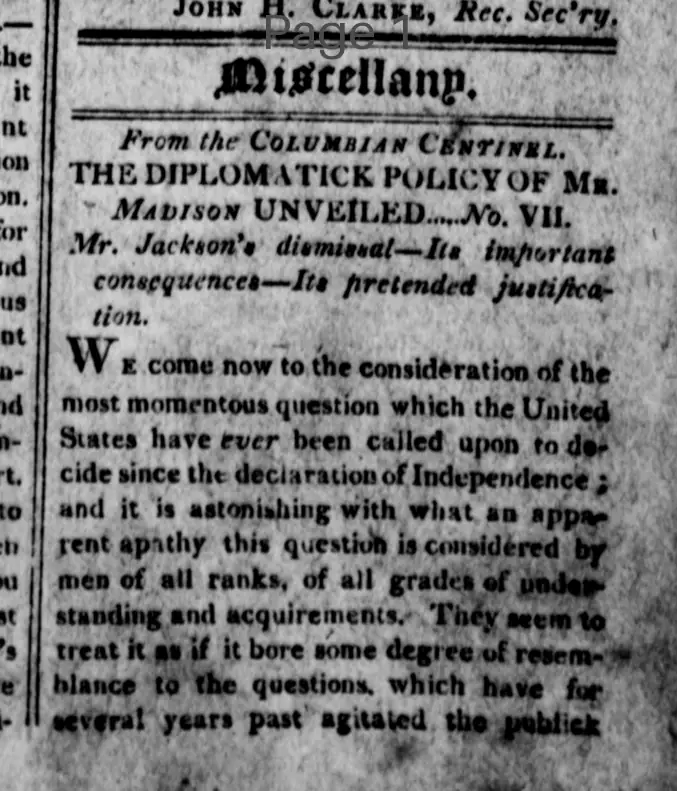
From the Columbian Centinel.
THE DIPLOMATICK POLICY OF Mr.
MADISON UNVEILED...NO. VII.
Mr. Jackson's dismissal-Its important
consequences-Its pretended justifica-
tion.
We come now to the consideration of the
most momentous question which the United
States have ever been called upon to de-
cide since the declaration of Independence;
and it is astonishing with what an appa-
rent apathy this question is considered by
men of all ranks, of all grades of under-
standing and acquirements. They seem to
treat it as if it bore some degree of resem-
blance to the questions which have for
several years past agitated the publick; and if it was certain that, like
then, it would end in noisy and vapid declamation. It is, however, no less a question
than that of a ruinous war, or a disgraceful peace. The position in which the
late dismissal of Mr. Jackson has placed
the United States, is one from which they
can never extricate themselves with honour
and they may esteem themselves the
favourites of Heaven if they escape from
it without serious calamity. Our fate no
longer depends on the wavering, noisy and
vapouring councils of boisterous demagogues, but upon the policy and prudence
of another nation, upon whose good-will
we can no longer calculate. Let us explain ourselves.
The right to dismiss a foreign minister
for indecorous, or offensive conduct, (however it may have been questioned, and indeed denied, as we shall shew, by Mr.
Madison's party) can never be doubted by
any man acquainted with public law, nor
will be contested by any person who is alive
to the true interests and honour of his
country. If the offence is palpable and unquestionable a nation which regards its
character one
which wishes to preserve
peace likely to recall its Minister
on account
of such an offence.
The harmony of the two nations is not in
such a case in any degree affected.
But if the case be a questionable one,
and especially if the time, conduct and
circumstances, be such as to render it
obvious that it was either intended as an
affront, or as an excuse for the rupture of
negotiation, it becomes impossible for the
injured nation to recall its Minister, to dis-
grace him in the eyes of the world, and to
renew the interrupted intercourse.
If such a dismissal be, moreover, accompanied with circumstances of insult and
aggravation, war may be expected to follow and Mr. Giles, in this case with a
spirit truly prophetic, has predicted that
such will probably be the result. Whether
that gentleman should have presumed it, if
Mr. Jackson has been rightfully dismissed
for his own personal misconduct, we leave
to the public to decide. Should, however,
Great-Britain not deem it for her interest.
in this instance, to declare war, let us con-
sider what will be our own predicament?
We pretend that we have sustained great
and unexampled wrongs. Great-Britain
will not send us another Minister if, (as it
will appear,) Mr. Jackson has been guilty
of no breach of indecorum. We shall be
compelled, from the invariable usage of nations, and respect to our national character. to recall Mr. Pinkney. What then will
become of our long continued complaints;
of those deep and premeditated injuries
with which our present administration has
so frequently filled the public ear, and
with which they have so often and so successfully inflamed the public passions?
Are we to submit to them, without redress? or, if we are, shall we forego, for-
ever, the advantages arising from a free
commerce not only to Great-Britain, but to
all the countries to which she now interdicts our entry. War then on our side
seems to be our only choice, unless we shall
prefer to submit. Great-Britain never can
send another minister to this country: and
surely our government never will make
another advance to her. It would be a
concession that we were in the wrong to
which so lofty a pride as that which dictated the dismissal of Mr. Jackson, for
merely an intimation not perceptible to ordinary understandings, could never submit.
Such then are the serious consequences
of this measure--consequences far more
important than any which have yet followed, from any measure adopted by any
administration in our country. Either war
upon us by Great-Britain, war by us against
her, or a submission to all her alleged
wrongs, and a total suspension of intercourse with her, until either she or ourselves shall so far forget our pride and
honour as to court a renewal of intercourse.
Now, serious and alarming as this position is, no honourable man, no man who regards the rights and dignity of his country, will regret the consequences, if the
measure was called for by our honour--if
not, let the censure fall upon those persons
who rashly advised so hasty and momentous a step. The administration have defended this measure by the example of
General Washington in the case of Genet;
the allusion is an unfortunate one, on every
account. I had intended to cite this case
against them, and I could not have dreamed that Mr. Madison or his friends would
have had the imprudence to induce us to
take a retrospective view of that disgraceful scene. That these men, who now affect
to be so alive to the national honour, who
are so ready to take offence at a look, a
word, an insinuation, shall remind us of a
period in which not only the honour of the
country was trampled under foot, but in
which the foreign agents who insulted us
were honoured, feasted and set up in hostile array by our own citizens against their
own government, is among the marvellous
events of even times on which we have fallen. Genet was not dismissed, his recall
only was requested, and his personal and
political friends, Thomas Jefferson and
James Madison, knew it full well; Genet
was not requested to be recalled merely for
any insulting language towards our own
government: It was for a long continued
series of overt acts, for which he might
have been tried and punished, that Mr.
Genet was suspended: It was for assuming the functions of his office before he was
accredited; for promoting military expeditions in our territory; for resisting the
executions of the laws; for openly defying the executive authority, to which was
only superadded personal insults, which
were repeated for several months before
the prudence and patience of General
Washington were exhausted. Mr. Jefferson and Mr. Madison can tell, why the
President was so forbearing. They can
tell us how large, how powerful was the
combination of their friends, against our
government, and in favour of Genet.
Let us now proceed to examine the concealed insult, which is said to lurk somewhere in Mr. Jackson's correspondence.
There were several interesting circumstances attending the disclosure of this pretended insult, which led many judicious
men to suspect, that the transaction would
not bear the closest examination. The
people at large are not capable of expending the time and devoting the attention necessary to the perusal and comparison of a
long correspondence expressed in the studied language of diplomatic men. It was
known to the administration, that if an unequivocal declaration should be made to
the public, that Mr. Jackson had insulted
our government, this would reach every
head, and inflame every heart in the
United States, while the slow and laborious
vindication and disproof of such a charge,
received with distrust, into minds already
prejudiced, would make but a feeble progress. The act of publishing the statement of Mr. Jackson's insult in the National
Intelligencer was the act of the government: That statement proves to be a copy of the official note addressed to Mr.
Jackson. The government then, ten days
only before the meeting of Congress, published an account of the dismissal and of its
pretended causes and called upon the people
to resent this conduct before any evidence
of it was laid before them. The National
Intelligencer endeavoured to excite the
highest degree of irritation, and succeeded
in it. Finding that the public mind would
become too much excited, they changed
their tone, and begged the people to restrain their rage, and not to violate the immunities of Mr. Jackson's office by an outrage on his person. If the formal notice of
the insult was the act of the government,
so also was this; and yet this very administration make it a subject of complaint
against Mr. Jackson that he demanded a
safe-conduct against the populace whom
the patrons of the National Intelligencer
endeavoured to appease, and whose fury
they appeared to dread. A second circumstance, which tended to excite a suspicion
of unfairness, was the attempt to divert
the public attention from the alleged insult which was the avowed cause of the
rupture of the negotiation, to the propositions pretended to have been made by Mr.
Jackson. This was a subject more complex, more difficult for the people to comprehend. But the resort to it was a subter-
fuge which we shall endeavour to remove.
A third circumstance, which has a very
suspicious appearance, is the change in the
terms of the charge brought against Mr.
Jackson. We were at first told, that he
had given the lie direct. When the National Intelligencer led us to suppose that
he had charged the government with the
knowledge of Mr. Erskine's instructions,
of which they had declared they had no
knowledge; we supposed the contradiction
was upon some plain, specific, and important fact; but as soon as Mr. Jackson's
explanation appeared, it was thought necessary to write a letter to Mr. Pinkney.
and to explain the charge. A very different view is given of the affair in this letter
from the first statement in the Intelligencer.
This leads us to a belief that if Mr. Jackson's circular had not reached the press,
we should never have seen Mr. Smith's
very extraordinary letter to Mr. Pinkney.
Under circumstances so inauspicious to
truth, did this transaction appear before
the public. Let us now proceed to shew,
from the documents, that there is not even
a shadow for the charge as it stands corrected, and dwindled down to pigmy size
in the letter to Mr. Pinkney. The charge
as it is now corrected and explained, may
be found in the following extract from Mr.
Smith's letter to Mr. Pinkney, of November 23d, 1809:-
"It was never objected to him that he
had stated it as a fact that the three propositions in question had been submitted to
me by Mr. Erskine, nor that he had stated
it, as made known to him by the instructions of Mr. Canning, that the instructions
to Mr. Erskine containing those three conditions was the only one from which his authority was derived to conclude an arrangement on the matter to which it related.
The objection was that a knowledge of this
restriction of Mr. Erskine was imputed to
his government, and the repetition of the
imputation after it had been peremptorily
disclaimed."
The amount of this paragraph and
charge is simply this, that Mr. Jackson
either by direct assertion, implication, inference or insinuation, did either say or
suggest, "that our government knew that
Mr. Erskine had no other instructions than those which Erskine made known to them." and that he repeated this insinuation after our government disclaimed
such knowledge. Had Mr. Jackson so have
conducted he would have been not only
insolent but extremely weak. For it would
have been ridiculous in him to impute to our government the knowledge of such a negative, which it was almost impossible they
could have known, besides that such a.
imputation would have been contradictory
to other parts of his own letters. In his
letter of the 11th of October, he tells Mr.
Smith, "that although when he left England it was believed that Mr. Erskine had
shown his instructions in extenso--yet it
now appeared he did not." This was a
candid admission of Mr. Smith's declaration on this subject: and in the same letter he adds that the letter of the 23d January, from Mr. Canning to Mr. Erskine,
was the only despatch by which the conditions of an arrangement were prescribed;"
—and he adds no insinuation or inference
that our government knew, this to be the
fact. On the contrary, the declaration to
Mr. Smith, in so solemn and formal a manner, implied, unavoidably implied, that our government did not know that fact before
If, then, it would have been absurd and
contradictory in Mr. Jackson to have insinuated such a knowledge of the restriction of Mr. Erskine, let us see whether in
point of fact, he was guilty of this folly.
The first instance in which any mention is
made of the instructions of Mr. Erskine is
in Mr. Jackson's first letter, of October 11th.
After stating, that it was believed that Mr.
Erskine had communicated his powers in
extenso, when Mr. Jackson left England,
and admitting the fact unconditionally and
frankly "that he had not," he proceeds to
state, that by Mr. Erskine's letters it appeared that the three conditions which
formed the basis of his instructions had
been made known to our Cabinet, and that
all the arguments and observations upon
those conditions by our Minister had been
stated by Mr. Erskine to his own government, from all which he infers, that the
substitution of other articles instead of
those proposed by Great-Britain was a
proof that the conditions were known to
us. He only adds to this simple and intelligible idea, one remark, "that our government must now perceive how widely
the agreement differs from the conditions
prescribed, and of course how just were the
claims of Great-Britain to refuse her assent to it." Is there in all this the remotest
intimation, inference or insinuation that
our Cabinet knew, or might have known,
or might have inferred that these were Mr.
Erskine's only instructions?--We confess
we cannot perceive any such insinuation.
On the subject of instructions Mr. Jackson
adds, that the despatch of the 23d January
was the only one by which the terms were
prescribed. This clause is simple, unaccompanied with any inference or insinuation whatever; and we assert, confidently, that no other passage can be found
in this first letter relative to this subject.
In Mr. Smith's reply to this letter we ought
to expect to find not only a reproof or notice of any offensive terms, had there been
any, but a particular designation of the
part which was deemed offensive. Mr.
Smith does express his surprise, that Mr.
Jackson should lay so much stress on the
want of complaint on the part of our Cabinet, and on the substitution of other terms
instead of those which Mr. Erskine was
authorized to propose;--but he does not
intimate that Mr. Jackson had drawn from
those circumstances a conclusion that our
government had a knowledge of the restricted powers of Mr. Erskine. Now,
as Mr. Jackson had not in fact, as we have
shown, drawn any such conclusion, and as
Mr. Smith did not tell him that he supposed he had, how could that Minister divine it or give any explanation of it? Mr. Smith
adds, "that if the government had known
that the conditions presented by Mr. Erskine were the only ones on which he was
authorized to make the arrangement, it
never would have been made." This was
the moment for him to have told Mr.
Jackson that he understood him to insinuate in his first letter, that our government
had such knowledge. This was omitted.
Why? Because Mr. Jackson had made no
such insinuation. But if he had made it,
it would have been no offence until our
government denied it, which they never
did, till this clause was inserted in Mr.
Smith's letter of October 19th. The offence, if any, must be found, therefore, in
the subsequent correspondence. The next
letter from Mr. Jackson in reply to this denial now first made by our government of
their knowledge of the restricted nature of
Mr. Erskine's powers, is dated October
23d: In this letter he most delicately abstains from any insinuation of the knowledge of our government of Mr. Erskine's
restrictions: The only sentences in relation to this subject are the following, and
are in strict and exact conformity to the
facts admitted by our cabinet:-
"These instructions (Mr. Erskine's) I
now understand by your letter as well as
the deductions which I took the liberty of
making in mine, of the 11th instant, were
at the time in substance made known to
you."
"You are already acquainted with that
which was given (alluding to the communication of Mr. Canning's letter to Mr. Erskine which was shown to Mr. Pinkney
and I have had the honour of informing
you that it was the only one by which the
conditions were prescribed."
These are the only sentences which affect this question in this letter. It is impossible to conceive of language more
clear it is difficult to form an idea of expressions more respectful or less offensive.
Yet the next we hear from Mr. Smith on
this subject, is in the highest possible tone
of haughtiness and affront: He assures Mr.
Jackson, without any qualification, that his
language is improper and irrelevant, and
that Mr. Jackson had insinuated, which
we have proved he had not that our government knew that Mr. Erskine's instructions did not authorize him to conclude the
arrangement, and that he must not repeat
the insinuation which he had never made.
Mr. Jackson had insinuated only what our
government admitted; that they knew the
substance of Mr. Erskine's powers, and
the only inference he made was that his
Majesty was not held by an agreement
which so essentially departed from them.
The language of Mr. Jackson heretofore
was not considered good cause for dismissing him: But we are told that in his last
letter he persisted in the same insinuations
with aggravating circumstances. In that
letter we affirm that not one line can be
found alluding to the contested point:-
There is a moderation accompanied with
firmness which Mr. Smith would do well to
imitate. The only passage which can be
pretended to refer to the dispute is the last
paragraph, where Mr. Jackson regrets
that he should be charged in unqualified
terms with irrelevant and improper arguments, and adds, "that he should not
think of uttering an insinuation where he
was unable to substantiate a fact." Now
it is said, and said with justice, that if Mr.
Jackson had made an improper insinuation
before, this was in effect an adherence to
it, and an offensive one. This we admit;
but as he had made no insinuation, as we
have proved, but of facts admitted by our
Cabinet, and especially as he had not made
the insinuation nor charged upon him, it
was not a breach of delicacy to assert that
he had made no insinuations unsupported
by facts.
[TO BE CONTINUED.]
What sub-type of article is it?
What keywords are associated?
What entities or persons were involved?
Editorial Details
Primary Topic
Critique Of The Dismissal Of British Minister Mr. Jackson And Its Diplomatic Consequences
Stance / Tone
Strongly Critical Of Madison's Administration, Warning Of Potential War Or National Dishonor
Key Figures
Key Arguments