Thank you for visiting SNEWPapers!
Sign up free
The Madison Daily Leader
Madison, Lake County, South Dakota
What is this article about?
Nine columns of the great hypostyle hall in the ancient temple of El Karnak, Egypt, built by Seti I and Rameses II, have recently collapsed. The hall, a notable monument of Thebes, measures 170 by 329 feet and was originally supported by 184 columns.
Clipping
OCR Quality
Full Text
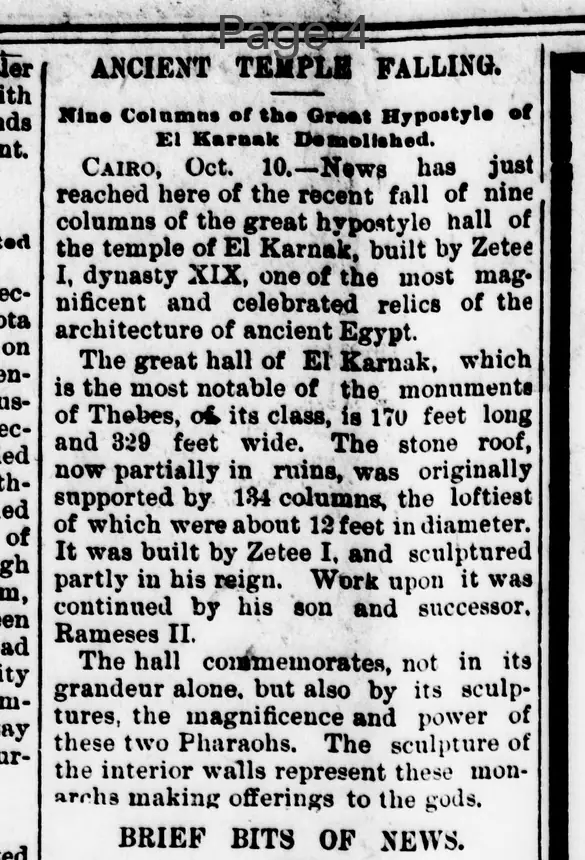
Nine Columns of the Great Hypostyle of El Karnak Demolished.
CAIRO, Oct. 10.—News has just reached here of the recent fall of nine columns of the great hypostyle hall of the temple of El Karnak, built by Seti I, dynasty XIX, one of the most magnificent and celebrated relics of the architecture of ancient Egypt.
The great hall of El Karnak, which is the most notable of the monuments of Thebes, of its class, is 170 feet long and 329 feet wide. The stone roof, now partially in ruins, was originally supported by 184 columns, the loftiest of which were about 12 feet in diameter.
It was built by Seti I, and sculptured partly in his reign. Work upon it was continued by his son and successor, Rameses II.
The hall commemorates, not in its grandeur alone, but also by its sculptures, the magnificence and power of these two Pharaohs. The sculpture of the interior walls represent these monarchs making offerings to the gods.
What sub-type of article is it?
What keywords are associated?
What entities or persons were involved?
Where did it happen?
Foreign News Details
Primary Location
El Karnak
Event Date
Recent (As Of Oct. 10)
Key Persons
Outcome
nine columns demolished
Event Details
News has just reached Cairo of the recent fall of nine columns of the great hypostyle hall of the temple of El Karnak, built by Seti I of dynasty XIX. The hall is 170 feet long and 329 feet wide, originally supported by 184 columns up to 12 feet in diameter. It was built and sculptured by Seti I and continued by Rameses II, commemorating their magnificence through sculptures of offerings to gods.