Thank you for visiting SNEWPapers!
Sign up free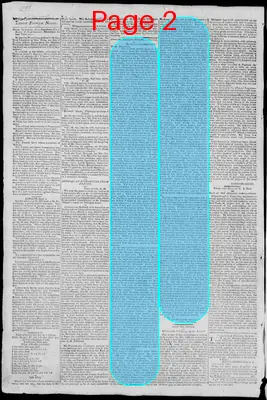
Story
November 5, 1806
Virginia Argus
Richmond, Virginia
What is this article about?
William Clark's letter from St. Louis details the Lewis and Clark expedition's return journey from the Pacific Ocean via the Columbia River, Rocky Mountains, and Missouri River, covering 3555 miles. It describes routes, challenges like snow and rapids, native interactions, and advantages for fur trade.
Clipping
OCR Quality
98%
Excellent
Full Text
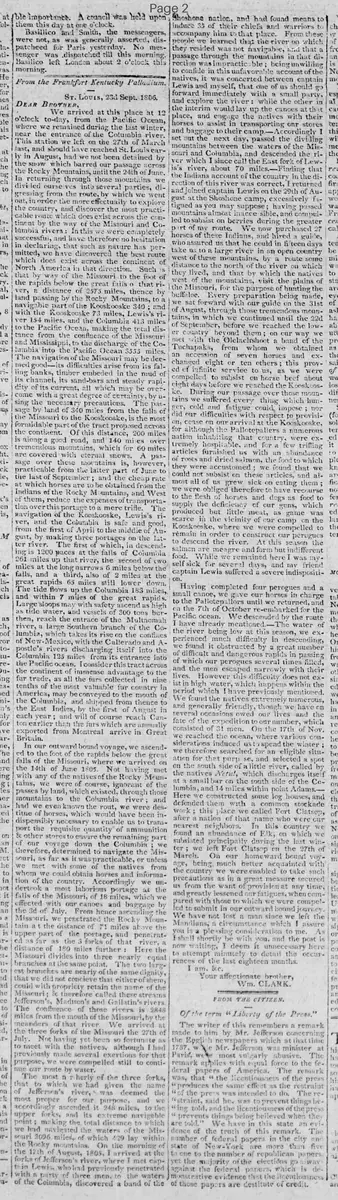
From the Frankfort Kentucky Palladium.
St. Louis, 22d Sept. 1806.
DEAR BROTHER,
We arrived at this place at 12 o'clock to-day, from the Pacific Ocean, where we remained during the last winter, near the entrance of the Columbia river. This station we left on the 27th of March last, and should have reached St. Louis earlier in August, had we not been detained by the snow which barred our passage across the Rocky Mountains, until the 24th of June.
In returning through those mountains we divided ourselves into several parties, digressing from the route, by which we went out, in order the more effectually to explore the country, and discover the most practicable route which does exist across the continent by the way of the Missouri and Columbia rivers: In this we were completely successful, and have therefore no hesitation in declaring, that such as nature has permitted, we have discovered the best route which does exist across the continent of North America in that direction. Such is that by way of the Missouri to the foot of the rapids below the great falls of that river, a distance of 2575 miles, thence by land passing by the Rocky Mountains, to a navigable part of the Kooskooske 340; and with the Kooskooske 73 miles, Lewis's river 154 miles, and the Columbia 413 miles to the Pacific Ocean, making the total distance from the confluence of the Missouri and Mississippi, to the discharge of the Columbia into the Pacific Ocean 3555 miles.
The navigation of the Missouri may be deemed good its difficulties arise from its falling banks, timber embedded in the mud of its channel, its sand-bars and steady rapidity of its current, all which may be overcome with a great degree of certainty, by using the necessary precautions. The passage by land of 340 miles from the falls of the Missouri to the Kooskooske, is the most formidable part of the tract proposed across the continent. Of this distance, 200 miles is along a good road, and 140 miles over tremendous mountains, which for 60 miles are covered with eternal snows. A passage over these mountains is, however, practicable from the latter part of June to the last of September; and the cheap rate at which horses are to be obtained from the Indians of the Rocky Mountains, and West of them, reduce the expenses of transportation over this portage to a mere trifle. The navigation of the Kooskooske, Lewis's river, and the Columbia is safe and good, from the first of April to the middle of August, by making three portages on the latter river. The first of which, in descending is 1200 paces at the falls of Columbia 261 miles up that river, the second of two miles at the long narrows 6 miles below the falls, and a third, also of 2 miles at the great rapids 65 miles still lower down.
The tide flows up the Columbia 183 miles, and within 7 miles of the great rapids. Large sloops may with safety ascend as high as tide water, and vessels of 500 tons burden, reach the entrance of the Multnomah river, a large Southern branch of the Columbia, which takes its rise on the confines of New-Mexico, with the Colorado and Apostle's rivers discharging itself into the Columbia 125 miles from its entrance into the Pacific ocean. I consider this tract across the continent of immense advantage to the fur trade, as all the furs collected in nine tenths of the most valuable fur country in America, may be conveyed to the mouth of the Columbia, and shipped from thence to the East Indies, by the first of August in each year; and will of course reach Canton earlier than the furs which are annually exported from Montreal arrive in Great Britain.
In our outward bound voyage, we ascended to the foot of the rapids below the great falls of the Missouri, where we arrived on the 14th of June 1805. Not having met with any of the natives of the Rocky Mountains, we were of course, ignorant of the passes by land, which existed, through those mountains to the Columbia river; and had we even known the rout, we were destitute of horses, which would have been indispensably necessary to enable us to transport the requisite quantity of ammunition & other stores to ensure the remaining part of our voyage down the Columbia; we therefore, determined to navigate the Missouri, as far as it was practicable, or unless we met with some of the natives from whom we could obtain horses and information of the country. Accordingly we undertook a most laborious portage at the falls of the Missouri, of 18 miles, which we effected with our canoes and baggage by the 3d of July. From hence ascending the Missouri, we penetrated the Rocky Mountain at the distance of 71 miles above the upper part of the portage, and penetrated as far as the 3 forks of that river, a distance of 180 miles further: Here the Missouri divides into three nearly equal branches at the same point. The two largest branches are nearly of the same dignity, that we did not conceive that either of them, could with propriety retain the name of the Missouri: & therefore called these streams Jefferson's, Madison's and Gallatin's rivers The confluence of those rivers is 2848 miles from the mouth of the Missouri, by the meanders of that river We arrived at the three forks of the Missouri the 27th of July. Not having yet been so fortunate as to meet with the natives, although I had previously made several exertions for that purpose, we were compelled still to continue our route by water.
The most northerly of the three forks, that to which we had given the name of Jefferson's river, was deemed the most proper for our purpose, and we accordingly ascended it 248 miles, to the upper forks, and its extreme navigable point; making the total distance to which we had navigated the waters of the Missouri 3096 miles, of which 429 lay within the Rocky mountains. On the morning of the 17th of August, 1805, I arrived at the forks of Jefferson's river, where I met captain Lewis, who had previously penetrated with a party of three men, to the waters of the Columbia, discovered a band of the Shoshone nation, and had found means to induce 85 of their chiefs and warriors to accompany him to that place. From these people we learned that the river on which they resided was not navigable, and that a passage through the mountains in that direction was impracticable; being unwilling to confide in this unfavorable account of the natives, it was concerted between captain Lewis and myself, that one of us should go forward immediately with a small party, and explore the river: while the other in the interim would lay up the canoes at that place, and engage the natives with their horses to assist in transporting our stores and baggage to their camp.—Accordingly I set out the next day, passed the dividing mountains between the waters of the Missouri and Columbia, and descended the river which I since call the East fork of Lewis's river, about 70 miles.—Finding that the Indians account of the country in the direction of this river was correct, I returned and joined captain Lewis on the 29th of August at the Shoshone camp, excessively fatigued as you may suppose; having passed mountains almost inaccessible, and compelled to subsist on berries during the greater part of my route. We now purchased 27 horses of these Indians, and hired a guide, who assured us that he could in fifteen days take us to a large river in an open country west of these mountains, by a route some distance to the north of the river on which they lived, and that by which the natives west of the mountains, visit the plains of the Missouri, for the purpose of hunting the buffaloe. Every preparation being made, we set forward with our guide on the 31st of August, through those tremendous mountains, in which we continued until the 22d of September, before we reached the lower country beyond them; on our way we met with the Olelachrshoot a band of the Tuchapaks, from whom we obtained an accession of seven horses and exchanged eight or ten others; this proved of infinite service to us, as we were compelled to subsist on horse beef about eight days before we reached the Kooskooske. During our passage over those mountains we suffered every thing which hunger, cold and fatigue could impose; nor did our difficulties with respect to provision, cease on our arrival at the Kooskooske, for although the Pallotepallers a numerous nation inhabiting that country, were extremely hospitable, and for a few trifling articles furnished us with an abundance of roots and dried salmon, the food to which they were accustomed; we found that we could not subsist on these articles, and almost all of us grew sick on eating them; we were obliged therefore to have recourse to the flesh of horses and dogs as food to supply the deficiency of our guns, which produced but little meat, as game was scarce in the vicinity of our camp on the Kooskooske, where we were compelled to remain in order to construct our perogues to descend the river. At this season the salmon are meagre and form but indifferent food. While we remained here I was myself sick for several days, and my friend captain Lewis suffered a severe indisposition.
Having completed four perogues and a small canoe, we gave our horses in charge to the Pallotepallors until we returned, and on the 7th of October re-embarked for the Pacific ocean. We descended by the route I have already mentioned. The water of the river being low at this season, we experienced much difficulty in descending, we found it obstructed by a great number of difficult and dangerous rapids in passing of which our perogues several times filled, and the men escaped narrowly with their lives. However this difficulty does not exist in high water, which happens within the period which I have previously mentioned.
We found the natives extremely numerous, and generally friendly, though we have on several occasions owed our lives and the fate of the expedition to our number, which consisted of 31 men. On the 17th of Nov. we reached the ocean, where various considerations induced us to spend the winter: we therefore searched for an eligible situation for that purpose, and selected a spot on the south side of a little river, called by the natives Netul, which discharges itself at a small bar on the south side of the Columbia, and 14 miles within point Adams.—Here we constructed some log houses, and defended them with a common stockade work; this place we called Fort Clatsop, after a nation of that name who were our nearest neighbors. In this country we found an abundance of Elk, on which we subsisted principally during the last winter; we left Fort Clatsop on the 27th of March. On our homeward bound voyage, being much better acquainted with the country we were enabled to take such precautions as in a great measure secured us from the want of provision at any time, and greatly lessened our fatigues, when compared with those to which we were compelled to submit in our outward bound journey.
We have not lost a man since we left the Mandans, a circumstance which I assure you is a pleasing consideration to me. As I shall shortly be with you, and the post is now waiting, I deem it unnecessary here to attempt minutely to detail the occurrences of the last eighteen months.
I am, &c.
Your affectionate brother,
Wm. CLARK.
St. Louis, 22d Sept. 1806.
DEAR BROTHER,
We arrived at this place at 12 o'clock to-day, from the Pacific Ocean, where we remained during the last winter, near the entrance of the Columbia river. This station we left on the 27th of March last, and should have reached St. Louis earlier in August, had we not been detained by the snow which barred our passage across the Rocky Mountains, until the 24th of June.
In returning through those mountains we divided ourselves into several parties, digressing from the route, by which we went out, in order the more effectually to explore the country, and discover the most practicable route which does exist across the continent by the way of the Missouri and Columbia rivers: In this we were completely successful, and have therefore no hesitation in declaring, that such as nature has permitted, we have discovered the best route which does exist across the continent of North America in that direction. Such is that by way of the Missouri to the foot of the rapids below the great falls of that river, a distance of 2575 miles, thence by land passing by the Rocky Mountains, to a navigable part of the Kooskooske 340; and with the Kooskooske 73 miles, Lewis's river 154 miles, and the Columbia 413 miles to the Pacific Ocean, making the total distance from the confluence of the Missouri and Mississippi, to the discharge of the Columbia into the Pacific Ocean 3555 miles.
The navigation of the Missouri may be deemed good its difficulties arise from its falling banks, timber embedded in the mud of its channel, its sand-bars and steady rapidity of its current, all which may be overcome with a great degree of certainty, by using the necessary precautions. The passage by land of 340 miles from the falls of the Missouri to the Kooskooske, is the most formidable part of the tract proposed across the continent. Of this distance, 200 miles is along a good road, and 140 miles over tremendous mountains, which for 60 miles are covered with eternal snows. A passage over these mountains is, however, practicable from the latter part of June to the last of September; and the cheap rate at which horses are to be obtained from the Indians of the Rocky Mountains, and West of them, reduce the expenses of transportation over this portage to a mere trifle. The navigation of the Kooskooske, Lewis's river, and the Columbia is safe and good, from the first of April to the middle of August, by making three portages on the latter river. The first of which, in descending is 1200 paces at the falls of Columbia 261 miles up that river, the second of two miles at the long narrows 6 miles below the falls, and a third, also of 2 miles at the great rapids 65 miles still lower down.
The tide flows up the Columbia 183 miles, and within 7 miles of the great rapids. Large sloops may with safety ascend as high as tide water, and vessels of 500 tons burden, reach the entrance of the Multnomah river, a large Southern branch of the Columbia, which takes its rise on the confines of New-Mexico, with the Colorado and Apostle's rivers discharging itself into the Columbia 125 miles from its entrance into the Pacific ocean. I consider this tract across the continent of immense advantage to the fur trade, as all the furs collected in nine tenths of the most valuable fur country in America, may be conveyed to the mouth of the Columbia, and shipped from thence to the East Indies, by the first of August in each year; and will of course reach Canton earlier than the furs which are annually exported from Montreal arrive in Great Britain.
In our outward bound voyage, we ascended to the foot of the rapids below the great falls of the Missouri, where we arrived on the 14th of June 1805. Not having met with any of the natives of the Rocky Mountains, we were of course, ignorant of the passes by land, which existed, through those mountains to the Columbia river; and had we even known the rout, we were destitute of horses, which would have been indispensably necessary to enable us to transport the requisite quantity of ammunition & other stores to ensure the remaining part of our voyage down the Columbia; we therefore, determined to navigate the Missouri, as far as it was practicable, or unless we met with some of the natives from whom we could obtain horses and information of the country. Accordingly we undertook a most laborious portage at the falls of the Missouri, of 18 miles, which we effected with our canoes and baggage by the 3d of July. From hence ascending the Missouri, we penetrated the Rocky Mountain at the distance of 71 miles above the upper part of the portage, and penetrated as far as the 3 forks of that river, a distance of 180 miles further: Here the Missouri divides into three nearly equal branches at the same point. The two largest branches are nearly of the same dignity, that we did not conceive that either of them, could with propriety retain the name of the Missouri: & therefore called these streams Jefferson's, Madison's and Gallatin's rivers The confluence of those rivers is 2848 miles from the mouth of the Missouri, by the meanders of that river We arrived at the three forks of the Missouri the 27th of July. Not having yet been so fortunate as to meet with the natives, although I had previously made several exertions for that purpose, we were compelled still to continue our route by water.
The most northerly of the three forks, that to which we had given the name of Jefferson's river, was deemed the most proper for our purpose, and we accordingly ascended it 248 miles, to the upper forks, and its extreme navigable point; making the total distance to which we had navigated the waters of the Missouri 3096 miles, of which 429 lay within the Rocky mountains. On the morning of the 17th of August, 1805, I arrived at the forks of Jefferson's river, where I met captain Lewis, who had previously penetrated with a party of three men, to the waters of the Columbia, discovered a band of the Shoshone nation, and had found means to induce 85 of their chiefs and warriors to accompany him to that place. From these people we learned that the river on which they resided was not navigable, and that a passage through the mountains in that direction was impracticable; being unwilling to confide in this unfavorable account of the natives, it was concerted between captain Lewis and myself, that one of us should go forward immediately with a small party, and explore the river: while the other in the interim would lay up the canoes at that place, and engage the natives with their horses to assist in transporting our stores and baggage to their camp.—Accordingly I set out the next day, passed the dividing mountains between the waters of the Missouri and Columbia, and descended the river which I since call the East fork of Lewis's river, about 70 miles.—Finding that the Indians account of the country in the direction of this river was correct, I returned and joined captain Lewis on the 29th of August at the Shoshone camp, excessively fatigued as you may suppose; having passed mountains almost inaccessible, and compelled to subsist on berries during the greater part of my route. We now purchased 27 horses of these Indians, and hired a guide, who assured us that he could in fifteen days take us to a large river in an open country west of these mountains, by a route some distance to the north of the river on which they lived, and that by which the natives west of the mountains, visit the plains of the Missouri, for the purpose of hunting the buffaloe. Every preparation being made, we set forward with our guide on the 31st of August, through those tremendous mountains, in which we continued until the 22d of September, before we reached the lower country beyond them; on our way we met with the Olelachrshoot a band of the Tuchapaks, from whom we obtained an accession of seven horses and exchanged eight or ten others; this proved of infinite service to us, as we were compelled to subsist on horse beef about eight days before we reached the Kooskooske. During our passage over those mountains we suffered every thing which hunger, cold and fatigue could impose; nor did our difficulties with respect to provision, cease on our arrival at the Kooskooske, for although the Pallotepallers a numerous nation inhabiting that country, were extremely hospitable, and for a few trifling articles furnished us with an abundance of roots and dried salmon, the food to which they were accustomed; we found that we could not subsist on these articles, and almost all of us grew sick on eating them; we were obliged therefore to have recourse to the flesh of horses and dogs as food to supply the deficiency of our guns, which produced but little meat, as game was scarce in the vicinity of our camp on the Kooskooske, where we were compelled to remain in order to construct our perogues to descend the river. At this season the salmon are meagre and form but indifferent food. While we remained here I was myself sick for several days, and my friend captain Lewis suffered a severe indisposition.
Having completed four perogues and a small canoe, we gave our horses in charge to the Pallotepallors until we returned, and on the 7th of October re-embarked for the Pacific ocean. We descended by the route I have already mentioned. The water of the river being low at this season, we experienced much difficulty in descending, we found it obstructed by a great number of difficult and dangerous rapids in passing of which our perogues several times filled, and the men escaped narrowly with their lives. However this difficulty does not exist in high water, which happens within the period which I have previously mentioned.
We found the natives extremely numerous, and generally friendly, though we have on several occasions owed our lives and the fate of the expedition to our number, which consisted of 31 men. On the 17th of Nov. we reached the ocean, where various considerations induced us to spend the winter: we therefore searched for an eligible situation for that purpose, and selected a spot on the south side of a little river, called by the natives Netul, which discharges itself at a small bar on the south side of the Columbia, and 14 miles within point Adams.—Here we constructed some log houses, and defended them with a common stockade work; this place we called Fort Clatsop, after a nation of that name who were our nearest neighbors. In this country we found an abundance of Elk, on which we subsisted principally during the last winter; we left Fort Clatsop on the 27th of March. On our homeward bound voyage, being much better acquainted with the country we were enabled to take such precautions as in a great measure secured us from the want of provision at any time, and greatly lessened our fatigues, when compared with those to which we were compelled to submit in our outward bound journey.
We have not lost a man since we left the Mandans, a circumstance which I assure you is a pleasing consideration to me. As I shall shortly be with you, and the post is now waiting, I deem it unnecessary here to attempt minutely to detail the occurrences of the last eighteen months.
I am, &c.
Your affectionate brother,
Wm. CLARK.
What sub-type of article is it?
Journey
Historical Event
Adventure
What themes does it cover?
Exploration
Survival
Triumph
What keywords are associated?
Lewis And Clark Expedition
Rocky Mountains Crossing
Columbia River Navigation
Fur Trade Route
Shoshone Indians
Fort Clatsop
What entities or persons were involved?
Wm. Clark
Captain Lewis
Shoshone Nation
Where did it happen?
Missouri River, Rocky Mountains, Columbia River, Pacific Ocean
Story Details
Key Persons
Wm. Clark
Captain Lewis
Shoshone Nation
Location
Missouri River, Rocky Mountains, Columbia River, Pacific Ocean
Event Date
1805 1806
Story Details
The Lewis and Clark expedition returns from the Pacific via the Columbia and Missouri Rivers, discovering the best practicable route across North America, overcoming mountains, rapids, and hardships, with no loss of life, and highlighting benefits for fur trade.