Thank you for visiting SNEWPapers!
Sign up free
Editorial
January 16, 1896
The Scranton Tribune
Scranton, Lackawanna County, Pennsylvania
What is this article about?
Editorial from the Chicago Times-Herald argues that Great Britain cannot engage in war with the United States due to heavy reliance on American food and raw cotton imports, which would lead to starvation and industrial paralysis if disrupted.
Clipping
OCR Quality
98%
Excellent
Full Text
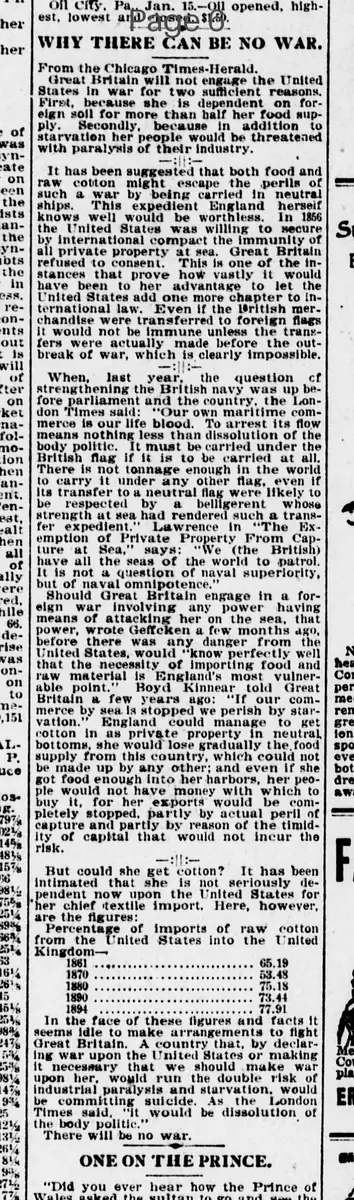
WHY THERE CAN BE NO WAR.
From the Chicago Times-Herald.
Great Britain will not engage the United States in war for two sufficient reasons. First, because she is dependent on foreign soil for more than half her food supply. Secondly, because in addition to starvation her people would be threatened with paralysis of their industry.
It has been suggested that both food and raw cotton might escape the perils of such a war by being carried in neutral ships. This expedient England herself knows well would be worthless. In 1856 the United States was willing to secure by international compact the immunity of all private property at sea, Great Britain refused to consent. This is one of the instances that prove how vastly it would have been to her advantage to let the United States add one more chapter to international law. Even if the British merchandise were transferred to foreign flags it would not be immune unless the transfers were actually made before the outbreak of war, which is clearly impossible.
When, last year, the question of strengthening the British navy was up before parliament and the country, the London Times said: "Our own maritime commerce is our life blood. To arrest its flow means nothing less than dissolution of the body politic. It must be carried under the British flag if it is to be carried at all. There is not tonnage enough in the world to carry it under any other flag, even if its transfer to a neutral flag were likely to be respected by a belligerent whose strength at sea had rendered such a transfer expedient." Lawrence in "The Exemption of Private Property From Capture at Sea," says: "We (the British) have all the seas of the world to patrol. It is not a question of naval superiority, but of naval omnipotence."
Should Great Britain engage in a foreign war involving any power having means of attacking her on the sea, that power, wrote Geffcken a few months ago, before there was any danger from the United States, would "know perfectly well that the necessity of importing food and raw material is England's most vulnerable point."
Boyd Kinnear told Great Britain a few years ago: "If our commerce by sea is stopped we perish by starvation." England could manage to get cotton in as private property in neutral bottoms, she would lose gradually the food supply from this country, which could not be made up by any other; and even if she got food enough into her harbors, her people would not have money with which to buy it, for her exports would be completely stopped, partly by actual peril of capture and partly by reason of the timidity of capital that would not incur the risk.
But could she get cotton? It has been intimated that she is not seriously dependent now upon the United States for her chief textile import. Here, however, are the figures:
Percentage of imports of raw cotton from the United States into the United Kingdom—
1861 65.19
1870 53.43
1880 75.18
1890 73.44
1894 77.91
In the face of these figures and facts it seems idle to make arrangements to fight Great Britain. A country that, by declaring war upon the United States or making it necessary that we should make war upon her, would run the double risk of industrial paralysis and starvation, would be committing suicide. As the London Times said, it would be dissolution of the body politic.
There will be no war.
From the Chicago Times-Herald.
Great Britain will not engage the United States in war for two sufficient reasons. First, because she is dependent on foreign soil for more than half her food supply. Secondly, because in addition to starvation her people would be threatened with paralysis of their industry.
It has been suggested that both food and raw cotton might escape the perils of such a war by being carried in neutral ships. This expedient England herself knows well would be worthless. In 1856 the United States was willing to secure by international compact the immunity of all private property at sea, Great Britain refused to consent. This is one of the instances that prove how vastly it would have been to her advantage to let the United States add one more chapter to international law. Even if the British merchandise were transferred to foreign flags it would not be immune unless the transfers were actually made before the outbreak of war, which is clearly impossible.
When, last year, the question of strengthening the British navy was up before parliament and the country, the London Times said: "Our own maritime commerce is our life blood. To arrest its flow means nothing less than dissolution of the body politic. It must be carried under the British flag if it is to be carried at all. There is not tonnage enough in the world to carry it under any other flag, even if its transfer to a neutral flag were likely to be respected by a belligerent whose strength at sea had rendered such a transfer expedient." Lawrence in "The Exemption of Private Property From Capture at Sea," says: "We (the British) have all the seas of the world to patrol. It is not a question of naval superiority, but of naval omnipotence."
Should Great Britain engage in a foreign war involving any power having means of attacking her on the sea, that power, wrote Geffcken a few months ago, before there was any danger from the United States, would "know perfectly well that the necessity of importing food and raw material is England's most vulnerable point."
Boyd Kinnear told Great Britain a few years ago: "If our commerce by sea is stopped we perish by starvation." England could manage to get cotton in as private property in neutral bottoms, she would lose gradually the food supply from this country, which could not be made up by any other; and even if she got food enough into her harbors, her people would not have money with which to buy it, for her exports would be completely stopped, partly by actual peril of capture and partly by reason of the timidity of capital that would not incur the risk.
But could she get cotton? It has been intimated that she is not seriously dependent now upon the United States for her chief textile import. Here, however, are the figures:
Percentage of imports of raw cotton from the United States into the United Kingdom—
1861 65.19
1870 53.43
1880 75.18
1890 73.44
1894 77.91
In the face of these figures and facts it seems idle to make arrangements to fight Great Britain. A country that, by declaring war upon the United States or making it necessary that we should make war upon her, would run the double risk of industrial paralysis and starvation, would be committing suicide. As the London Times said, it would be dissolution of the body politic.
There will be no war.
What sub-type of article is it?
War Or Peace
Foreign Affairs
Economic Policy
What keywords are associated?
British Food Dependency
Us Cotton Exports
Naval Vulnerability
War Impossibility
Industrial Paralysis
Maritime Commerce
Neutral Ships
Starvation Risk
What entities or persons were involved?
Great Britain
United States
Chicago Times Herald
London Times
Lawrence
Geffcken
Boyd Kinnear
Editorial Details
Primary Topic
Reasons Great Britain Cannot Go To War With The United States
Stance / Tone
Assertive Argument Against War Due To British Economic Vulnerabilities
Key Figures
Great Britain
United States
Chicago Times Herald
London Times
Lawrence
Geffcken
Boyd Kinnear
Key Arguments
Great Britain Depends On Foreign Soil For Over Half Its Food Supply
War Would Threaten British Industry With Paralysis
Neutral Ships Cannot Reliably Protect Food And Cotton Imports
Britain Refused 1856 International Compact On Private Property At Sea
British Maritime Commerce Is Vital And Must Be Under British Flag
Importing Food And Raw Materials Is England's Most Vulnerable Point
Stopping Sea Commerce Would Cause Starvation
High Percentage Of Raw Cotton Imports From Us (65 78% From 1861 1894)
War Would Lead To Industrial Paralysis And Starvation, Equivalent To Suicide