Thank you for visiting SNEWPapers!
Sign up free
Editorial
September 22, 1792
National Gazette
Philadelphia, Philadelphia County, Pennsylvania
What is this article about?
This editorial, continued from a prior issue, argues against establishing privileged national manufactories in the US, using historical examples from Holland, Siam, Britain, and France to illustrate how government interference in commerce and agriculture leads to economic ruin, advocating for free trade and non-interference.
Clipping
OCR Quality
95%
Excellent
Full Text
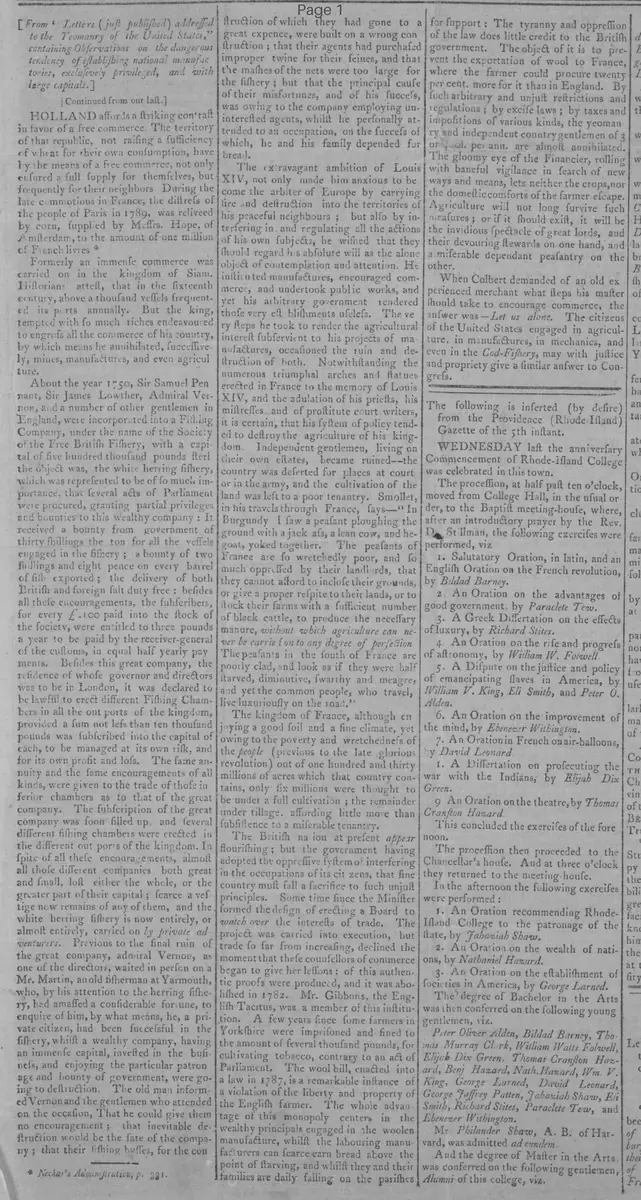
[From Letters just published addressed to the Yeomanry of the United States, containing Observations on the dangerous tendency of establishing national manufactories, exclusively privileged, and with large capitals.]
[Continued from our last.]
HOLLAND affords a striking contrast in favor of a free commerce. The territory of that republic, not raising a sufficiency of wheat for their own consumption, have by the means of a free commerce, not only ensured a full supply for themselves, but frequently for their neighbors. During the late commotions in France, the distress of the people of Paris in 1789, was relieved by corn, supplied by Messrs. Hope, of Amsterdam, to the amount of one million of French livres.
Formerly an immense commerce was carried on in the kingdom of Siam. Historians attest, that in the sixteenth century, above a thousand vessels frequented its ports annually. But the king, tempted with so much riches endeavoured to engross all the commerce of his country, by which means he annihilated, successively, mines, manufactures, and even agriculture.
About the year 1750, Sir Samuel Pennant, Sir James Lowther, Admiral Vernon, and a number of other gentlemen in England, were incorporated into a Fishing Company, under the name of the Society of the Free British Fishery, with a capital of five hundred thousand pounds sterling; the object was, the white herring fishery, which was represented to be of so much importance, that several acts of Parliament were procured, granting partial privileges and bounties to this wealthy company. It received a bounty from government of thirty shillings the ton for all the vessels engaged in the fishery; a bounty of two shillings and eight pence on every barrel of fish exported; the delivery of both British and foreign salt duty free: besides all these encouragements, the subscribers, for every £100 paid into the stock of the society, were entitled to three pounds a year to be paid by the receiver-general of the customs, in equal half yearly payments. Besides this great company, the residence of whose governor and directors was to be in London, it was declared to be lawful to erect different Fishing Chambers in all the out ports of the kingdom, provided a sum not less than ten thousand pounds was subscribed into the capital of each, to be managed at its own risk, and for its own profit and loss. The same annuity and the same encouragements of all kinds, were given to the trade of those inferior chambers as to that of the great company. The subscription of the great company was soon filled up, and several different fishing chambers were erected in the different out ports of the kingdom. In spite of all these encouragements, almost all those different companies both great and small, lost either the whole, or the greater part of their capital; scarce a vestige now remains of any of them, and the white herring fishery is now entirely, or almost entirely, carried on by private adventurers. Previous to the final ruin of the great company, admiral Vernon, as one of the directors, waited in person on a Mr. Martin, an old fisherman at Yarmouth, who, by his attention to the herring fishery, had amassed a considerable fortune, to enquire of him, by what means, he, a private citizen, had been successful in the fishery, whilst a wealthy company, having an immense capital, invested in the business, and enjoying the particular patronage and bounty of government, were going to destruction. The old man informed Vernon and the gentlemen who attended on the occasion, That he could give them no encouragement; that inevitable destruction would be the fate of the company; that their fishing boats, for the construction of which they had gone to a great expense, were built on a wrong construction; that their agents had purchased improper twine for their seines, and that the meshes of the nets were too large for the fishery; but that the principal cause of their misfortunes, and of his success, was owing to the company employing uninterested agents, whilst he personally attended to an occupation, on the success of which, he and his family depended for bread.
The extravagant ambition of Louis XIV, not only made him anxious to become the arbiter of Europe by carrying fire and destruction into the territories of his peaceful neighbours; but also by interfering in and regulating all the actions of his own subjects, he wished that they should regard his absolute will as the alone object of contemplation and attention. He instituted manufactures, encouraged commerce, and undertook public works, and yet his arbitrary government rendered those very establishments useless. The very steps he took to render the agricultural interest subservient to his projects of manufactures, occasioned the ruin and destruction of both. Notwithstanding the numerous triumphal arches and statues erected in France to the memory of Louis XIV, and the adulation of his priests, his mistresses, and of prostitute court writers, it is certain, that his system of policy tended to destroy the agriculture of his kingdom. Independent gentlemen, living on their own estates, became ruined—the country was deserted for places at court or in the army, and the cultivation of the land was left to a poor tenantry. Smollet, in his travels through France, says 'In Burgundy I saw a peasant ploughing the ground with a jack ass, a lean cow, and he-goat, yoked together. The peasants of France are so wretchedly poor, and so much oppressed by their landlords, that they cannot afford to enclose their grounds, or give a proper respite to their lands, or to stock their farms with a sufficient number of black cattle, to produce the necessary manure, without which agriculture can never be carried on to any degree of perfection. The peasants in the south of France are poorly clad, and look as if they were half starved, diminutive, swarthy and meagre, and yet the common people, who travel, live luxuriously on the road.' The kingdom of France, although enjoying a good soil and a fine climate, yet owing to the poverty and wretchedness of the people (previous to the late glorious revolution) out of one hundred and thirty millions of acres which that country contains, only six millions were thought to be under a full cultivation; the remainder under tillage, affording little more than subsistence to a miserable tenantry.
The British nation at present appears flourishing; but the government having adopted the oppressive system of interfering in the occupations of its citizens, that fine country must fall a sacrifice to such unjust principles. Some time since the Minister formed the design of erecting a Board to watch over the interests of trade. The project was carried into execution, but trade so far from increasing, declined the moment that these counsellors of commerce began to give her lessons: of this authentic proofs were produced, and it was abolished in 1782. Mr. Gibbon, the English Tacitus, was a member of this institution. A few years since some farmers in Yorkshire were imprisoned and fined to the amount of several thousand pounds, for cultivating tobacco, contrary to an act of Parliament. The wool bill, enacted into a law in 1787, is a remarkable instance of a violation of the liberty and property of the English farmer. The whole advantage of this monopoly centers in the wealthy principals engaged in the woolen manufacture, whilst the labouring manufacturers can scarce earn bread above the point of starving, and whilst they and their families are daily falling on the parishes for support: The tyranny and oppression of the law does little credit to the British government. The object of it is to prevent the exportation of wool to France, where the farmer could procure twenty per cent. more for it than in England. By such arbitrary and unjust restrictions and regulations; by excise laws; by taxes and impositions of various kinds, the yeomanry and independent country gentlemen of £300 or £400 per ann. are almost annihilated. The gloomy eye of the Financier, rolling with baneful vigilance in search of new ways and means, lets neither the crops, nor the domestic comforts of the farmer escape. Agriculture will not long survive such measures; or if it should exist, it will be the invidious spectacle of great lords, and their devouring stewards on one hand, and a miserable dependant peasantry on the other.
When Colbert demanded of an old experienced merchant what steps his master should take to encourage commerce, the answer was—Let us alone. The citizens of the United States engaged in agriculture, in manufactures, in mechanics, and even in the Cod-Fishery, may with justice and propriety give a similar answer to Congress.
* Necker's Administration, p. 331.
[Continued from our last.]
HOLLAND affords a striking contrast in favor of a free commerce. The territory of that republic, not raising a sufficiency of wheat for their own consumption, have by the means of a free commerce, not only ensured a full supply for themselves, but frequently for their neighbors. During the late commotions in France, the distress of the people of Paris in 1789, was relieved by corn, supplied by Messrs. Hope, of Amsterdam, to the amount of one million of French livres.
Formerly an immense commerce was carried on in the kingdom of Siam. Historians attest, that in the sixteenth century, above a thousand vessels frequented its ports annually. But the king, tempted with so much riches endeavoured to engross all the commerce of his country, by which means he annihilated, successively, mines, manufactures, and even agriculture.
About the year 1750, Sir Samuel Pennant, Sir James Lowther, Admiral Vernon, and a number of other gentlemen in England, were incorporated into a Fishing Company, under the name of the Society of the Free British Fishery, with a capital of five hundred thousand pounds sterling; the object was, the white herring fishery, which was represented to be of so much importance, that several acts of Parliament were procured, granting partial privileges and bounties to this wealthy company. It received a bounty from government of thirty shillings the ton for all the vessels engaged in the fishery; a bounty of two shillings and eight pence on every barrel of fish exported; the delivery of both British and foreign salt duty free: besides all these encouragements, the subscribers, for every £100 paid into the stock of the society, were entitled to three pounds a year to be paid by the receiver-general of the customs, in equal half yearly payments. Besides this great company, the residence of whose governor and directors was to be in London, it was declared to be lawful to erect different Fishing Chambers in all the out ports of the kingdom, provided a sum not less than ten thousand pounds was subscribed into the capital of each, to be managed at its own risk, and for its own profit and loss. The same annuity and the same encouragements of all kinds, were given to the trade of those inferior chambers as to that of the great company. The subscription of the great company was soon filled up, and several different fishing chambers were erected in the different out ports of the kingdom. In spite of all these encouragements, almost all those different companies both great and small, lost either the whole, or the greater part of their capital; scarce a vestige now remains of any of them, and the white herring fishery is now entirely, or almost entirely, carried on by private adventurers. Previous to the final ruin of the great company, admiral Vernon, as one of the directors, waited in person on a Mr. Martin, an old fisherman at Yarmouth, who, by his attention to the herring fishery, had amassed a considerable fortune, to enquire of him, by what means, he, a private citizen, had been successful in the fishery, whilst a wealthy company, having an immense capital, invested in the business, and enjoying the particular patronage and bounty of government, were going to destruction. The old man informed Vernon and the gentlemen who attended on the occasion, That he could give them no encouragement; that inevitable destruction would be the fate of the company; that their fishing boats, for the construction of which they had gone to a great expense, were built on a wrong construction; that their agents had purchased improper twine for their seines, and that the meshes of the nets were too large for the fishery; but that the principal cause of their misfortunes, and of his success, was owing to the company employing uninterested agents, whilst he personally attended to an occupation, on the success of which, he and his family depended for bread.
The extravagant ambition of Louis XIV, not only made him anxious to become the arbiter of Europe by carrying fire and destruction into the territories of his peaceful neighbours; but also by interfering in and regulating all the actions of his own subjects, he wished that they should regard his absolute will as the alone object of contemplation and attention. He instituted manufactures, encouraged commerce, and undertook public works, and yet his arbitrary government rendered those very establishments useless. The very steps he took to render the agricultural interest subservient to his projects of manufactures, occasioned the ruin and destruction of both. Notwithstanding the numerous triumphal arches and statues erected in France to the memory of Louis XIV, and the adulation of his priests, his mistresses, and of prostitute court writers, it is certain, that his system of policy tended to destroy the agriculture of his kingdom. Independent gentlemen, living on their own estates, became ruined—the country was deserted for places at court or in the army, and the cultivation of the land was left to a poor tenantry. Smollet, in his travels through France, says 'In Burgundy I saw a peasant ploughing the ground with a jack ass, a lean cow, and he-goat, yoked together. The peasants of France are so wretchedly poor, and so much oppressed by their landlords, that they cannot afford to enclose their grounds, or give a proper respite to their lands, or to stock their farms with a sufficient number of black cattle, to produce the necessary manure, without which agriculture can never be carried on to any degree of perfection. The peasants in the south of France are poorly clad, and look as if they were half starved, diminutive, swarthy and meagre, and yet the common people, who travel, live luxuriously on the road.' The kingdom of France, although enjoying a good soil and a fine climate, yet owing to the poverty and wretchedness of the people (previous to the late glorious revolution) out of one hundred and thirty millions of acres which that country contains, only six millions were thought to be under a full cultivation; the remainder under tillage, affording little more than subsistence to a miserable tenantry.
The British nation at present appears flourishing; but the government having adopted the oppressive system of interfering in the occupations of its citizens, that fine country must fall a sacrifice to such unjust principles. Some time since the Minister formed the design of erecting a Board to watch over the interests of trade. The project was carried into execution, but trade so far from increasing, declined the moment that these counsellors of commerce began to give her lessons: of this authentic proofs were produced, and it was abolished in 1782. Mr. Gibbon, the English Tacitus, was a member of this institution. A few years since some farmers in Yorkshire were imprisoned and fined to the amount of several thousand pounds, for cultivating tobacco, contrary to an act of Parliament. The wool bill, enacted into a law in 1787, is a remarkable instance of a violation of the liberty and property of the English farmer. The whole advantage of this monopoly centers in the wealthy principals engaged in the woolen manufacture, whilst the labouring manufacturers can scarce earn bread above the point of starving, and whilst they and their families are daily falling on the parishes for support: The tyranny and oppression of the law does little credit to the British government. The object of it is to prevent the exportation of wool to France, where the farmer could procure twenty per cent. more for it than in England. By such arbitrary and unjust restrictions and regulations; by excise laws; by taxes and impositions of various kinds, the yeomanry and independent country gentlemen of £300 or £400 per ann. are almost annihilated. The gloomy eye of the Financier, rolling with baneful vigilance in search of new ways and means, lets neither the crops, nor the domestic comforts of the farmer escape. Agriculture will not long survive such measures; or if it should exist, it will be the invidious spectacle of great lords, and their devouring stewards on one hand, and a miserable dependant peasantry on the other.
When Colbert demanded of an old experienced merchant what steps his master should take to encourage commerce, the answer was—Let us alone. The citizens of the United States engaged in agriculture, in manufactures, in mechanics, and even in the Cod-Fishery, may with justice and propriety give a similar answer to Congress.
* Necker's Administration, p. 331.
What sub-type of article is it?
Trade Or Commerce
Economic Policy
Agriculture
What keywords are associated?
Free Commerce
Government Interference
Monopolies
Agriculture Ruin
Privileged Manufactories
Historical Examples
What entities or persons were involved?
Louis Xiv
Colbert
Admiral Vernon
British Government
Congress
Editorial Details
Primary Topic
Dangers Of Government Established Privileged Manufactories
Stance / Tone
Opposition To Government Interference In Commerce And Agriculture
Key Figures
Louis Xiv
Colbert
Admiral Vernon
British Government
Congress
Key Arguments
Free Commerce In Holland Ensured Food Supply And Aided Neighbors
King Of Siam's Monopoly Destroyed Economy Including Agriculture
British Fishing Company Failed Despite Government Bounties Due To Poor Management
Louis Xiv's Interventions Ruined French Agriculture And Peasantry
British Policies Like Wool Bill Oppress Farmers And Yeomanry
Government Boards And Restrictions Harm Trade And Agriculture
Merchants Advise 'Let Us Alone' To Encourage Commerce