Thank you for visiting SNEWPapers!
Sign up free
The National Intelligencer And Washington Advertiser
Washington, District Of Columbia
What is this article about?
Governor Caleb Strong's 1804 address to the Massachusetts legislature covers judicial review, neutrality amid European war, militia improvements, state prison setup, pardons, anti-robbery measures, federal claims, and constitutional updates. (187 characters)
Merged-components note: Continuation of the Massachusetts Governor's speech across pages, merged based on sequential reading order and text flow.
Clippings
1 of 2
OCR Quality
Full Text
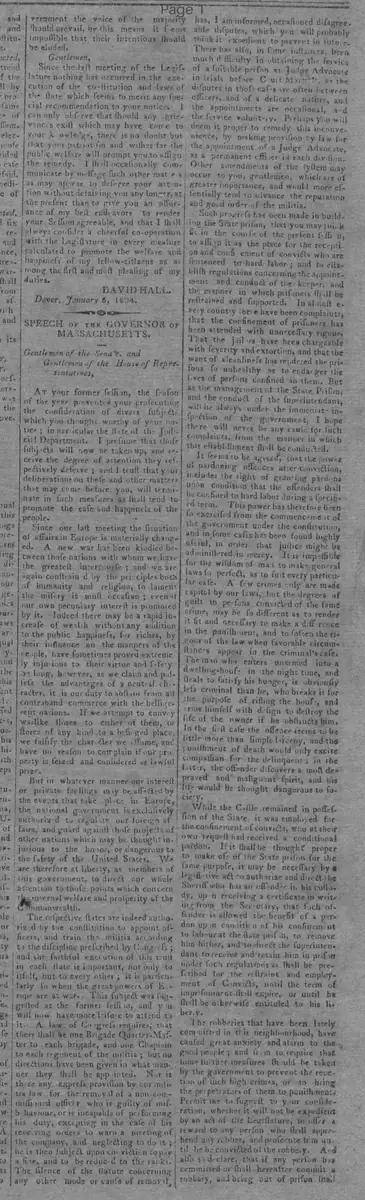
Gentlemen of the Senate and Gentlemen of the House of Representatives,
At your former session, the season of the year prevented your prosecuting the consideration of divers subjects which you thought worthy of your notice; in particular the state of the Judicial Department. I presume that those subjects will now be taken up, and receive the degree of attention they respectively deserve; and I trust that your deliberations on these and other matters that may come before you, will terminate in such measures as shall tend to promote the peace and happiness of the people.
Since our last meeting the situation of affairs in Europe is materially changed. A new war has been kindled between those nations with whom we have the greatest intercourse; and we are again constrained by the principles both of humanity and religion, to lament the misery it must occasion; even if our own pecuniary interest is promoted by it. Indeed there may be a rapid increase of wealth without any addition to the public happiness, for riches, by their influence on the manners of the people, have sometimes proved extremely injurious to their virtue and safety. So long, however, as we claim and possess the advantages of a neutral character, it is our duty to abstain from all contraband commerce with the belligerent nations. If we attempt to convey warlike stores to either of them, or stores of any kind to a besieged place, we falsify the character we assume, and have no reason to complain if our property is seized and considered as lawful prize.
But in whatever manner our interest or private feelings may be affected by the events that take place in Europe, the national government is exclusively authorized to regulate our foreign affairs, and guard against those projects of other nations which may be thought injurious to the honor, or dangerous to the safety of the United States. We are therefore at liberty, as members of this government, to direct our whole attention to those points which concern the internal welfare and prosperity of the Commonwealth.
The respective states are indeed authorized by the constitution to appoint officers, and train the militia according to the discipline prescribed by Congress; and the faithful execution of this trust in each state is important, not only to itself, but to every other; it is particularly so when the great powers of Europe are at war. This subject was suggested at the former session, and you will now have more leisure to attend to it. A law of Congress requires, that there shall be one Brigade Quarter-Master to each brigade, and one Chaplain to each regiment of the militia; but no directions have been given in what manner they shall be appointed. Nor is there any express provision by our militia law for the removal of a non-commissioned officer who is guilty of misbehaviour, or is incapable of performing his duty, excepting in the case of his receiving orders to warn a meeting of the company, and neglecting to do it; he is then subject upon conviction to pay a fine, and to be reduced to the ranks. The silence of the statute concerning any other mode or cause of removal
has, I am informed, occasioned disagreeable disputes, which you will probably think it expedient to prevent in future. There has also, in some instances, been much difficulty in obtaining the service of a suitable person as Judge Advocate in trials before Court Martial, as the subjects of disputes in those cases are often between officers, and of a delicate nature, and the appointments are occasional, and the service voluntary. Perhaps you will think it proper to remedy this inconvenience, by taking provision by law for the appointment of a Judge Advocate, as a permanent officer in each division.
Other amendments of the system may occur to you, gentlemen, which are of greater importance, and would more essentially tend to advance the reputation and good order of the militia.
Such progress has been made in building the State prison, that you may think it fit in the course of the present session to assign it as the place for the reception and confinement of convicts who are sentenced to hard labor: and to establish regulations concerning the appointment and conduct of the keeper, and the manner in which prisoners shall be restrained and supported. In almost every country there have been complaints that the confinement of prisoners has been attended with unnecessary rigour. That the jailers have been chargeable with severity and extortion, and that the want of cleanliness has rendered the prisons so unhealthy as to endanger the lives of persons confined in them. But as the management of the State Prison, and the conduct of the superintendent, will be always under the immediate inspection of the government, I hope there will never be any cause for such complaints, from the manner in which this establishment shall be conducted.
It seems to be agreed, that the power of pardoning offences after conviction, includes the right of granting pardons upon condition that the offenders shall be confined to hard labor during a specified term. This power has therefore been so exercised from the commencement of the government under the constitution, and in some cases has been found highly useful, in order that justice might be administered in mercy. It is impossible for the wisdom of man to make general laws so perfect, as to suit every particular case. A few crimes only are made capital by our laws, but the degrees of guilt in persons convicted of the same crime, may be so different as to render it fit and necessary to make a difference in the punishment, and to soften the rigour of the law when favorable circumstances appear in the criminal's case.
The man who enters unarmed into a dwelling-house in the night time, and steals to satisfy his hunger, is obviously less criminal than he, who breaks it for the purpose of rifling the house, and arms himself with design to destroy the life of the owner if he obstructs him. In the first case the offence seems to be little more than simple larceny, and the punishment of death would only excite compassion for the delinquent; in the latter, the offender discovers a most depraved and malignant spirit, and his life would be thought dangerous to society.
While the Castle remained in possession of the State it was employed for the confinement of convicts, who at their own request had received a conditional pardon. If it shall be thought proper to make use of the State prison for the same purpose, it may be necessary by legislative act to authorize and direct the Sheriff who has an offender in his custody, upon receiving a certificate in writing from the Secretary, that such offender is allowed the benefit of a pardon upon condition of his confinement to labour at the state prison, to remove him hither, and to direct the superintendent to receive and retain him in prison under such regulations as shall be prescribed for the restraint and employment of Convicts, until the term of imprisonment shall expire, or until he shall be otherwise entitled to his liberty.
The robberies that have been lately committed in this neighbourhood, have caused great anxiety and alarm to the good people; and seem to require that some further measures should be taken by the government to prevent the repetition of such high crimes, or to bring the perpetrators of them to punishment.
Permit me to suggest to your consideration, whether it will not be expedient by an act of the Legislature, to offer a reward to any person who shall apprehend any robber, and prosecute him until he be convicted of the robbery. And also to declare, that if any person has committed or shall hereafter commit a robbery, and being out of prison shall afterwards discover any one who has committed or shall hereafter be guilty of any robbery, he or they may be convicted: such discoverer shall be entitled to pardon for all robberies which he shall have committed before such discovery was made.
In conformity with the resolve of the 5th of last March, I wrote to the Secretary of War, proposing that the demand of this Commonwealth against the United States for the ordnance and military stores delivered for their use, should be referred in the manner recommended by that resolve. In his answer the Secretary declined the proposed reference, and adhered to the proposition he had before made that there should be a new appraisement of the ordnance and stores, excepting the cannon that were delivered for the ship Constitution, and those delivered with the Castle, from which the trunnions had been broken off, which he refused to consider as the property of the United States. By advice of the Council I acceded to this on condition that the estimate should have relation to the time when the articles were delivered, and that interest should be allowed on the appraised value. He afterwards informed me, that he had directed the appraiser appointed by him to attend to the business, and objected, that he could not undertake to give a positive opinion of the subject of interest, but that whatever had been the usual practice at the Treasury in similar cases, would undoubtedly be done. The articles not objected to were appraised at 21,305 dollars and 87 cents, the appraisers certifying that they were of that value when delivered; and I requested the Secretary of War, if he consented to the payment of interest, to pay the whole amount to the Treasury of this State. He has lately enclosed to me a report from the Accountant of the War Department, stating that our claim of interest is inadmissible, unless specifically granted by Congress. He also informed me, that the Treasurer of the United States had been directed to pay the principal sum to the Treasurer of this State. The papers relative to this subject will be delivered to you by the Secretary.
A copy of an article of amendment proposed by Congress to be added to the Constitution of the United States, respecting the election of President, and Vice-President, has been transmitted to me by the President of the United States, and will be laid before you.
I have also received from the Department of State, three boxes supposed to contain eleven hundred and five copies of the laws of the United States. They are deposited in the office of the Secretary of the Commonwealth to be disposed of as the legislature shall direct.
That I may detain you, Gentlemen, no longer at this time I will communicate by message any other circumstances of which I may be informed, that shall have a claim to your notice; and I flatter myself that during the session we will cherish sentiments of mutual friendship and respect, and not suffer personal disagreement or party interest to divert us, in any instance, from the practice of those duties which we owe to the public, and to one another.
CALEB STRONG.
Boston, Jan. 13, 1804.
What sub-type of article is it?
What keywords are associated?
What entities or persons were involved?
Where did it happen?
Domestic News Details
Primary Location
Boston, Massachusetts
Event Date
Jan. 13, 1804
Key Persons
Event Details
Governor Caleb Strong addresses the Massachusetts legislature on judicial matters, European war and neutrality, militia organization and reforms, state prison establishment, conditional pardons, recent robberies and proposed rewards/pardons for informants, claim against the United States for military stores, proposed constitutional amendment on presidential election, and distribution of U.S. laws.