Thank you for visiting SNEWPapers!
Sign up free
Gadsden County Times
Quincy, Gadsden County, Florida
What is this article about?
A Florida politician reflects on the 1952 Democratic National Convention in Chicago, criticizing the process and advocating for national primaries by 1956. He praises the Southern delegation's resistance to radical elements, support for Senator Russell, and the party's avoidance of splits over civil rights, emphasizing honest disagreement within the Democratic Party ahead of the November election.
Clipping
OCR Quality
Full Text
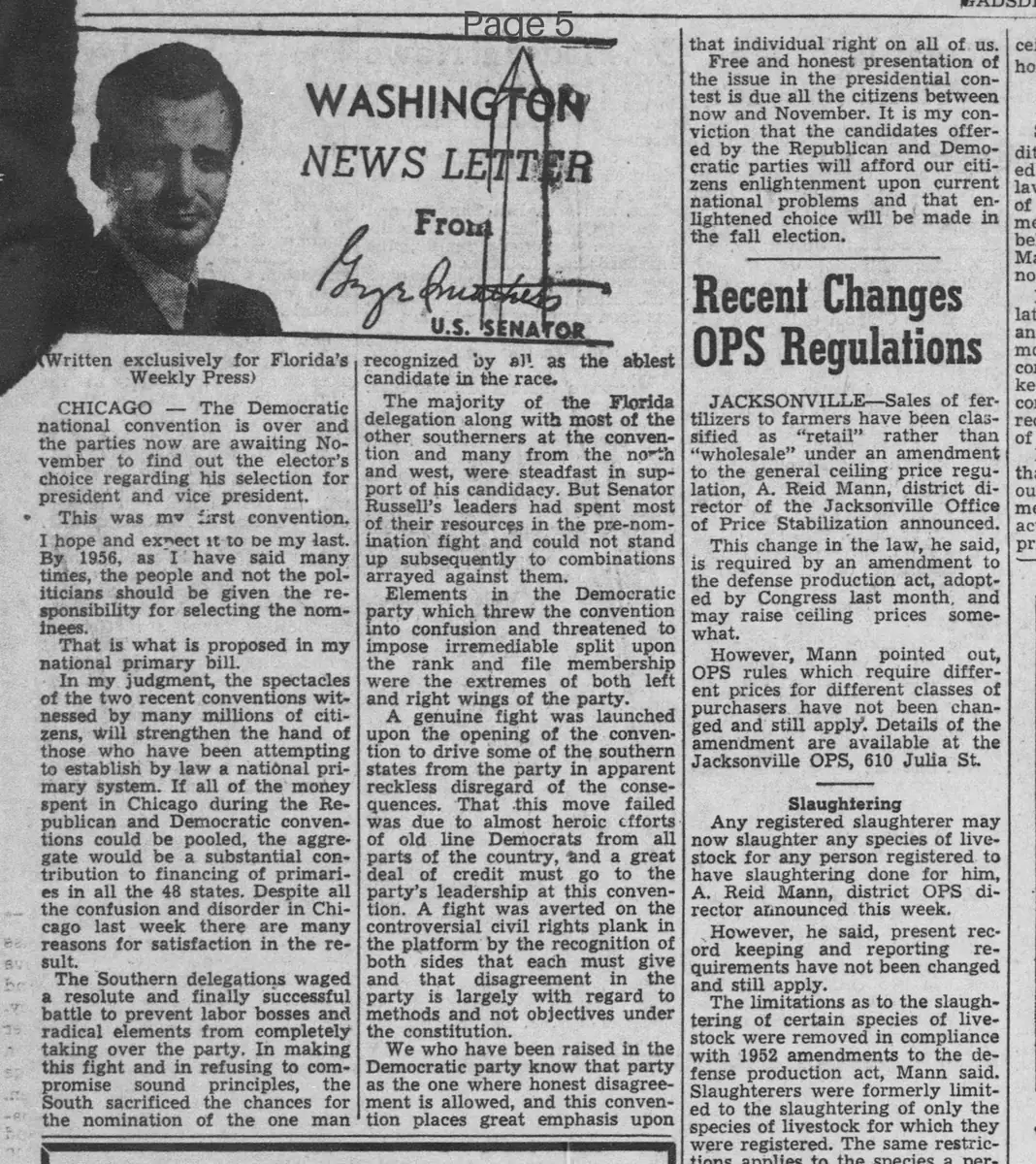
CHICAGO - The Democratic national convention is over and the parties now are awaiting November to find out the elector's choice regarding his selection for president and vice president.
This was my first convention. I hope and expect it to be my last.
By 1956, as I have said many times, the people and not the politicians should be given the responsibility for selecting the nominees.
That is what is proposed in my national primary bill.
In my judgment, the spectacles of the two recent conventions witnessed by many millions of citizens, will strengthen the hand of those who have been attempting to establish by law a national primary system. If all of the money spent in Chicago during the Republican and Democratic conventions could be pooled, the aggregate would be a substantial contribution to financing of primaries in all the 48 states. Despite all the confusion and disorder in Chicago last week there are many reasons for satisfaction in the result.
The Southern delegations waged a resolute and finally successful battle to prevent labor bosses and radical elements from completely taking over the party. In making this fight and in refusing to compromise sound principles, the South sacrificed the chances for the nomination of the one man recognized by all as the ablest candidate in the race.
The majority of the Florida delegation along with most of the other southerners at the convention and many from the north and west, were steadfast in support of his candidacy. But Senator Russell's leaders had spent most of their resources in the pre-nomination fight and could not stand up subsequently to combinations arrayed against them.
Elements in the Democratic party which threw the convention into confusion and threatened to impose irremediable split upon the rank and file membership were the extremes of both left and right wings of the party.
A genuine fight was launched upon the opening of the convention to drive some of the southern states from the party in apparent reckless disregard of the consequences. That this move failed was due to almost heroic efforts of old line Democrats from all parts of the country, and a great deal of credit must go to the party's leadership at this convention. A fight was averted on the controversial civil rights plank in the platform by the recognition of both sides that each must give and that disagreement in the party is largely with regard to methods and not objectives under the constitution.
We who have been raised in the Democratic party know that party as the one where honest disagreement is allowed, and this convention places great emphasis upon that individual right on all of us.
Free and honest presentation of the issue in the presidential contest is due all the citizens between now and November. It is my conviction that the candidates offered by the Republican and Democratic parties will afford our citizens enlightenment upon current national problems and that enlightened choice will be made in the fall election.
What sub-type of article is it?
What themes does it cover?
What keywords are associated?
What entities or persons were involved?
Where did it happen?
Story Details
Key Persons
Location
Chicago
Event Date
1952
Story Details
The author, a first-time attendee, critiques the Democratic National Convention's chaos and advocates for national primaries by 1956 to empower voters. Southern delegates, including Florida's, supported Senator Russell but failed due to resource depletion; they successfully resisted radical takeovers and party splits over civil rights, preserving Democratic unity and honest disagreement ahead of the November election.