Thank you for visiting SNEWPapers!
Sign up free
Alexandria Gazette
Alexandria, Alexandria County, District Of Columbia
What is this article about?
Reports on Russo-Turkish War peace negotiations: Turkey accepts Russian terms for armistice and preliminaries granting independence to Servia, territory to Montenegro, Bulgarian autonomy, and Russian gains; British fleet ordered to Dardanelles but halted; parliamentary debates and Earl of Carnarvon's resignation over policy differences.
Clipping
OCR Quality
Full Text
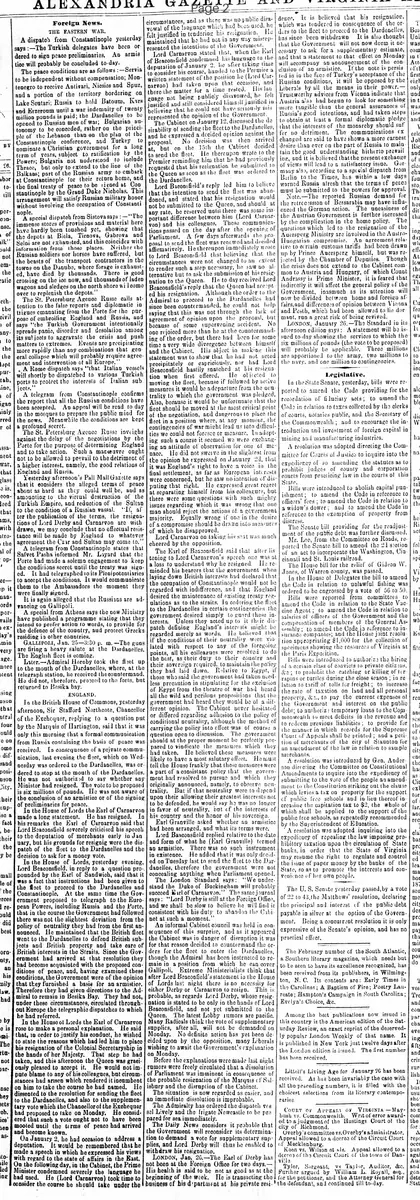
THE EASTERN WAR.
A dispatch from Constantinople yesterday says: - The Turkish delegates have been ordered to sign peace preliminaries. An armistice will probably be concluded to-day.
The peace conditions are as follows: - Servia to be independent without compensation; Montenegro to receive Antivari, Niksics and Spuz, and a portion of the territory bordering on Lake Scutari; Russia to hold Batoum, Kars and Erzeroum until a war indemnity of twenty million pounds is paid; the Dardanelles to be opened to Russian men of war; Bulgarian autonomy to be conceded, rather on the principle of the Lebanon than on the plan of the Constantinople conference, and Turkey to nominate a Christian government for a long term of years, subject to ratification by the Powers; Bulgaria not understood to include Thrace, but only to extend to the line of the Balkans; part of the Russian army to embark at Constantinople for their return home, and the final treaty of peace to be signed at Constantinople by the Grand Duke Nicholas. This arrangement will satisfy Russian military honor without involving the occupation of Constantinople.
A special dispatch from Sistova says: - "The immense stores of provisions and material here have hardly been touched yet, showing that the depots at Biela, Tirnova, Gabrova and Selvi are not exhausted, and this coincides with information from those places. Neither the Russian soldiers nor horses have suffered, but the beasts of the transport contractors in the towns on the Danube, where forage is exhausted, have died by thousands. There is good crossing on the ice now, and thousands of laden wagons and sledges on the north shore will come over to replenish the depots."
The St. Petersburg Agency Russe calls attention to the false reports and diplomatic intrigues emanating from the Porte for the purpose of embroiling England and Russia, and says "the Turkish Government intentionally spreads panic, disorder and desolation among its subjects to aggravate the crisis and push matters to extremes. Events are precipitating more rapidly than any combinations that geoporal collapse which will probably require agreement and intervention of all Europe."
A Rome dispatch says "that Italian vessels will shortly be dispatched to various Turkish ports to protect the interests of Italian subjects."
A telegram from Constantinople confirms the report that all the Russian conditions have been accepted. An appeal will be read to-day in the mosques to prepare the public mind for the news. Meanwhile the conditions are kept a profound secret.
The St. Petersburg Agency Russe inveighs against the delay of the negotiations by the Porte for the purpose of determining England and to take action. 'Such a manoeuvre ought not to be allowed to prevail to the detriment of a higher interest, namely, the good relations of England and Russia."
Yesterday afternoon's Pall Mall Gazette says that it considers the alleged terms of peace about as hard as they could well be, and as amounting to the virtual destruction of the Turkish Empire, and reduction of the Sultan to the condition of a Russian vassal. If, after the publication of the terms, the resignations of Lord Derby and Carnarvon are withdrawn, we may conclude that no effectual resistance will be made by England to whatever agreement the Czar and Sultan may come to.
A telegram from Constantinople states that Safvet Pasha informed Mr. Layard that the Porte had made a solemn engagement to keep the conditions secret until the treaty was signed. It had telegraphed its Plenipotentiaries to accept the conditions. It would communicate them to the Ambassadors the moment they were finally signed.
It is again alleged that the Russians are advancing on Gallipoli.
A special from Athens says the new Ministry have published a programme stating that they intend to prefer action to words, to provide for the defence of the country, and protect Greeks residing in other countries.
GALLIPOLI, Jan. 25 - 3:30 p. m. - The guns are firing a heavy salute at the Dardanelles. The English fleet is coming.
Later. - Admiral Hornby took the fleet up to the mouth of the Dardanelles, where, at the telegraph station, he received the countermand. He did not, therefore, proceed to the forts, but returned to Besika bay.
ENGLAND.
In the British House of Commons, yesterday afternoon, Sir Stafford Northcote, Chancellor of the Exchequer, replying to a question put by the Marquis of Hartington, said that it was only this morning that a formal communication from Russia containing the basis of peace was received. In consequence of a private communication, last evening the fleet, which on Wednesday was ordered to the Dardanelles, was ordered to stop at the mouth of the Dardanelles. He was not authorized to say whether any Minister had resigned. The vote to be proposed is six millions of pounds. He was not aware of the conclusion of an armistice or of the signing of preliminaries for peace.
In the House of Lords the Earl of Carnarvon made a long statement. He has resigned. In his remarks the Earl of Carnarvon said that Lord Beaconsfield severely criticised his speech to the deputation of merchants early in January, but his grounds for resigning were the dispatch of the fleet to the Dardanelles and the decision to ask for a money vote.
In the House of Lords, yesterday evening, Lord Beaconsfield, in reply to a question propounded by the Earl of Sandwich, said that it was a fact that instructions had been given to the fleet to proceed to the Dardanelles and Constantinople. At the same time the Government proposed to telegraph to the European Powers, including Russia and the Porte, that in the course the Government had followed there was not the slightest deviation from the policy of neutrality they had from the first announced. He maintained that the British fleet went to the Dardanelles to defend British subjects and British property and take care of British interests in the Straits. Since the Government had arrived at that resolution they had become acquainted with the proposed conditions of peace, and, having examined these conditions, the Government were of the opinion that they furnished a basis for an armistice. Therefore they had given directions to the Admiral to remain in Besika Bay. They had not, under these circumstances, circulated throughout Europe the telegraphic dispatches to which he had referred.
In the House of Lords the Earl of Carnarvon rose to make a personal explanation. He said that, in order to justify his conduct, he wished to state the reasons which had led him to place his resignation of the Colonial Secretaryship in the hands of her Majesty. That step he had taken, and this afternoon the Queen was graciously pleased to accept it. He would not impute blame to any of his colleagues, but circumstances had arisen which rendered it incumbent on him to take the course he had pursued. He dissented to the resolution for sending the fleet to the Dardanelles, and also to the supplementary vote which the Chancellor of the Exchequer had proposed to take on Monday. He considered that such a vote ought not to have been mooted until the terms of peace had arrived and become known.
On January 2, he had occasion to address a deputation. It would be remembered that he made a speech in which he expressed his views with regard to the state of affairs in the East. On the following day, in the Cabinet, the Prime Minister condemned severely the language he had used. He (Lord Carnarvon) took time to consider the course he should take under the circumstances, and as there was no public disavowal of the language which had been used, he felt justified in tendering his resignation. He maintained that he had not in any way misrepresented the intentions of the Government.
Lord Carnarvon stated that, when the Earl of Beaconsfield condemned his language to the deputation of January 2, he after taking time to consider his course, handed to the Premier a written statement of the position he (Lord Carnarvon) had taken upon that occasion, and there the matter for a time rested. His language not being publicly disavowed, he felt justified and still considered himself justified in believing that he could not have seriously misrepresented the opinion of the Government.
The Cabinet on January 12, discussed the desirability of sending the fleet to the Dardanelles and he expressed a decided opinion against the proposal. No decision was then arrived at, but on the 15th the Cabinet decided to send the fleet. He thereupon wrote to the Premier reminding him that he had previously requested that his resignation be submitted to the Queen as soon as the fleet was ordered to the Dardanelles.
Lord Beaconsfield's reply led him to believe that the intention to send the fleet was abandoned, and stated that his resignation would not be submitted to the Queen, and should at any rate, be reserved until there was some important difference between him (Lord Carnarvon) and his colleagues. These communications passed on the day after the opening of Parliament. A few days afterwards the proposal to send the fleet was renewed and decided affirmatively. He thereupon immediately wrote to Lord Beaconsfield that believing that the circumstances were not changed to an extent to render such a step necessary, he saw no alternative but to ask the submission of his resignation to the Queen. He to-day received Lord Beaconsfield's reply that the Queen had accepted his resignation. Although the order to the Admiral to proceed to the Dardanelles had since been countermanded, he could not help saying that this was not through the lack of agreement of opinion upon the proposal, but because of some supervening accident. No one rejoiced more than he at the countermanding of the order, but there had been for some time a very wide divergence between himself and the Cabinet. His object in making this statement was to show that he had not acted precipitately or capriciously, nor had Lord Beaconsfield hastily snatched at his resignation when first offered. He objected to moving the fleet, because if followed by active measures it would be a departure from the neutrality to which the government was pledged. Also, because it would be unfortunate that the fleet should be moved at the most critical point of the negotiation, and dangerous to place the fleet in a position where, at any moment, the contingencies of war might lead us into difficulties we could not foresee or measure. In adopting such a course it seemed we were exchanging an attitude of observation for one of menace. He did not swerve in the slightest from the opinion he expressed on January 2d, that it was England's right to have a voice in the final settlement, as far as European interests were concerned, but he saw no intention of disputing that right. He expressed great regret at separating himself from his colleagues, but there were some questions with such mighty issues regarding which it was wrong that one man should reject the actions of a government majority. Equally wrong if one in the desire of a compromise should be drawn into measures of which he disapproved.
Lord Carnarvon on taking his seat was much cheered by the opposition.
The Earl of Beaconsfield said that after listening to Lord Carnarvon's speech one was at a loss to understand why he resigned. He reminded his hearers that the government when laying down British interests had declared that the occupation of Constantinople would not be regarded with indifference, and that England desired the maintenance of existing treaty regulations as to the straits. In ordering the fleet to the Dardanelles in certain contingencies the government desired simply to guard these interests. Unless they acted up to it their dispatch defining England's interests might be regarded merely as words. He believed that if the conditions of their neutrality were violated with respect to any of the foregoing points, all his colleagues were resolved to do the best, as their duty to their country and their sovereign required, to maintain the policy they had laid down. Relative to Egypt, if those who said the government had taken needless precaution in stipulating for the exclusion of Egypt from the theatre of war had heard all the wild and perilous propositions that the government had heard they would be of a different opinion. The Cabinet never hesitated or differed regarding adhesion to the policy of conditional neutrality, although the method of carrying the policy into effect was of course a question open to discussion. The government should at the proper moment be perfectly prepared to vindicate the measures which they had taken. He believed these measures were likely to have a most salutary effect. He must tell the House frankly that these measures were a part of a consistent policy that the government had resolved to pursue and which they originally announced, namely, to observe neutrality. But if that neutrality were to depend upon their allowing their greatest interests not to be defended, he would say he was no longer in favor of neutrality, not of the interests of his country and the honor of his sovereign.
Earl Granville asked whether an armistice had been arranged, and what its terms were.
Lord Beaconsfield replied relative to the date and form of what he (Earl Granville) termed an armistice. There was no such instrument in existence. He added that it was only decided on Tuesday last to send the fleet to the Dardanelles, therefore the government were not concealing anything when Parliament opened.
The London Standard says: "We understand the Duke of Buckingham will probably succeed Earl of Carnarvon." The same journal says: "Lord Derby is still at the Foreign Office, and we shall be slow to believe he will find it consistent with his duty to abandon the Cabinet at such a moment."
An informal Cabinet council was held in consequence of this surprise, and as it appeared the Cabinet was in danger of disruption it was for that reason decided to countermand the orders for the fleet to enter the Dardanelles, though the Admiral has been instructed to remain in a position from which he can cover Gallipoli. Extreme Ministerialists think that after Lord Beaconsfield's statement in the House of Lords last night there is no necessity for either Derby or Carnarvon to resign. This is probable, as regards Lord Derby, whose resignation is stated to be only in the hands of Lord Beaconsfield, and not yet submitted to the Queen. The latest Lobby rumors are pacific. Many Radicals think the vote of supplementary supplies, after all, will not be demanded on Monday. No definite action has yet been decided upon by the opposition, many Liberals wishing to await the Government's explanation on Monday.
Before the explanations were made last night rumors were freely circulated that a dissolution of Parliament was imminent in consequence of the probable resignation of the Marquis of Salisbury and the disruption of the Cabinet. The situation is now regarded as easier, and an immediate dissolution is improbable.
The Admiralty has ordered the dispatch vessel Lively and the frigate Newcastle to be prepared for sea immediately.
The Daily News considers it probable that the Government will reconsider its determination to demand a vote for supplementary supplies, and Lord Derby will thus be enabled to withdraw his resignation.
LONDON, Jan. 26. - The Earl of Derby has not been at the Foreign Office for two days. - His health is said to be not as good as at the beginning of the week. He is transacting the business of his department at his private residence. It is believed that his resignation, which was tendered in consequence of the orders to the fleet to proceed to the Dardanelles, has since been withdrawn. It is also thought that the Government will not now deem it necessary to ask for a supplementary estimate, and that a statement to that effect on Monday will accompany an announcement of the conclusion of an armistice. If the vote is persisted in in the face of Turkey's acceptance of the Russian conditions, it will be opposed by the Liberals by all the means in their power. - Trustworthy advices from Vienna indicate that Austria also had begun to look for something more tangible than the general assurances of Russia's good intentions, and had taken steps to obtain at least a formal diplomatic pledge that the interests of the monarchy should suffer no detriment. The communications exchanged are said to have shown a more earnest desire than ever on the part of Russia to maintain the good understanding hitherto prevailing, and it is believed that the present exchange of views will lead to a satisfactory issue. Germany also, according to a special dispatch from Berlin to the Times, has within a few days warned Russia afresh that the terms of peace must be submitted to the powers for approval.
Note. - The reported Russian demand for the retrocession of Bessarabia may have influenced the German action. The uneasiness of the Austrian Government is further increased by the complication in the home policy. The questions which led to the resignation of the Auersperg Ministry are involved in the Austro-Hungarian compromise. An agreement relative to certain customs tariffs had been drawn up by Prince Auersperg himself, but was rejected by the Chamber of Deputies. Though the crisis does not extend to the Cabinet common to Austria and Hungary, of which Count Andrassy is Prime Minister, it is feared that indirectly it will affect the general policy of the Government, inasmuch as its attention will now be divided between home and foreign affairs, and differences of opinion between Vienna and Pesth, which had been allowed to lie dormant, run a great risk of being revived.
London, January 26. - The Standard in its afternoon edition says: A statement will be issued to-day showing the services to which the six millions of pounds (the vote to be proposed) will probably be applicable. Three millions are apportioned to the army, two millions to the navy, and one million to contingencies.
What sub-type of article is it?
What keywords are associated?
What entities or persons were involved?
Where did it happen?
Foreign News Details
Primary Location
Constantinople
Event Date
Jan. 25 26
Key Persons
Outcome
turkish delegates ordered to sign peace preliminaries; armistice likely; servia independent; montenegro receives antivari, niksics, spuz, and lake scutari territory; russia holds batoum, kars, erzeroum until 20 million pounds indemnity; dardanelles opened to russian warships; bulgarian autonomy conceded; part of russian army to embark at constantinople; final treaty at constantinople; british fleet ordered to dardanelles but countermanded; earl of carnarvon resigns.
Event Details
Dispatch from Constantinople reports Turkish delegates ordered to sign peace preliminaries with armistice probable; details peace conditions including Servian independence, Montenegrin territorial gains, Russian holdings and indemnity, Dardanelles access, Bulgarian autonomy, and treaty signing. Sistova dispatch notes ample provisions and transport issues. St. Petersburg Agency Russe criticizes Turkish intrigues. Rome dispatch on Italian vessels to Turkish ports. Confirmation of Russian conditions accepted in Constantinople. Further St. Petersburg criticism of delays. Pall Mall Gazette views terms as harsh. Constantinople telegram on secrecy pledge. Rumors of Russian advance on Gallipoli. Athens on new Ministry's program. Gallipoli report of English fleet movement to Dardanelles countermanded. In British Parliament, discussions on Russian peace basis, fleet orders, and resignations; Earl of Carnarvon resigns over fleet dispatch and vote; detailed explanations of policy and neutrality.