Thank you for visiting SNEWPapers!
Sign up free
The Kentucky Gazette
Lexington, Fayette County, Kentucky
What is this article about?
Detailed account of George Washington's inauguration as first U.S. President on April 30, 1789, in New York City, including procession from Cherry Street to Federal Hall, oath administered by Chancellor Livingston, inaugural speech emphasizing duty and providence, divine service, and evening fireworks.
Merged-components note: Merged components 20-24 as they form a continuous narrative story about George Washington's inauguration and speech, spanning page 1 to page 2. Relabeled the overall component to 'story' as it is a full narrative article on a domestic event.
Clippings
1 of 2
OCR Quality
Full Text
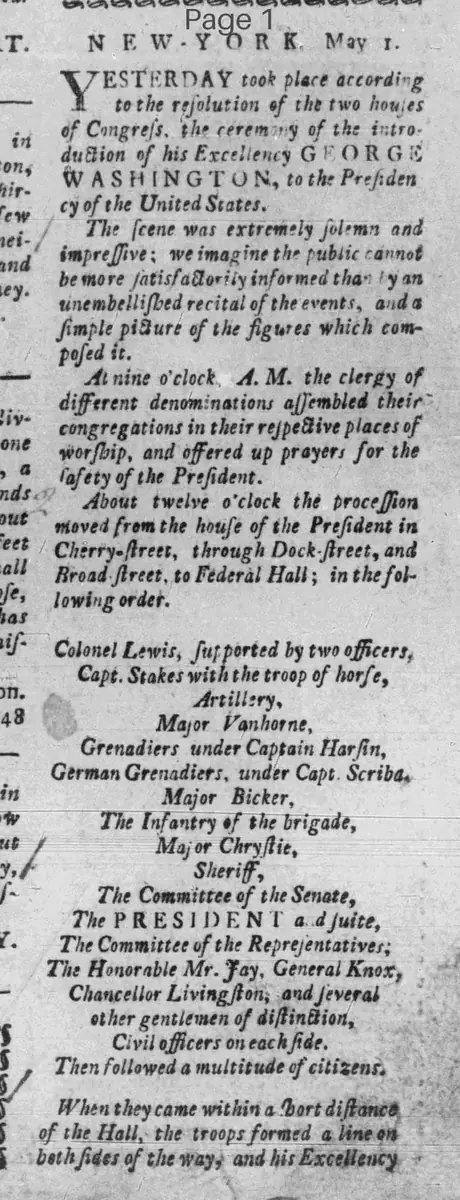
YESTERDAY took place according to the resolution of the two houses of Congress, the ceremony of the introduction of his Excellency GEORGE WASHINGTON, to the Presidency of the United States.
The scene was extremely solemn and impressive; we imagine the public cannot be more satisfactorily informed than by an unembellished recital of the events, and a simple picture of the figures which composed it.
At nine o'clock A.M. the clergy of different denominations assembled their congregations in their respective places of worship, and offered up prayers for the safety of the President.
About twelve o'clock the procession moved from the house of the President in Cherry-street, through Dock-street, and Broad street, to Federal Hall; in the following order.
Colonel Lewis, supported by two officers,
Capt. Stakes with the troop of horse,
Artillery,
Major Vanhorne,
Grenadiers under Captain Harlin.
German Grenadiers, under Capt. Scriba.
Major Bicker,
The Infantry of the brigade,
Major Christy,
Sheriff,
The Committee of the Senate,
The PRESIDENT as usual.
The Committee of the Representatives:
The Honorable Mr. Fay, General Knox Chancellor Livingston; and several other gentlemen of distinction,
Civil officers on each side.
Then followed a multitude of citizens.
When they came within a short distance of the Hall, the troops formed a line on both sides of the way, and his Excellency
Passing through the ranks, was conducted into the building, and in the Senate Chamber introduced to both houses of Congress, immediately afterwards, accompanied by the two houses. He went into the gallery fronting Broad-street where in the presence of an immense concourse of citizens, he took the oath prescribed by the constitution, which was administered to him by the Honorable R. R. Livingston, Esq; Chancellor of the state of New-York. Immediately after he had taken the oath, the chancellor proclaimed him President of the United States. Was answered by the discharge of 13 guns, and by loud repeated shouts; on this the President bowed to the people, and the air again rang with their acclamations. His Excellency with the two houses, then retired to the Senate Chamber, where he made the following SPEECH.
Fellow-Citizens of the Senate, and of the House of Representatives.
AMONG the vicissitudes incident to life, no event could have filled me with greater anxieties, than that of which the notification was transmitted by your order, and received on the 14th day of the present month. On the one hand, I was summoned by my country, whose voice I can never hear but with veneration and love. from a retreat which I had chosen with the fondest predilection, and in my flattering hopes, with an immutable decision, as the asylum of my declining years; a retreat which was rendered every day more necessary, as well as more dear to me, by the addition of habit to inclination, and of frequent interruptions in my health to the gradual waste committed on it by time. On the other hand, the magnitude and difficulty of the trust to which the voice of my country called me, being sufficient to awaken in the wisest and most experienced of her citizens, a distrustful scrutiny into his qualifications, could not but overwhelm with despondence one, who, inheriting inferior endowments from nature, and unpractised in the duties of civil administration, ought to be peculiarly conscious of his own deficiencies. In this conflict of emotions all I dare aver is, that it has been my faithful study to collect my duty from a just appreciation of every circumstance, by which it might be affected. All I dare hope, is, that, if in executing this task, I have been too much swayed by a grateful remembrance of former instances, or by an affectionate sensibility to this transcendent proof of the confidence of my fellow citizens; and have thence too little consulted my incapacity as well as disinclination for the weighty and untried cares before me; my error will be palliated by the motives which misled me, and its consequences be judged by my country, with some bare of the partiality in which they originated.
Such being the impressions under which I have, in obedience to the public summons, repaired to the present station; it would be peculiarly improper to omit in this first official act my fervent supplications to that Almighty Being who rules over the universe; who presides in the councils of nations; and whose providential aids can supply every human defect; that His benediction may consecrate to the liberties and happiness of the people of the United States, a government instituted by themselves for these essential purposes; and may enable every instrument employed in its administration to execute with success the functions allotted to his charge. In tendering this homage to the Great Author of every public and private good, I assure myself that it expresses your sentiments not less than my own; nor those of my fellow citizens at large, less than either. No people can be bound to acknowledge and adore the invisible Hand, which conducts the affairs of men, more than the people of the United States. Every step by which they have advanced to the character of an independent nation, seems to have been distinguished by some token of providential agency. And in the important revolution just accomplished in the system of their united government, the tranquil deliberations, and voluntary consent of so many distinct communities, from which the event has resulted, cannot be compared with the means by which most governments have been established, without some return of pious gratitude, along with an humble anticipation of the future blessings which the past seems to presage. These reflections arising out of the present crisis, have forced themselves too strongly on my mind to be suppressed.
ent crisis, have forced themselves too strongly on my mind to be suppressed. They will accompany me while I continue to discharge the duties of my office. In some, I trust, they will be found to strengthen that sincere zeal for the public welfare, by which I have been ever animated. In others, I am sure, they will be a source of additional instruction.
I will join with you. I trust. in thinking, that there are none under the influence of which, the proceedings of a new and free government can more auspiciously commence.
By the article establishing the executive department, it is made the duty of the President "to recommend to your consideration, such measures as he shall judge necessary and expedient." The circumstances under which I now meet you, will acquit me from entering into that subject, farther than to refer to the great constitutional charter under which you are assembled, and which, in defining your powers, designates the objects to which your attention is to be given. It will be more consistent with those circumstances, and far more congenial with the feelings which actuate me, to substitute, in place of recommendation of particular measures, the tribute that is due to the talents, the rectitude, and the patriotism which adorn the characters elected to devise and adopt them. In those honorable qualifications, I behold the surest pledges, that as on one side, no local prejudices, or attachments; no separate views nor party animosities, will misdirect the comprehensive and equal eye which ought to watch over this great assemblage of communities and interests; so, on another, that the foundations of our national policy will be laid in the pure and immutable principles of private morality; and the pre-eminence of free government, be exemplified by all the attributes which can win the affections of its citizens: and command the respect of the world. I dwell on this prospect with every satisfaction which an ardent love for my country can inspire. Since there is no truth more thoroughly established, than that there exists in the economy and course of nature, an indissoluble union between virtue and happiness; between duty and advantage, between the genuine maxims of an honest and magnanimous policy, and the solid rewards of public prosperity and felicity. Since we ought to be no less persuaded that the propitious smiles of Heaven, can never be expected on a nation that disregards the eternal rules of order and right, which Heaven itself has ordained. And since the preservation of the sacred fire of liberty, and the destiny of the republican model of government, are justly considered as deeply, perhaps as finally staked on the experiment entrusted to the hands of the American people.
Besides the ordinary objects submitted to your care, it will remain with your judgment to decide, how far an exercise of the occasional power delegated by the fifth article of the constitution, is rendered expedient at the present juncture by the nature of objections which have been urged against the system, or by the degree of inquietude which has given birth to them. Instead of undertaking particular recommendations on this subject, in which I could be guided by no lights derived from official opportunities, I shall again give way to my entire confidence in your discernment and pursuit of the public good.
For I assure myself that whilst you carefully avoid every alteration which might endanger the benefits of an united and effective government, or which ought to await the future lessons of experience; a reverence for the characteristic rights of freemen, and a regard for the public harmony, will sufficiently influence your deliberations on the question, how far the former can be more impregnably fortified, or the latter safely and advantageously promoted.
To the preceding observations I have one to add, which will be most properly addressed to the House of Representatives. It concerns myself, and will therefore be as brief as possible. When I was first honored with a call into the service of my country, then on the eve of an arduous struggle for its liberties, the light in which I contemplated my duty required that I should renounce every pecuniary compensation. From this resolution I have in no instance departed. And being still under the impressions which produced it, I must decline as inapplicable to myself, any share in the personal emoluments, which may be indispensably included in a permanent provision for the executive department; and must accordingly pray, that the pecuniary estimates for the station in which I am placed: may, during my continuance in it, be limited to such actual expenditures, as the public good may be thought to require.
Having thus imparted to you my sentiments, as they have been awakened by the occasion which brings us together, I shall take my present leave; but not without resorting once more to the benign Parent of the human race, in humble supplication, that since He has been pleased to favor the American people with opportunities for deliberating in perfect tranquility, and dispositions for deciding with unparalleled unanimity on a form of government, for the security of their union and the advancement of their happiness: so His Divine blessing may be equally conspicuous in the enlarged views, the temperate consultations, and the wise measures, on which the success of this government must depend.
GEORGE WASHINGTON.
His Excellency, accompanied by the Vice-President, the Speaker of the House of Representatives, and both Houses of Congress, then went to Paul's chapel, where divine service was performed by the Right Reverend Dr. Provost, Bishop of the Episcopal Church in this State, and Chaplain to Congress. The religious solemnity being ended, the President was escorted to his house, and the citizens retired to their homes. In the evening was exhibited under the direction of Colonel Bauman, a very ingenious and splendid show of Fireworks; the various kinds of which, want of time will not permit us to particularize. Betwixt the Fort and the Bowling Green stood conspicuous, a superb and brilliant transparent painting: in the centre of which was the portrait of the President, represented under the emblem of Fortitude: on his right hand Justice representing the State of the United States, and several figures and decorations were painted with great taste and judgment in the front of the structure. The Count de Mounier's house was elegantly illuminated, and a variety of transparent paintings were exhibited. His Excellency Don Diego de Gardoqui's house also displayed a great assemblage of beautiful figures, executed in the most masterly and striking manner and which attracted considerable attention from the vast multitude of citizens assembled to view the various scenes of the evening.
In this sketch of the proceedings of the day, we ought not to omit that Mr. Dohrman's ship the North Carolina, was handsomely dressed, and at sun-set discharged thirteen cannon in honor of the day, and in the evening was brilliantly illuminated. Nor ought we to be unmindful of the truly beautiful and superb scenery that was displayed in the front of the Theatre. The ceremony of this memorable day completed the organization of the Federal Body. Every honest man must feel a singular felicity in contemplating this day. Good government, the best of blessings, now commences under favorable auspices. We beg leave to congratulate our readers on the great event.
What sub-type of article is it?
What themes does it cover?
What keywords are associated?
What entities or persons were involved?
Where did it happen?
Story Details
Key Persons
Location
New York
Event Date
1789 04 30
Story Details
Procession to Federal Hall, oath of office taken by George Washington, inaugural address delivered, followed by divine service and public celebrations including fireworks.