Thank you for visiting SNEWPapers!
Sign up free
Norfolk Gazette And Publick Ledger
Norfolk, Virginia
What is this article about?
Judge Carrington's opinion in a Virginia court case regarding the forfeiture of town lots in Winchester due to unpaid rents from Lord Fairfax's 1753 grant. He rules that the 5s. sterling rent is a ground rent, not a quit-rent, allowing the appellant (Marshall) to enforce re-entry after non-payment, reversing the district court's decision.
Merged-components note: Merged continuation of law report across pages; relabeled from notice to story as it is part of the narrative.
Clippings
1 of 2
OCR Quality
Full Text
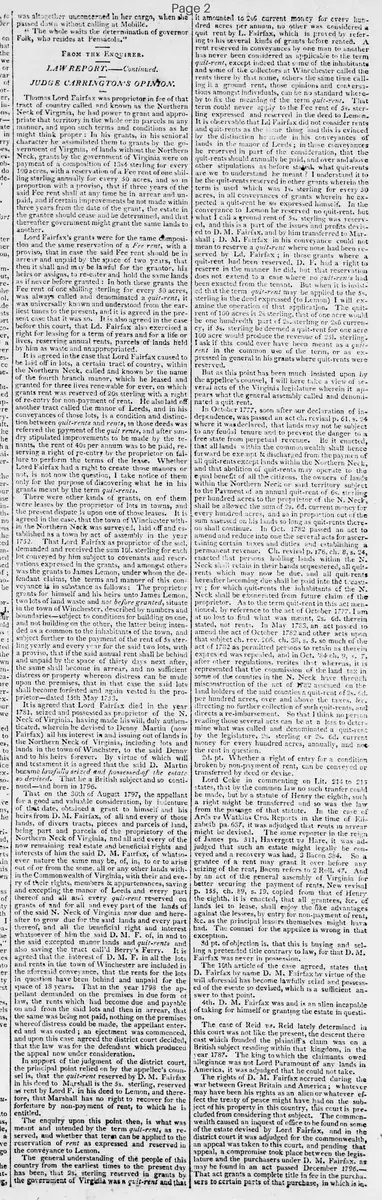
LAW REPORT.--Continued.
JUDGE CARRINGTON'S OPINION.
Thomas Lord Fairfax was proprietor in fee of that tract of country called and known as the Northern Neck of Virginia, he had power to grant and appropriate that territory in the whole or in parcels in any manner, and upon such terms and conditions as he might think proper: In his grants, in his seignorial character he assimilated them to grants by the government of Virginia, of lands without the Northern Neck, grants by the government of Virginia were on payment of a composition of 13s 4 sterling for every 100 acres, with a reservation of a fee rent of one shilling sterling annually for every 50 acres, and so in proportion with a proviso, that if three years of the said fee rent shall at any time be in arrear and unpaid, and if certain improvements be not made within three years from the date of the grant, the estate in the grantee should cease and be determined, and that thereafter government might grant the same lands to another.
Lord Fairfax's grants were for the same composition and the same reservation of a fee rent, with a proviso, that in case the said fee rent should be in arrear and unpaid by the space of two years, that then it shall and may be lawful for the grantor, his heirs or assigns, to re-enter and hold the same lands as if never before granted: In both these grants the fee rent of one shilling sterling for every 50 acres, was always called and denominated a quit-rent, it was universally known and understood from the earliest times to the present, and it is agreed in the present case that it was so. It is also agreed in the case before this court, that Ld. Fairfax also exercised a right for leasing for a term of years and for a life or lives, reserving annual rents, parcels of lands held by him as waste and unappropriated.
It is agreed in the case that Lord Fairfax caused to be laid off in lots, a certain tract of country, within the Northern Neck, called and known by the name of the fourth branch manor, which he leased and granted for three lives renewable for ever, on which grants rent was reserved of 20s sterling with a right of re-entry for non-payment of rent. He also laid off another tract called the manor of Leeds, and in his conveyances of those lots, is a condition and distinction between quit-rents and rents, in those deeds was reserved the payment of the quit rents, and after sundry stipulated improvements to be made by the tenants, the rent of 40s per annum was to be paid, reserving a right of re-entry by the proprietor on failure to perform the terms of the lease. Whether Lord Fairfax had a right to create those manors or not, is not now the question, I take notice of them only for the purpose of discovering what he in his grants meant by the term quit-rents.
There were other kinds of grants, one of them were leases by the proprietor of lots in towns, and the present dispute is upon one of those leases. It is agreed in the case, that the town of Winchester within the Northern Neck was surveyed, laid off and established as a town by act of assembly in the year 1752. That Lord Fairfax as proprietor of the soil, demanded and received the sum 10l. sterling for each lot conveyed by him subject to covenants and reservations expressed in the grants, and amongst others was the grants to James Lemon, under whom the defendant claims, the terms and manner of this conveyance is in substance as follows: The proprietor grants for himself and his heirs unto James Lemon, two lots of land waste and not before granted, situate in the town of Winchester, described by numbers and boundaries—subject to conditions for building on one, and not building on the other, the latter being intended as a common to the inhabitants of the town, and subject further to the payment of the rent of 5s sterling yearly and every year for the said two lots, with a proviso, that if the said annual rent shall be behind and unpaid by the space of thirty days next after the same shall become in arrear, and no sufficient distress or property whereon distress can be made upon the premises, that in that case the said lots shall become forfeited and again vested in the proprietor—dated 15th May 1753.
It is agreed that Lord Fairfax died in the year 1781, seized and possessed as proprietor of the N. Neck of Virginia, having made his will, duly authenticated, wherein he devised to Denny Martin (now Fairfax) all his interest in and issuing out of lands in the Northern Neck of Virginia, including lots and lands in the town of Winchester, to the said Denny and to his heirs forever. By virtue of which will and testament it is agreed that the said D. Martin became lawfully seized and possessed of the estate so devised. That he a British subject and so continued—and born in 1796.
That on the 30th of August 1797, the appellant for a good and valuable consideration, by indenture of that date, obtained a grant to himself and his heirs from D. M. Fairfax, of all and every of those lands, of divers tracts, pieces and parcels of land, being part and parcels of the proprietory of the Northern Neck of Virginia, and all and every of the now remaining real estate and beneficial rights and interests of him the said D. M. Fairfax, of whatsoever nature the same may be, of, in, to or to arise out of or from the some, all or any other lands within the Commonwealth of Virginia, with their and every of their rights, members & appurtenances, saving and excepting the manor of Leeds and every part thereof and all and every quit-rent reserved on grants of and for all and every part of the lands of the said N. Neck of Virginia now due and hereafter to grow due for the said lands and every part thereof, and all the beneficial right and interest whatsoever of him the said D. M. F. of, in and to the said excepted manor lands and quit-rents and also saving the tract call'd Berry's Ferry. It is agreed that the interest of D. M. F. in all the lots and rents in the town of Winchester are included in the aforesaid conveyance, that the rents for the lots in question have been behind and unpaid for the space of 18 years. That in the year 1798 the appellant demanded on the premises in due form of law, the rents which had become due and payable on and from the said lots and then in arrear, that the same was being not paid, nothing on the premises whereof distress could be made, the appellant entered and was ousted; an ejectment was commenced, and upon this case agreed the district court decided, that the law was for the defendant which produced the appeal now under consideration.
In support of the judgment of the district court, the principal point relied on by the appellee's counsel is, that the quit-rent reserved by D. M. Fairfax in his deed to Marshall is the 5s. sterling, reserved as rent by Lord F. in his deed to Lemon, and therefore, that Marshall has no right to recover for the forfeiture by non-payment of rent, to which he is entitled,
The enquiry upon this point then, is what was meant and intended by the term quit-rent; as reserved, and whether that term can be applied to the reservation of rent as expressed and reserved in the conveyance to Lemon.
The general understanding of the people of this country from the earliest times to the present day has been, that 2s. sterling reserved in grants by the government of Virginia was a quit-rent and that it amounted to 2s 6 current money for every hundred acres per annum, no other was considered a quit rent by L. Fairfax, which is proved by referring to his several kinds of grants before rented. A rent reserved in conveyances by one man to another has never been considered as applicable to the term quit-rent, except indeed that some of the inhabitants and some of the collectors at Winchester called the rents there by that name, others the same time calling it a ground rent, those opinions and conversations amongst individuals, can be no standard whereby to fix the meaning of the term quit-rent. That term could never apply to the fee rent of 5s. sterling expressed and reserved in the deed to Lemon.
It is observable that Ld Fairfax did not consider rents and quit-rents as the same thing and this is evinced by the distinction he made in his conveyances of lands in the manor of Leeds; in those conveyances he reserved in part of the consideration, that the quit-rents should annually be paid, and over and above other stipulations as before stated, what quit-rents are we to understand he meant? I understand it to be the quit-rents reserved in other grants wherein the term is used which was 1s. sterling for every 50 acres, in all conveyances of grants wherein he expected a quit-rent he so expressed himself. In the conveyance to Lemon he reserved no quit-rent, but what I call a ground rent of 5s. sterling was reserved, and this is a part of the issues and profits devised to D. M. Fairfax, and by him transferred to Marshall; D. M. Fairfax in his conveyance could not mean to reserve a quit-rent where none had been reserved by Ld. Fairfax; in those grants where a quit-rent had been reserved, D. F. had a right to reserve in the manner he did, but that reservation does not extend to a case where no quit-rents had been exacted from the tenant. But when it is insisted that the term quit-rent may be applied to the 5s. sterling in the deed expressed (to Lemon) I will examine the operation of that application. The quit-rent of 100 acres is 2s sterling, that of one acre would be one hundredth part of 2s. sterling or 2s 6 currency, if 5s. sterling be deemed a quit-rent for one acre 100 acre would produce the revenue of 25l. sterling. I ask if this could ever have been meant as a quit-rent in the common use of the term, or as expressed in general in his grants where quit-rents were reserved,
But as this point has been much insisted upon by the appellee's counsel, I will here take a view of several acts of the Virginia legislature wherein it appears what the general assembly called and denominated a quit-rent.
In October 1777, soon after our declaration of independence, was passed an act ch. revisal p. 61, s. 24 where it was declared, that lands may not be subject to any feudal tenure and to prevent the danger to a free state from perpetual revenue. Be it enacted, that all lands within the commonwealth shall henceforward be exempt & discharged from the payment of all quit-rents except lands within the Northern Neck, and that abolition of quit-rents may operate to the equal benefit of all the citizens, the owners of lands within the Northern Neck or said territory subject to the payment of an annual quit-rent of 6s. sterling per hundred acres to the proprietor of the N. Neck, shall be allowed the sum of 2s. 6d. current money for every hundred acres, and so in proportion out of the sum assessed on his lands so long as quit-rents thereon shall continue. In Oct. 1782 passed an act to amend and reduce into one the several acts for ascertaining certain taxes and duties and establishing a permanent revenue. Ch. revisal p. 176, ch. 8, s. 24, enacted that persons holding lands within the N. Neck shall retain in their hands sequestered, all quit-rents which may now be due, and all quit-rents hereafter becoming due shall be paid into the treasury; for which quit-rents the inhabitants of the N. Neck shall be exonerated from future claim of the proprietor. As to the term quit-rent in this act mentioned, by reference to the act of October 1777. I am at no loss to find what was meant, 2s. 6d. therein stated, not rents. In May 1783, an act passed to amend the act of October 1782 and other acts upon that subject ch. rev. 206. ch. 38, s. 5. so much of the act of 1782 as permitted persons to retain as therein expressed was repealed, and in Oct. '84 ch. 9, s. 7, after other regulations, recites that whereas, it is represented that the commission of the land tax in some of the counties in the N. Neck have through misconstruction of the act of 1782 assessed on the land holders of the said counties a quit-rent of 2s. 6d. per hundred acres, over and above the taxes, &c. directing no further collection of such quit-rents, and directs a re-imbursement. So that I think no person reading those several acts can be at a loss to determine what was called and denominated a quit-rent by the legislature, 2s. sterling or 2s. 6d. current money for every hundred acres, annually, and not the rent in question.
2d. pt. Whether a right of entry for a condition broken by non-payment of rent, can be conveyed or transferred by deed or devise.
Lord Coke in commenting on Lit. 214 to 215 states, that by the common law no such transfer could be made, but by a statute of Henry the eighth, such a right might be transferred and so was the law from the passage of that statute. In the case of Ards vs Watkins Cro. Reports in the time of Elizabeth pa. 637, it was adjudged that rents in arrear might be devised. The same reporter in the reign of James pa. 511, Havergott vs Hare, it was adjudged that such an estate might legally be conveyed and a recovery was had, 3 Bacon 584. So a grantee of a rent may grant it over before any seizing of the rent, Bacon refers to 2 Roll. 47. And by an act of the general assembly of Virginia for better securing the payment of rents, New revisal p. 155, ch. 89, s. 19, copied from that of Henry the eighth, it is enacted, that all grantees, &c. of lands let to lease, shall enjoy the like advantages against the lessees, by entry for non-payment of rent, &c. as the principal lessors themselves might have had. The counsel for the appellee is wrong in that exception.
3d pt. of objection is, that this is buying and selling a pretended title contrary to law, for that D. M. Fairfax was never in possession.
The 10th article of the case agreed, states that D. Fairfax by name D. M. Fairfax by virtue of the will aforesaid has become lawfully seized and possessed of the estate so devised, which is a sufficient answer to that point.
4th. D. M. Fairfax was and is an alien incapable of taking for himself or granting the estate in question.
The case of Reid vs. Reid lately determined in this court was not like the present, the descent there cast which founded the plaintiff's claim was on a British subject residing within that kingdom, in the year 1787. The king to which the claimants owed allegiance was not Lord Paramount of any lands in America, it was adjudged that he could not take.
The rights of D. M. Fairfax accrued during the war between Great Britain and America; whatever may have been his rights as an alienor whatever effect the treaty of peace might have had on the subject of his property in this country, this court is precluded from considering that subject. The commonwealth caused an inquest of office to be found on some of the estate devised by Lord Fairfax, and in the district court it was adjudged for the commonwealth, an appeal was taken to this court, and pending that appeal, a compromise took place between the legislature and the purchasers under D. M. Fairfax, as may be found in an act passed December 1796.- That act grants a complete title in fee in the purchasers to certain parts of that purchase, in which is included the lots in question.
Concluded the last in question. The legislature had a right to grant at discretion, and it is agreed that the terms of that act have been complied with on the part of the purchasers.
Of whatever opinion I might have been on the appeal from the judgment of the district court if the act of compromise had not taken place, I now consider myself bound by law to declare that the judgment of the district court is erroneous, that it ought to be reversed and judgment for the appellant.
What sub-type of article is it?
What themes does it cover?
What keywords are associated?
What entities or persons were involved?
Where did it happen?
Story Details
Key Persons
Location
Northern Neck Of Virginia, Town Of Winchester
Event Date
1752 1798
Story Details
Judge Carrington rules in favor of appellant Marshall in a dispute over forfeiture of Winchester lots granted by Lord Fairfax in 1753 for non-payment of 5s. sterling ground rent, distinguishing it from quit-rents, upholding transfer rights and legislative compromise validating the title.