Thank you for visiting SNEWPapers!
Sign up free
Daily National Intelligencer
Washington, District Of Columbia
What is this article about?
The 13th Congress of the United States convened in Washington City on May 24-25, 1813. Vice President Elbridge Gerry addressed the Senate, emphasizing unity and resolve in the War of 1812. The House elected Henry Clay as Speaker with 89 votes.
Clipping
OCR Quality
Full Text
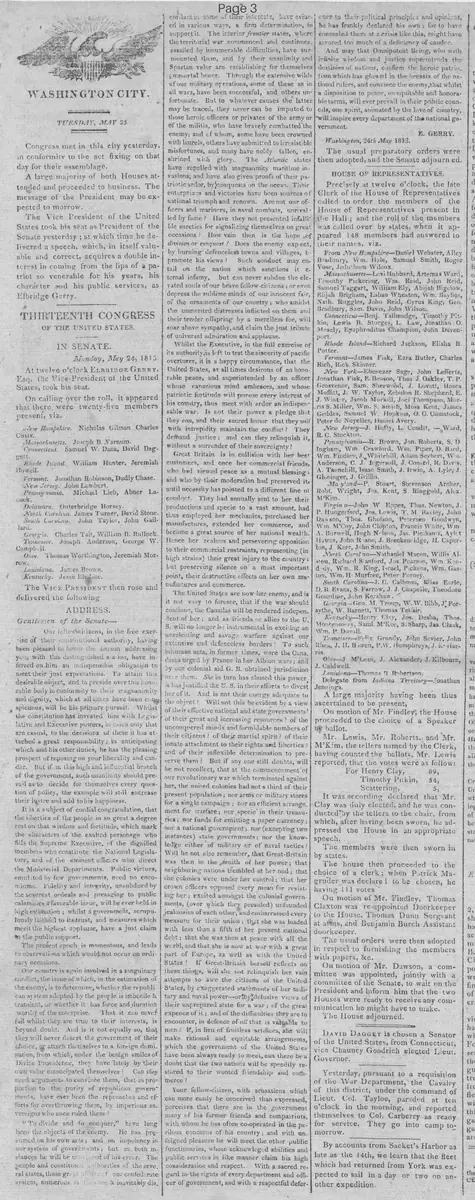
TUESDAY, MAY 25.
Congress met in this city yesterday, in conformity to the act fixing on that day for their assemblage. A large majority of both Houses attended and proceeded to business. The message of the President may be expected to morrow.
The Vice President of the United States took his seat as President of the Senate yesterday; at which time he delivered a speech, which, in itself valuable and correct, acquires a double interest in coming from the lips of a patriot so venerable for his years, his character and his public services, as Elbridge Gerry.
THIRTEENTH CONGRESS
OF THE UNITED STATES.
IN SENATE.
Monday, May 24, 1813.
At twelve o'clock Elbridge Gerry, Esq. the Vice-President of the United States, took his seat. On calling over the roll, it appeared that there were twenty-five members present, viz.
New Hampshire. Nicholas Gilman Charles Cutts.
Massachusetts. Joseph B. Varnum.
Connecticut. Samuel W. Dana, David Daggett.
Rhode Island. William Hunter. Jeremiah Howell.
Vermont. Jonathan Robinson, Dudley Chase.
New Jersey. John Lambert.
Pennsylvania. Michael Lieb, Abner Lacock.
Delaware. Outerbridge Horsey.
North Carolina. James Turner, David Stone.
South Carolina. John Taylor, John Gaillard.
Georgia. Charles Tait, William B. Bullock.
Tennessee. Joseph Anderson, George W. Campbell.
Ohio. Thomas Worthington, Jeremiah Morrow.
Louisiana. James Brown.
Kentucky. Jesse Bledsoe.
The Vice President then rose and delivered the following
ADDRESS.
Gentlemen of the Senate—
Our fellow citizens, in the free exercise of their constitutional authority, having been pleased to honor the person addressing you, with this distinguished station, have inferred on him an indispensable obligation to meet their just expectations. To attain this desirable object, and to preside over this honorable body in conformity to their magnanimity and dignity, which at all times have been conspicuous, will be his primary pursuit. Whilst the constitution has invested him with Legislative and Executive powers, in cases only that are casual, to the decisions of these it has attached a great responsibility; in anticipating which and his other duties, he has the pleasing prospect of reposing on your liberality and candor. But if in this high and influential branch of the government, such unanimity should prevail as to decide for themselves every question of policy, the example will still increase their lustre and add to his happiness.
It is a subject of cordial congratulation, that the liberties of the people in so great a degree rest on that wisdom and fortitude, which mark the characters of the exalted personage who fills the Supreme Executive, of the dignified members who constitute the National Legislature, and of the eminent officers who direct the Ministerial Departments. Public virtues, emulated by few governments, need no encomiums. Fidelity and integrity, unsubdued by the severest ordeals and presaging to public calamities a favorable issue, will be ever held in high estimation; whilst a government, scrupulously faithful to its trust, and measures which merit the highest applause, have a just claim to the public support.
The present epoch is momentous, and leads to observations which would not occur on ordinary occasions. Our country is again involved in a sanguinary conflict, the issue of which, in the estimation of the enemy, is to determine, whether the republican system adopted by the people is imbecile & transient, or whether it has force and duration worthy of the enterprise. That it can never fail whilst they are true to their interests, is beyond doubt. And is it not equally so, that they will never desert the government of their choice, or attach themselves to a foreign domination, from which, under the benign smiles of Divine Providence, they have lately by their own valor emancipated themselves? Can they need arguments to convince them, that in proportion to the purity of republican governments, have ever been the reproaches and efforts for overthrowing them, by imperious sovereigns who once ruled them?
"To divide and to conquer," have long been the objects of the enemy. He has presumed on his own arts; and on impotency in our system of governments; but in both instances he will be convinced of his error. The people and constituted authorities of the several states, those great pillars of our confederate system, numerous as they are & inevitably discordant in some of their interests, have evinced in various ways, a firm determination, to support it. The interior frontier states, where the territorial war commenced and continues, assailed by innumerable difficulties, have surmounted them, and by their unanimity and Spartan valor are establishing for themselves immortal honor. Through the extensive wilds of our military operations, some of these as in all wars, have been successful, and others unfortunate. But to whatever causes the latter may be traced, they never can be imputed to those heroic officers or privates of the army or of the militia, who have bravely combatted the enemy; and of whom, some have been crowned with laurels, others have submitted to irresistible misfortunes, and many have nobly fallen, enshrined with glory. The Atlantic states have repelled with magnanimity maritime invasions, and have also given proofs of their patriotic ardor, by conquests on the ocean. Their enterprizes and victories have been sources of national triumph and renown. Are not our officers and mariners, in naval combats, unrivalled by fame? Have they not presented infallible sureties for signalizing themselves on great occasions? How vain then is the hope of dirision or conquest! Does the enemy expect, by burning defenceless towns and villages, to promote his views? Such conduct may entail on the nation which sanctions it eternal infamy, but can never subdue the elevated souls of our brave fellow-citizens; or even depress the sublime minds of our innocent fair, the ornaments of our country; who amidst the unmerited distresses inflicted on them and their tender offspring by a merciless foe, will soar above sympathy, and claim the just tribute of universal admiration and applause.
Whilst the Executive, in the full exercise of its authority, is left to test the sincerity of pacific overtures, it is a happy circumstance, that the United States, at all times desirous of an honorable peace, and superintended by an officer whose capacious mind embraces, and whose patriotic fortitude will pursue every interest of his country, thus meet with ardor an indispensable war. Is not their power a pledge that they can, and their sacred honor that they will with intrepidity maintain the conflict? They demand justice; and can they relinquish it, without a surrender of their sovereignty?
Great Britain is in collision with her best customers, and once her commercial friends, who had viewed peace as a mutual blessing; and who by their moderation had preserved it until necessity has pointed to a different line of conduct. They had annually sent to her their productions and specie to a vast amount, had thus employed her mechanics, purchased her manufactures, extended her commerce, and become a great source of her national wealth. Hence her zealous and persevering opposition to their commercial restraints, representing (in high strains) their great injury to the country; but preserving silence on a most important point, their destructive effects on her own manufactures and commerce.
The United States are now her enemy, and is it not easy to foresee, that if the war should continue, the Canadas will be rendered independent of her; and as friends or allies to the U. S. will no longer be instrumental in exciting an unrelenting and savage warfare against our extensive and defenceless borders? To such inhuman acts, in former times, were the Canadians urged by France in her Albion wars; and by our colonial aid G. B. obtained jurisdiction over them. She in turn has abused this power & has justified the U. S. in their efforts to divest her of it. And is not their energy adequate to the object? Will not this be evident by a view of their effective national and state governments? of their great and increasing resources? of the unconquered minds and formidable numbers of their citizens? of their martial spirit? of their innate attachment to their rights and liberties? and of their inflexible determination to preserve them? But if any one still doubts, will he not recollect, that at the commencement of our revolutionary war which terminated against her, the united colonies had not a third of their present population; nor arms or military stores for a single campaign; nor an efficient arrangement for warfare; nor specie in their treasuries; nor funds for emitting a paper currency: nor a national government; nor (excepting two instances) state governments; nor the knowledge either of military or of naval tactics?
Will he not also remember, that Great-Britain was then in the zenith of her power; that neighboring nations trembled at her nod; that the colonies were under her control; that her crown officers opposed every mean for resisting her; excited amongst the colonial governments, (over which they presided) unfounded jealousies of each other, and embarrassed every measure for their union; that she was loaded with less than a fifth of her present national debt; that she was then at peace with all the world, and that she is now at war with a great part of Europe, as well as with the United States? If Great-Britain herself reflects on these things, will she not relinquish her vain attempts to awe the citizens of the United States, by exaggerated statements of her military and naval power—or by delusive views of their unprepared state for a war; of the great expence of it; and of the difficulties they are to encounter, in defence of all that is valuable to men? If, in lieu of fruitless artifices, she will make rational and equitable arrangements, which the government of the United States have been always ready to meet, can there be a doubt that the two nations will be speedily restored to their wonted friendship and commerce?
Your fellow-citizen, with sensations which can more easily be conceived than expressed, perceives that there are in the government many of his former friends and compatriots, with whom he has often co-operated in the perilous concerns of his country; and with unfeigned pleasure he will meet the other public functionaries, whose acknowledged abilities and public services in like manner claim his high consideration and respect. With a sacred regard to the rights of every department and officer of government, and with a respectful deference to their political principles and opinions he has frankly declared his own: for to have concealed them at a crisis like this, might have savored too much of a deficiency of candor. And may that Omnipotent Being, who with infinite wisdom and justice superintends the destinies of nations, confirm the heroic patriotism which has glowed in the breasts of the national rulers, and convince the enemy, that whilst a disposition to peace, on equitable and honorable terms, will ever prevail in their public councils, one spirit, animated by the love of country, will inspire every department of the national government.
E. GERRY.
Washington, 24th May 1813.
The usual preparatory orders were then adopted, and the Senate adjourned
HOUSE OF REPRESENTATIVES.
Precisely at twelve o'clock, the late Clerk of the House of Representatives called to order the members of the House of Representatives present in the Hall: and the roll of the members was called over by states, when it appeared 148 members had answered to their names, viz.
From New Hampshire—Daniel Webster, Alley Bradbury, Wm. Hale, Samuel Smith, Roger Vose, Jeduthun Wilcox.
Massachusetts—Levi Hubbard. Artemas Ward Timothy Pickering, Wm. Reed, John Reed. Samuel Taggart, William Ely, Abijah Bigelow Elijah Brigham, Laban Wheaton, Wm. Baylies, Nath. Ruggles, John Reed, Cyrus King; Geo. Bradbury. Sam. Davis. John Wilson.
Connecticut—Benj. Tallmadge, Timothy Pitkin, Lewis B. Sturges, L. Law, Jonathan O. Mosely, Epaphroditus Champion, John Davenport.
Rhode Island—Richard Jackson, Elisha R. Potter.
Vermont—James Fisk, Ezra Butler, Charles Rich, Rich. Skinner.
New York—Ebenezer Sage, John Lefferts, Jonathan Fisk, E. Benson, Thos J. Oakley, T. P. Grosvenor, Sam. Sherwood, J. Lovett, Hosea Moffitt, J. W. Taylor, Zebulon R. Shepherd, E. J. Winter, Jacob Murkill, Joel Thompson, Morris S. Miller, Wm. S. Smith, Moss Kent, James Geddes, Samuel W. Hopkins, O. C. Comstock. Peter de Noyelles; Daniel Avery.
New Jersey—J. Hufty, L. Condit, - Ward R. C. Stockton.
Pennsylvania—R. Brown, Jon. Roberts. S. D Ingham, Wm. Crawford, Wm. Piper, D. Bard, Wm. Findley, J. Whitehill, Adam Seybert, W n. Anderson, C. J. Ingersoll, J. Conard, R. Davis, A. Taunehill, Isaac Smith, J. Irwin, A. Lyle; J. Gloninger, J. Griffin.
Maryland—P. Stuart, Stevenson Archer. Robt. Wright, Jas. Kent, S. Ringgold, Alex. M'Kim.
Virginia—John W. Eppes, Thos. Newton, J. P. Hungerford, Jos. Lewis, T. M Bayley, John Dawson, Thos. Gholson, Peterson Goodwyn, Wm. M'Coy, John Clopton. Francis White, Wm. A. Burwell, Hugh Nelson, Jas. Pleasants, Aylett Hawes, John Ranne, J. Breckenridge, H. Caper ton, J Kerr, John Smith.
North Carolina—Nathaniel Macon. Willis Alston, Richard Stanford, Jos. Pearson. Wm. Kennedy. Wm. R. King, Israel Pickens, Wm. Gaston, Wm. H. Murfree, Peter Forney.
South Carolina—J. C. Calhoun, Elias Earle, D. R. Evans, S. Farrow, J. J. Chapelle, Theodore Gourdine, John Kershaw.
Georgia—Geo. M. Troup, W. W. Bibb, J Forsyth, W. Barnett, Thomas Telfair
Kentucky—Henry Clay, Jos. Desha, Thos. Montgomery, Saml. M'Kee, S. Sharp, Jas. Clark, Wm. P. Duvall.
Tennessee—Felix Grundy. John Sevier, John Rhea, J. H. Bowen, P. W. Humphreys, J. K. Harris.
Ohio—J M'Lean, J. Alexander, J. Kilbourn, J. Caldwell.
Louisiana—Thomas B Robertson.
Delegate from Indiana Territory—Jonathan Jennings.
A large majority having been thus ascertained to be present,
On motion of Mr. Findley, the House proceeded to the choice of a Speaker by ballot.
Mr. Lewis, Mr. Roberts, and Mr. M'Kim, the tellers named by the Clerk, having counted the ballots, Mr. Lewis reported, that the votes were as follow:
For Henry Clay, 89,
Timothy Pitkin, 54,
Scattering, 5,
It was accordingly declared that Mr. Clay was duly elected, and he was conducted by the tellers to the chair, from which, after having been sworn, he addressed the House in an appropriate speech.
The members were then sworn in by states.
The house then proceeded to the choice of a clerk; when Patrick Magruder was declared to be chosen, he having 111 votes
On motion of Mr. Findley, Thomas Claxton was re-appointed Doorkeeper to the House, Thomas Dunn Sergeant at arms, and Benjamin Burch Assistant doorkeeper.
The usual orders were then adopted in respect to furnishing the members with papers, &c.
On motion of Mr. Dawson, a committee was appointed, jointly with a committee of the Senate, to wait on the President and inform him that the two Houses were ready to receive any communication he might have to make.
The House adjourned.
What sub-type of article is it?
What keywords are associated?
What entities or persons were involved?
Where did it happen?
Domestic News Details
Primary Location
Washington City
Event Date
May 24 25, 1813
Key Persons
Outcome
congress assembled with large majorities; henry clay elected speaker of the house with 89 votes; preparatory orders adopted; committee appointed to inform the president.
Event Details
The 13th Congress convened; Senate roll call showed 25 members present; Vice President Elbridge Gerry delivered an address on national unity and the War of 1812; House roll call showed 148 members; Henry Clay elected Speaker, Patrick Magruder as Clerk, and other officers appointed.