Thank you for visiting SNEWPapers!
Sign up free
Gazette Of The United States & Evening Advertiser
Philadelphia, Philadelphia County, Pennsylvania
What is this article about?
Continuation of Mr. Tracy's speech in the House of Representatives on January 24, defending British trade practices, critiquing French reciprocity, and arguing against new treaties or restrictions that entangle the U.S. in European conflicts, emphasizing neutral rights and negotiation.
Merged-components note: Continuation of Mr. Tracy's speech reported in Congress from page 1 to page 2; relabeled from 'editorial' to 'story' as it is a factual report of congressional proceedings.
Clippings
1 of 2
OCR Quality
Full Text
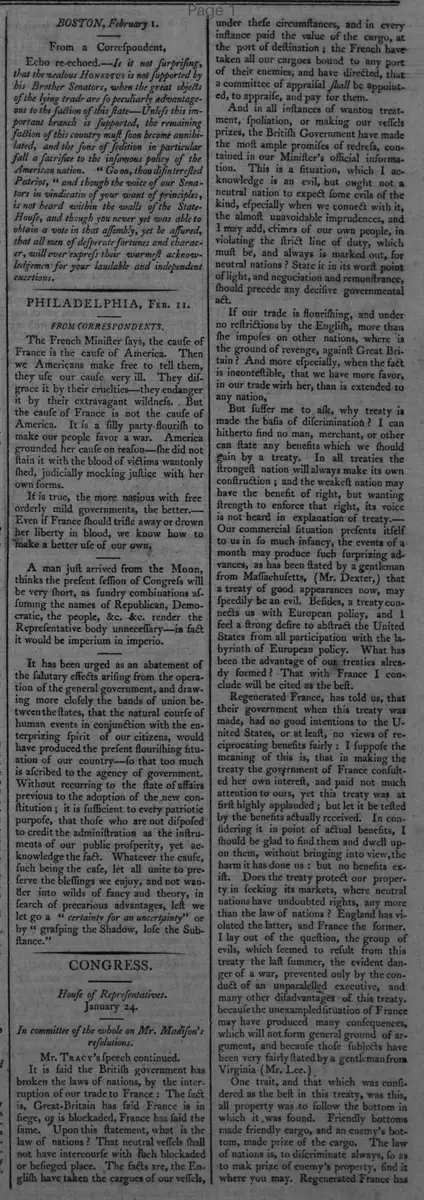
House of Representatives.
January 24.
In committee of the whole on Mr. Madison's resolutions.
Mr. Tracy's speech continued.
It is said the British government has broken the laws of nations, by the interruption of our trade to France : The fact is, Great-Britain has said France is in siege, or is blockaded, France has said the same. Upon this statement, what is the law of nations ? That neutral vessels shall not have intercourse with such blockaded or besieged place. The facts are, the English have taken the cargoes of our vessels, under these circumstances, and in every instance paid the value of the cargo, at the port of destination; the French have taken all our cargoes bound to any port of their enemies, and have directed, that a committee of appraisal shall be appointed, to appraise, and pay for them. And in all instances of wanton treatment, spoliation, or making our vessels prizes, the British Government have made the most ample promises of redress, contained in our Minister's official information. This is a situation, which I acknowledge is an evil, but ought not a neutral nation to expect some evils of the kind, especially when we connect with it, the almost unavoidable imprudences, and I may add, crimes of our own people, in violating the strict line of duty, which must be, and always is marked out, for neutral nations ? State it in its worst point of light, and negociation and remonstrance, should precede any decisive governmental act.
If our trade is flourishing, and under no restrictions by the English, more than the impositions on other nations, where is the ground of revenge, against Great Britain ? And more especially, when the fact is incontestible, that we have more favor in our trade with her, than is extended to any nation,
But suffer me to ask, why treaty is made the basis of discrimination ? I can hitherto find no man, merchant, or other can state any benefits which we should gain by a treaty. In all treaties the strongest nation will always make its own construction ; and the weakest nation may have the benefit of right, but wanting strength to enforce that right, its voice is not heard in explanation of treaty.-- Our commercial situation presents itself to us in so much infancy, the events of a month may produce such surprising advances, as has been stated by a gentleman from Massachusetts, (Mr. Dexter,) that a treaty of good appearances now, may speedily be an evil. Besides, a treaty connects us with European policy, and I feel a strong desire to abstract the United States from all participation with the labyrinth of European policy. What has been the advantage of our treaties already formed? That with France I conclude will be cited as the best. Regenerated France, has told us, that their government when this treaty was made, had no good intentions to the United States, or at least, no views of reciprocating benefits fairly : I suppose the meaning of this is, that in making the treaty the government of France consulted her own interest, and paid not much attention to ours, yet this treaty was at first highly applauded ; but let it be tested by the benefits actually received. In considering it in point of actual benefits, I should be glad to find them and dwell upon them, without bringing into view, the harm it has done us : but no benefits exist. Does the treaty protect our property in seeking its markets, where neutral nations have undoubted rights, any more than the law of nations ? England has violated the latter, and France the former. I lay out of the question, the group of evils, which seemed to result from this treaty the last summer, the evident danger of a war, prevented only by the conduct of an unparallelled executive, and many other disadvantages of this treaty. because the unexampled situation of France may have produced many consequences, which will not form general ground of argument, and because those subjects have been very fairly stated by a gentleman from Virginia (Mr. Lee.) One trait, and that which was considered as the best in this treaty, was this, all property was to follow the bottom in which it was found. Friendly bottoms made friendly cargo, and an enemy's bottom, made prize of the cargo. The law of nations is, to discriminate always, so as to make prize of enemy's property, find it where you may. Regenerated France has
Been in the constant act, under sanction of this treaty of making prize of all property belonging to citizens of the United States, found in English, Spanish, Portuguese, Austrian, Dutch and Prussian vessels, I mean since those nations have been at war with her; and what do we gain?
It cannot operate in our favor any further than to save French property to them, if found in our vessels, if we had treaties of a similar kind with the world. So that this kind of treaty is uncommonly circumstanced indeed, we can gain nothing but a protection for our friend's property; but lose directly our own: and we never can be in a situation to gain unless we presuppose war, which I hope we may avoid; certainly we are not as liable to war, as the nations in Europe, who are generally in war 3 or 4 years in every 7: of course this trait in treaties is no very inviting one to us. If treaties are formed in the common style, that is, place the nation treating, on the basis of the most favored nations, every one can discern, it amounts to little, if any thing, more than complimentary language of course.
One great object of these resolves is, to effect a treaty with Great Britain, and we are told in the same breath, that Great Britain is in a habit of breaking, not only the law of nations, but solemn treaty. But we are told a free trade or rather a trade on principles of more reciprocity is to be obtained by these regulations: And that France gives us that reciprocity, and of course, we ought to withdraw our trade from the English, and give it to France. If the markets of France, and the benefits of trade in her ports, exceed those of any other nation, our trade will go there of itself if not, why force it? In this part of the argument, I request the liberty of treating both France and England merely as commercial nations, for if commercial benefits are not found in the trade of two nations, I very much doubt the continuation of the trade, from principles of friendship.
What favors do we receive from France, which will justify such an exertion to put down her rival, and build her up? Our trade is at present under no very auspicious circumstances with France; even in the best of times, a merchant having established his correspondence there on the most favored footing, when he sent his cargo, could draw bills for one third of the amount, and they would be honored: the remaining two thirds, after sold, the American merchant would be advised he might draw for, but no interest allowed for the time the French merchant held the property; but if the amount of bills drawn at first, exceeded the third part of sales, interest was charged. The English merchant, would honor his American correspondent's bills, when accompanied by his bill of lading only, for the whole amount, and cargoes have often been purchased and the insurance, wages, and finding of the ship, been paid, out of the avails of her cargo, thus anticipated by bills, before the voyage. This course of trade, as practiced by the two nations, needs no comment. Are the fabrics of the French better than the English? Is this a proper time to depend upon France for our articles of clothing, when she is convulsed to her center by a war? And can any man suppose, the column established in Lyons, sacred to Liberty, is any more favorable to her manufacturers than if no such column had been there, and her manufactures were increasing instead of diminishing? Does the government of France admit us into her West-Indies, with any favor peculiar to us?— The act opening her West-Indies, was no more for us, than the British act is against us, the fact is, neither of them cared for us, they each did what they thought would best promote their own interest.
If these regulations are to unshackle our trade, why not leave it unshackled? The fetters are only changed from one side to the other, and France stamped upon them instead of England. The circumstance of heavily taxing our trade to Great Britain, for the sake of driving it to France, is a proof that it enjoys more freedom where it is. If it be true, that we injure ourselves in the first instance, by these restrictions, although Great Britain deserves punishment, I have said we should be cautious how we sacrifice ourselves to a principle of revenge: But it may be worth enquiry, how much it is probable we can injure Great Britain?
It is said Great Britain depends upon the United States, or the bread of her manufacturers and their raw materials which employ them.
It ought to be remarked here, that a principal complaint against Great Britain is, that she prohibits our bread-stuff, and this is a fact, except in times of scarcity. One would think to hear the declarations in this house, that all men were fed at the openings of our hand, and if we shut that hand, the nations starve, and if we but shake the fist after it is shut, they die. This language, to say no more of it, will prove our origin to be British and that not long ago, for the same gentlemen say, the British nation is proud in the extreme.
It is well known the Dutch are in treaty with us, and of course are to be favoured by the third resolution, which places all nations in treaty with us, on a footing of lower tonnage: It is likewise known that the English have as much ascendancy over the Dutch as propriety would dictate: What would these restrictions do then, at best, but shape the course of our trade through Holland? Our trade might perhaps come more from the Texel than the Thames, but the names would constitute the chief difference.
Spain and Portugal, in Europe, and their other dominions, if once called upon by necessity, can raise bread stuff to an unlimited amount. And if we refuse our provisions to the West Indies, would not Great Britain thank us, for the bounty we should give, in that very act of denial to the Canadian country, which she is so rapidly filling, even with our own citizens? The provisions of every kind, which may be raised there, no man can limit with any kind of certainty. But cannot Great Britain retaliate, and distress us in a commercial war? I will not enlarge upon this, it has already been shown, that Great Britain can retaliate with ten-fold advantages.
It is said although she can injure us in part, she will suffer in the greatest degree and that our sufferings will be spread nearly over the whole community, each will bear a part, but Great Britain will suffer in one entire class of citizens, her manufacturers. It will be but a poor consolation to our farmers at large, when they find themselves suffering, to inform them, that a very innocent set of men, the manufacturers of Great Britain are suffering much more than they do; and if they should clamour against government, it would be an unsatisfactory answer to them, that there was a greater clamour, and even mob in England.
(To be concluded in our next.)
What sub-type of article is it?
What themes does it cover?
What keywords are associated?
What entities or persons were involved?
Where did it happen?
Story Details
Key Persons
Location
House Of Representatives
Event Date
January 24
Story Details
Mr. Tracy argues that British actions on neutral trade are lawful under blockades and compensated, unlike French seizures; critiques U.S.-France treaty for lacking benefits and causing harms; opposes new treaties with Britain or restrictions favoring France, advocating negotiation and avoiding European entanglements.