Thank you for visiting SNEWPapers!
Sign up free
The National Intelligencer And Washington Advertiser
Washington, District Of Columbia
What is this article about?
Editorial from London Morning Chronicle critiques the new British ministry's inheritance of weakened resources and hopes due to the failed continental war, defeat at Austerlitz, Peace of Presburg, and Pitt's death, emphasizing shifted war prospects against Napoleon.
Clipping
OCR Quality
Full Text
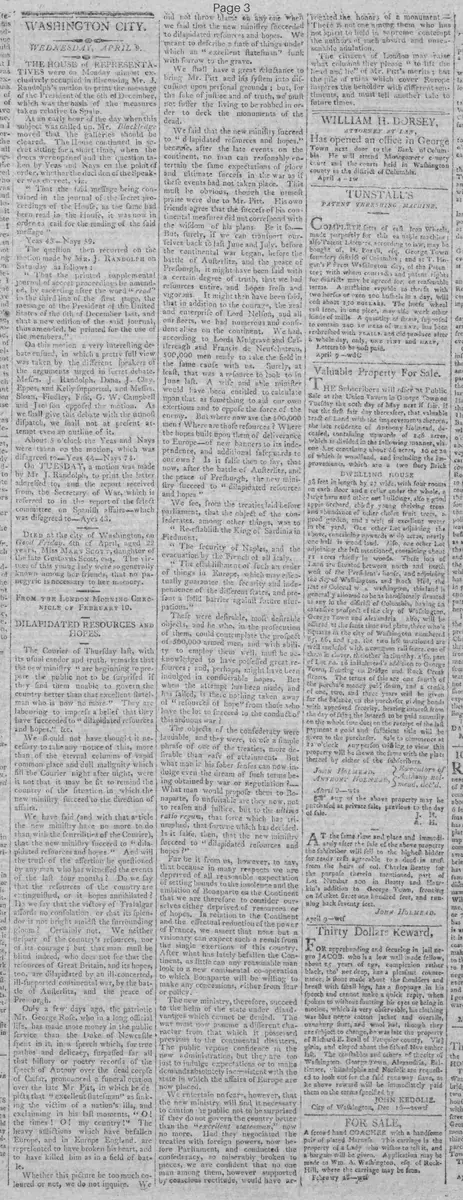
DILAPIDATED RESOURCES AND HOPES.
The Courier of Thursday last, with its usual candor and truth, remarks that the new ministry "are beginning to prepare the public not to be surprised if they find them unable to govern the country better than that excellent statesman who is now no more." They are labouring to impress a belief that they have succeeded to "dilapidated resources and hopes," &c.
We should not have thought it necessary to take any notice of this, more than of the eternal columns of vapid commonplace and dull malignity which fill the Courier night after night, were it not that it may be fit to remind the country of the situation in which the new ministry succeed to the direction of affairs.
We have said (and with that article the new ministry have no more to do than with the currilities of the Courier), that the new ministry succeed to "dilapidated resources and hopes." And will the truth of the assertion be questioned by any man who has witnessed the events of the last four months? Do we say that the resources of the country are extinguished, or its hopes annihilated? Do we say that the victory of Trafalgar affords no consolation, or that its splendour is not bright amidst the surrounding gloom? Certainly not. We neither despair of the country's resources, nor of its courage; but that man must be blind indeed, who does not see that the resources of Great Britain, and its hopes, too, are dilapidated by an ill-concerted, ill-supported continental war, by the battle of Austerlitz, and the peace of Presburg.
Only a few days ago, the patriotic Mr. George Rose, who in a long official life, has made more money in the public service than the Duke of Newcastle spent in it, in a speech which, for true pathos and delicacy, surpassed all that history or poetry records of the speech of Antony over the dead corpse of Caesar, pronounced a funeral oration over the late Mr. Pitt, in which he depicts that "excellent statesman" as sinking the victim of a nation's ills, and exclaiming in his last moments, "O! the times! O! my country!" The heavy afflictions which have befallen Europe, and in Europe England, are represented to have broken his heart, and to have killed him as in a field of battle.
Whether this picture be too much coloured or not, we do not inquire. We did not throw blame on any one when we said that the new ministry succeeded to dilapidated resources and hopes. We "meant to describe a state of things under which an "excellent statesman sunk with sorrow to the grave."
We shall have a great reluctance to bring Mr. Pitt and his system into discussion upon personal grounds; but, for the sake of justice and of truth, we must not suffer the living to be robbed in order to deck the monuments of the dead.
We said that the new ministry succeed to "dilapidated resources and hopes," because, after the late events on the continent, no man can reasonably entertain the same expectations of glory and ultimate success in the war as if these events had not taken place. This must be obvious, though the utmost praise were due to Mr. Pitt. His own friends agree that the success of his continental measures did not correspond with the wisdom of his plans. Be it so.—
But, surely, if we can transport ourselves back to last June and July, before the continental war began, before the battle of Austerlitz, and the peace of Presburg, it might have been said with a certain degree of truth, that we had resources entire, and hopes fresh and vigorous. It might then have been said, that in addition to the courage, the zeal and enterprise of Lord Nelson, and all our fleets, we had numerous and confident allies on the continent. We had, according to Lords Mulgrave and Castlereagh and Francis de Neufchateau, 500,000 men ready to take the field in the same cause with us. Surely, at least, that was a resource to look to in June last. A wise and able minister would have been entitled to calculate upon that as something to aid our own exertions and to oppose the force of the enemy. But where now are the 500,000 men? Where are those resources? Where the hopes built upon them of deliverance to Europe—of new barriers to its independence, and additional safeguards to our own? Is it false then to say, that now, after the battle of Austerlitz, and the peace of Presburg, the new ministry succeed to "dilapidated resources and hopes"?
We see, from the treaties laid before parliament, that the object of the confederates, among other things, was to
"Re-establish the King of Sardinia in Piedmont.
"The security of Naples, and the evacuation by the French of all Italy.
"The establishment of such an order of things in Europe, which may effectually guarantee the security and independence of the different states, and present a solid barrier against future usurpations."
These were desirable, most desirable objects, and he who, in the prosecution of them, could contemplate the prospect of 500,000 armed men, and with ability to employ them well, must be acknowledged to have possessed great resources: and, perhaps, might have been indulged in considerable hopes. But when the attempt has been made, and has failed, is there nothing taken away of "resources or hope" from those who have the lot to succeed to the conduct of this arduous war?
The objects of the confederacy were laudable, and they were, to use a simple phrase of one of the treaties, more desirable than easy of attainment. But what man in his sober senses can now indulge even the dream of such terms being obtained by war or negotiation—What man would propose them to Bonaparte, so unsuitable are they now, not to reason and justice, but to the ultima ratio regum, that force which has triumphed, that fortune which has decided.
Is it false, then, that the new ministry succeed to "dilapidated resources and hopes"?
Far be it from us, however, to say, that because in many respects we are deprived of all reasonable expectation of setting bounds to the insolence and the ambition of Bonaparte on the Continent that we are therefore to consider ourselves either deprived of resources or of hopes. In relation to the Continent and the effectual reduction of the power of France, we assert that none but a visionary can expect such a result from the single exertions of this country.
After what has lately befallen the Continent, as little can any reasonable man look to a new continental co-operation to which Bonaparte will be willing to make any concessions, either from fear or policy.
The new ministry, therefore, succeed to the helm of the state under disadvantages which cannot be denied. The war must now assume a different character from that which it possessed previous to the continental disasters. The public repose confidence in the new administration, but they are too just to indulge expectations or to make demands absolutely inconsistent with the state in which the affairs of Europe are now placed.
We entertain no fears, however, that the new ministry will find it necessary to caution the public not to be surprised if they do not govern the country better than the "excellent statesman," now no more. Had they negotiated the treaties with foreign powers, now before Parliament, and conducted the confederacy, so miserably broken to pieces, we are confident that no one man among them, however supported by conscious rectitude, would have ventured the honors of a monument.
What sub-type of article is it?
What keywords are associated?
What entities or persons were involved?
Where did it happen?
Foreign News Details
Primary Location
Continent
Event Date
Events Of The Last Four Months
Key Persons
Outcome
failure of continental confederacy after battle of austerlitz and peace of presburg; loss of 500,000 allied troops as resource; shifted war prospects with no reasonable expectation of reducing french power on continent without allies; pitt's death attributed to national ills.
Event Details
The article argues that the new British ministry inherits dilapidated resources and hopes due to the ill-concerted continental war, defeat at Austerlitz, and Peace of Presburg, which shattered alliances and objectives like re-establishing the King of Sardinia, securing Naples, evacuating French from Italy, and guaranteeing European independence. Earlier hopes rested on 500,000 allied troops, now lost, altering the war's character against Bonaparte's triumph.