Thank you for visiting SNEWPapers!
Sign up free
Story
May 8, 1937
The Key West Citizen
Key West, Monroe County, Florida
What is this article about?
In the 1930s, PWA and WPA administrators visit Florida's Everglades to push for its national park status, authorized in 1934. The article details the area's unique ecosystem, rare species, historical support efforts, and future as a major attraction and sanctuary.
Clipping
OCR Quality
98%
Excellent
Full Text
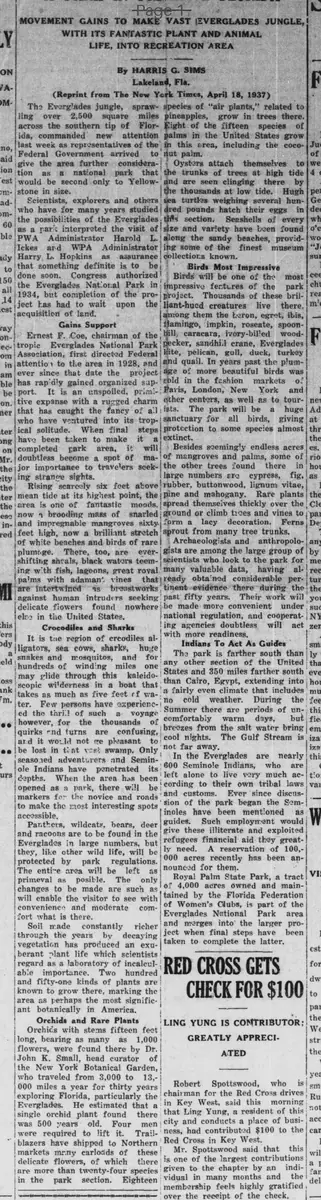
MOVEMENT GAINS TO MAKE VAST EVERGLADES JUNGLE WITH ITS FANTASTIC PLANT AND ANIMAL LIFE, INTO RECREATION AREA
By HARRIS G. SIMS
Lakeland, Fla.
The Everglades jungle, sprawling over 2,500 square miles across the southern tip of Florida, commanded new attention last week as representatives of the Federal Government arrived to give the area further consideration as a national park that would be second only to Yellowstone in size.
Scientists, explorers and others who have for many years studied the possibilities of the Everglades as a park interpreted the visit of PWA Administrator Harold L. Ickes and WPA Administrator Harry L. Hopkins as assurance that something definite is to be done soon. Congress authorized the Everglades National Park in 1934, but completion of the project has had to wait upon the acquisition of land.
Gains Support
Ernest F. Coe, chairman of the Tropical Everglades National Park Association, first directed Federal attention to the area in 1928, and ever since that date the project has rapidly gained organized support. It is an unspoiled, primitive expanse with a rugged charm that has caught the fancy of all who have ventured into its tropical solitude. When final steps have been taken to make it a completed park area, it will doubtless become a spot of major importance to travelers seeking strange sights.
Rising scarcely six feet above mean tide at its highest point, the area is one of fantastic moods, now a brooding mass of snarled and impregnable mangroves sixty feet high, now a brilliant stretch of white beaches and birds of rare plumage. There, too, are ever-shifting shoals, black waters teeming with fish, lagoons, great royal palms with adamantine vines that are intertwined as breastworks against human intruders seeking delicate flowers found nowhere else in the United States.
Crocodiles and Sharks
It is the region of crocodiles, alligators, sea cows, sharks, huge snakes and mosquitoes, and for hundreds of winding miles one may glide through this kaleidoscopic wilderness in a boat that takes as much as five feet of water. Few persons have experienced the thrill of such a voyage however, for the thousands of quirks and turns are confusing, and it would not be pleasant to be lost in that vast swamp. Only seasoned adventurers and Seminole Indians have penetrated its depths. When the area has been opened as a park, there will be markers for the novice and roads to make the most interesting spots accessible.
Panthers, wildcats, bears, deer and raccoons are to be found in the Everglades in large numbers, but they, like other wild life, will be protected by park regulations.
The entire area will be left as primeval as possible. The only changes to be made are such as will enable the visitor to see with convenience and moderate comfort what is there.
Soil made constantly richer through the years by decaying vegetation has produced an exuberant plant life which scientists regard as a laboratory of incalculable importance. Two hundred and fifty-one kinds of plants are known to grow there, marking the area as perhaps the most significant botanically in America.
Orchids and Rare Plants
Orchids with stems fifteen feet long, bearing as many as 1,000 flowers, were found there by Dr. John K. Small, head curator of the New York Botanical Garden, who traveled from 3,000 to 13,000 miles a year for thirty years exploring Florida, particularly the Everglades. He estimated that a single orchid plant found there was 500 years old. Four men were required to lift it. Trail-blazers have shipped to Northern markets many carloads of these delicate flowers, of which there are more than twenty-four species in the park section. Eighteen species of "air plants," related to pineapples, grow in trees there.
Eight of the fifteen species of palms in the United States grow in this area, including the coconut palm.
Oysters attach themselves to the trunks of trees at high tide and are seen clinging there by the thousands at low tide. Huge sea turtles weighing several hundred pounds hatch their eggs in this section.
Seashells of every size and variety have been found along the sandy beaches, providing some of the finest museum collections known.
Birds Most Impressive
Birds will be one of the most impressive features of the park project. Thousands of these brilliant-hued creatures live there, among them the heron, egret, ibis, flamingo, limpkin, roseate spoonbill, caracara, ivory-billed woodpecker, sandhill crane, Everglades kite, pelican, gull, duck, turkey and quail. In years past the plumage of more beautiful birds was sold in the fashion markets of Paris, London, New York and other centers, as well as to tourists. The park will be a huge sanctuary for all birds, giving protection to some species almost extinct.
Besides seemingly endless acres of mangroves and palms, some of the other trees found there in large numbers are cypress, fig, rubber, buttonwood, lignum vitae, pine and mahogany. Rare plants spread themselves thickly over the ground or climb trees and vines to form a lacy decoration. Ferns sprout from many tree trunks.
Archaeologists and anthropologists are among the large group of scientists who look to the park for many valuable data, having already obtained considerable pertinent evidence there during the past fifty years. Their work will be made more convenient under national regulation, and cooperating agencies doubtless will act with more readiness.
Indians To Act As Guides
The park is farther south than any other section of the United States and 350 miles farther south than Cairo, Egypt, extending into a fairly even climate that includes no cold weather. During the Summer there are periods of uncomfortably warm days, but breezes from the salt water bring cool nights. The Gulf Stream is not far away.
In the Everglades are nearly 600 Seminole Indians, who are left alone to live very much according to their own tribal laws and customs. Ever since discussion of the park began the Seminoles have been mentioned as guides. Such employment would give these illiterate and exploited refugees financial aid they greatly need. A reservation of 100,000 acres recently has been announced for them.
Royal Palm State Park, a tract of 4,000 acres owned and maintained by the Florida Federation of Women's Clubs, is part of the Everglades National Park area and merges into the larger project when final steps have been taken to complete the latter.
By HARRIS G. SIMS
Lakeland, Fla.
The Everglades jungle, sprawling over 2,500 square miles across the southern tip of Florida, commanded new attention last week as representatives of the Federal Government arrived to give the area further consideration as a national park that would be second only to Yellowstone in size.
Scientists, explorers and others who have for many years studied the possibilities of the Everglades as a park interpreted the visit of PWA Administrator Harold L. Ickes and WPA Administrator Harry L. Hopkins as assurance that something definite is to be done soon. Congress authorized the Everglades National Park in 1934, but completion of the project has had to wait upon the acquisition of land.
Gains Support
Ernest F. Coe, chairman of the Tropical Everglades National Park Association, first directed Federal attention to the area in 1928, and ever since that date the project has rapidly gained organized support. It is an unspoiled, primitive expanse with a rugged charm that has caught the fancy of all who have ventured into its tropical solitude. When final steps have been taken to make it a completed park area, it will doubtless become a spot of major importance to travelers seeking strange sights.
Rising scarcely six feet above mean tide at its highest point, the area is one of fantastic moods, now a brooding mass of snarled and impregnable mangroves sixty feet high, now a brilliant stretch of white beaches and birds of rare plumage. There, too, are ever-shifting shoals, black waters teeming with fish, lagoons, great royal palms with adamantine vines that are intertwined as breastworks against human intruders seeking delicate flowers found nowhere else in the United States.
Crocodiles and Sharks
It is the region of crocodiles, alligators, sea cows, sharks, huge snakes and mosquitoes, and for hundreds of winding miles one may glide through this kaleidoscopic wilderness in a boat that takes as much as five feet of water. Few persons have experienced the thrill of such a voyage however, for the thousands of quirks and turns are confusing, and it would not be pleasant to be lost in that vast swamp. Only seasoned adventurers and Seminole Indians have penetrated its depths. When the area has been opened as a park, there will be markers for the novice and roads to make the most interesting spots accessible.
Panthers, wildcats, bears, deer and raccoons are to be found in the Everglades in large numbers, but they, like other wild life, will be protected by park regulations.
The entire area will be left as primeval as possible. The only changes to be made are such as will enable the visitor to see with convenience and moderate comfort what is there.
Soil made constantly richer through the years by decaying vegetation has produced an exuberant plant life which scientists regard as a laboratory of incalculable importance. Two hundred and fifty-one kinds of plants are known to grow there, marking the area as perhaps the most significant botanically in America.
Orchids and Rare Plants
Orchids with stems fifteen feet long, bearing as many as 1,000 flowers, were found there by Dr. John K. Small, head curator of the New York Botanical Garden, who traveled from 3,000 to 13,000 miles a year for thirty years exploring Florida, particularly the Everglades. He estimated that a single orchid plant found there was 500 years old. Four men were required to lift it. Trail-blazers have shipped to Northern markets many carloads of these delicate flowers, of which there are more than twenty-four species in the park section. Eighteen species of "air plants," related to pineapples, grow in trees there.
Eight of the fifteen species of palms in the United States grow in this area, including the coconut palm.
Oysters attach themselves to the trunks of trees at high tide and are seen clinging there by the thousands at low tide. Huge sea turtles weighing several hundred pounds hatch their eggs in this section.
Seashells of every size and variety have been found along the sandy beaches, providing some of the finest museum collections known.
Birds Most Impressive
Birds will be one of the most impressive features of the park project. Thousands of these brilliant-hued creatures live there, among them the heron, egret, ibis, flamingo, limpkin, roseate spoonbill, caracara, ivory-billed woodpecker, sandhill crane, Everglades kite, pelican, gull, duck, turkey and quail. In years past the plumage of more beautiful birds was sold in the fashion markets of Paris, London, New York and other centers, as well as to tourists. The park will be a huge sanctuary for all birds, giving protection to some species almost extinct.
Besides seemingly endless acres of mangroves and palms, some of the other trees found there in large numbers are cypress, fig, rubber, buttonwood, lignum vitae, pine and mahogany. Rare plants spread themselves thickly over the ground or climb trees and vines to form a lacy decoration. Ferns sprout from many tree trunks.
Archaeologists and anthropologists are among the large group of scientists who look to the park for many valuable data, having already obtained considerable pertinent evidence there during the past fifty years. Their work will be made more convenient under national regulation, and cooperating agencies doubtless will act with more readiness.
Indians To Act As Guides
The park is farther south than any other section of the United States and 350 miles farther south than Cairo, Egypt, extending into a fairly even climate that includes no cold weather. During the Summer there are periods of uncomfortably warm days, but breezes from the salt water bring cool nights. The Gulf Stream is not far away.
In the Everglades are nearly 600 Seminole Indians, who are left alone to live very much according to their own tribal laws and customs. Ever since discussion of the park began the Seminoles have been mentioned as guides. Such employment would give these illiterate and exploited refugees financial aid they greatly need. A reservation of 100,000 acres recently has been announced for them.
Royal Palm State Park, a tract of 4,000 acres owned and maintained by the Florida Federation of Women's Clubs, is part of the Everglades National Park area and merges into the larger project when final steps have been taken to complete the latter.
What sub-type of article is it?
Historical Event
Curiosity
What themes does it cover?
Nature
Exploration
Triumph
What keywords are associated?
Everglades National Park
Federal Visit
Tropical Wilderness
Flora And Fauna
Seminole Guides
Conservation Effort
What entities or persons were involved?
Harold L. Ickes
Harry L. Hopkins
Ernest F. Coe
Dr. John K. Small
Seminole Indians
Where did it happen?
Everglades, Southern Tip Of Florida
Story Details
Key Persons
Harold L. Ickes
Harry L. Hopkins
Ernest F. Coe
Dr. John K. Small
Seminole Indians
Location
Everglades, Southern Tip Of Florida
Event Date
1934
Story Details
Federal officials visit the Everglades to advance its establishment as a national park authorized by Congress in 1934, highlighting its vast unspoiled jungle with unique plants, animals, and potential for recreation and scientific study.