Thank you for visiting SNEWPapers!
Sign up free
Story
November 20, 1914
Ladysmith News Budget
Ladysmith, Rusk County, Wisconsin
What is this article about?
Reminiscences of local pioneers like J. Fritz on abundant game, deer habits, and hunting methods in the Ladysmith area around 1893, including survival during fires and clever deer strategies.
Clipping
OCR Quality
95%
Excellent
Full Text
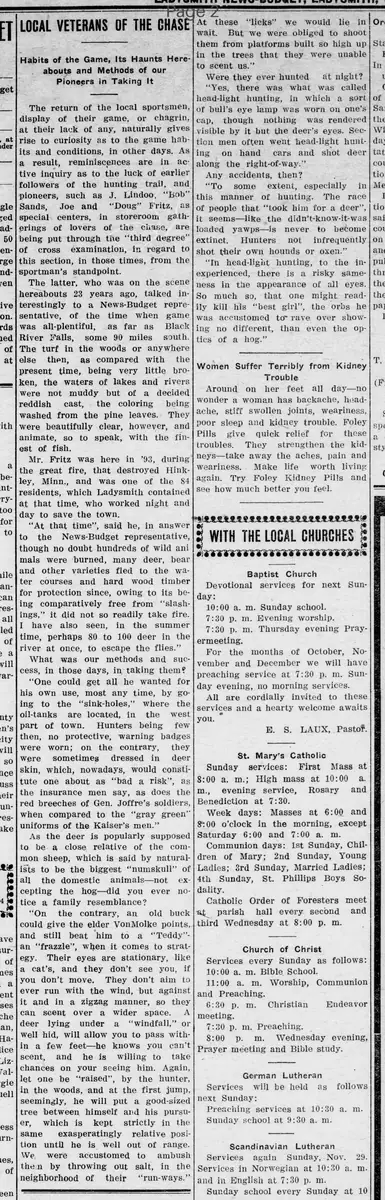
LOCAL VETERANS OF THE CHASE
Habits of the Game, Its Haunts Hereabouts and Methods of our Pioneers in Taking It
The return of the local sportsmen, display of their game, or chagrin at their lack of any, naturally gives rise to curiosity as to the game habits and conditions, in other days. As a result, reminiscences are in active inquiry as to the luck of earlier followers of the hunting trail, and pioneers, such as J. Lindoo, "Bob" Sands, Joe and "Doug" Fritz, as special centers, in storeroom gatherings of lovers of the chase, are being put through the "third degree" of cross examination, in regard to this section, in those times, from the sportsman's standpoint.
The latter, who was on the scene hereabouts 23 years ago, talked interestingly to a News-Budget representative, of the time when game was all-plentiful, as far as Black River Falls, some 90 miles south. The turf in the woods or anywhere else then, as compared with the present time, being very little broken, the waters of lakes and rivers were not muddy but of a decided reddish cast, the coloring being washed from the pine leaves. They were beautifully clear, however, and animate, so to speak, with the finest of fish.
Mr. Fritz was here in '93, during the great fire that destroyed Hinckley, Minn., and was one of the 84 residents which Ladysmith contained at that time, who worked night and day to save the town.
"At that time", said he, in answer to the News-Budget representative, though no doubt hundreds of wild animals were burned, many deer, bear and other varieties fled to the water courses and hard wood timber for protection since, owing to its being comparatively free from "slashings," it did not so readily take fire. I have also seen, in the summer time, perhaps 80 to 100 deer in the river at once, to escape the flies."
What was our methods and success, in those days, in taking them?
"One could get all he wanted for his own use, most any time, by going to the "sink-holes," where the oil-tanks are located, in the west part of town, hunters being few then. no protective warning badges were worn; on the contrary, they were sometimes dressed in deer skin, which, nowadays, would constitute one about as "bad a risk", as the insurance men say, as does the red breeches of Gen. Joffre's soldiers, when compared to the "gray green" uniforms of the Kaiser's men."
As the deer is popularly supposed to be a close relative of the common sheep, which is said by naturalists to be the biggest "numskull" of all the domestic animals—not excepting the hog—did you ever notice a family resemblance?
"On the contrary, an old buck could give the elder Von Moltke points, and still beat him to a "Teddy" an "frazzle", when it comes to strategy. Their eyes are stationary, like a cat's, and they don't see you, if you don't move. They don't aim to ever run with the wind, but against it and in a zigzag manner, so they can scent over a wider space. A deer lying under a "windfall," or well hid, will allow you to pass within a few feet—he knows you can't scent, and he is willing to take chances on your seeing him. Again, let one be "raised", by the hunter, in the woods, and at the first jump, seemingly, he will put a good-sized tree between himself and his pursuer, which is kept strictly in the same exasperatingly relative position until he is well out of range.
We were accustomed to ambush them by throwing out salt, in the neighborhood of their "run-ways."
At these "licks" we would lie in wait. But we were obliged to shoot them from platforms built so high up in the trees that they were unable to scent us."
Were they ever hunted at night?
"Yes, there was what was called head-light hunting, in which a sort of bull's eye lamp was worn on one's cap, though nothing was rendered visible by it but the deer's eyes. Section men often went head-light hunt ing on hand cars and shot deer along the right-of-way."
Any accidents, then?
"To some extent, especially in this manner of hunting. The race of people that "took him for a deer" it seems—like the didn't-know-it-was-loaded yawps—is never to become extinct. Hunters not infrequently shot their own hounds or oxen."
"In head-light hunting, to the inexperienced, there is a risky sameness in the appearance of all eyes. So much so, that one might readily kill his "best girl", the orbs he was accustomed to rave over showing no different, than even the optics of a hog."
Habits of the Game, Its Haunts Hereabouts and Methods of our Pioneers in Taking It
The return of the local sportsmen, display of their game, or chagrin at their lack of any, naturally gives rise to curiosity as to the game habits and conditions, in other days. As a result, reminiscences are in active inquiry as to the luck of earlier followers of the hunting trail, and pioneers, such as J. Lindoo, "Bob" Sands, Joe and "Doug" Fritz, as special centers, in storeroom gatherings of lovers of the chase, are being put through the "third degree" of cross examination, in regard to this section, in those times, from the sportsman's standpoint.
The latter, who was on the scene hereabouts 23 years ago, talked interestingly to a News-Budget representative, of the time when game was all-plentiful, as far as Black River Falls, some 90 miles south. The turf in the woods or anywhere else then, as compared with the present time, being very little broken, the waters of lakes and rivers were not muddy but of a decided reddish cast, the coloring being washed from the pine leaves. They were beautifully clear, however, and animate, so to speak, with the finest of fish.
Mr. Fritz was here in '93, during the great fire that destroyed Hinckley, Minn., and was one of the 84 residents which Ladysmith contained at that time, who worked night and day to save the town.
"At that time", said he, in answer to the News-Budget representative, though no doubt hundreds of wild animals were burned, many deer, bear and other varieties fled to the water courses and hard wood timber for protection since, owing to its being comparatively free from "slashings," it did not so readily take fire. I have also seen, in the summer time, perhaps 80 to 100 deer in the river at once, to escape the flies."
What was our methods and success, in those days, in taking them?
"One could get all he wanted for his own use, most any time, by going to the "sink-holes," where the oil-tanks are located, in the west part of town, hunters being few then. no protective warning badges were worn; on the contrary, they were sometimes dressed in deer skin, which, nowadays, would constitute one about as "bad a risk", as the insurance men say, as does the red breeches of Gen. Joffre's soldiers, when compared to the "gray green" uniforms of the Kaiser's men."
As the deer is popularly supposed to be a close relative of the common sheep, which is said by naturalists to be the biggest "numskull" of all the domestic animals—not excepting the hog—did you ever notice a family resemblance?
"On the contrary, an old buck could give the elder Von Moltke points, and still beat him to a "Teddy" an "frazzle", when it comes to strategy. Their eyes are stationary, like a cat's, and they don't see you, if you don't move. They don't aim to ever run with the wind, but against it and in a zigzag manner, so they can scent over a wider space. A deer lying under a "windfall," or well hid, will allow you to pass within a few feet—he knows you can't scent, and he is willing to take chances on your seeing him. Again, let one be "raised", by the hunter, in the woods, and at the first jump, seemingly, he will put a good-sized tree between himself and his pursuer, which is kept strictly in the same exasperatingly relative position until he is well out of range.
We were accustomed to ambush them by throwing out salt, in the neighborhood of their "run-ways."
At these "licks" we would lie in wait. But we were obliged to shoot them from platforms built so high up in the trees that they were unable to scent us."
Were they ever hunted at night?
"Yes, there was what was called head-light hunting, in which a sort of bull's eye lamp was worn on one's cap, though nothing was rendered visible by it but the deer's eyes. Section men often went head-light hunt ing on hand cars and shot deer along the right-of-way."
Any accidents, then?
"To some extent, especially in this manner of hunting. The race of people that "took him for a deer" it seems—like the didn't-know-it-was-loaded yawps—is never to become extinct. Hunters not infrequently shot their own hounds or oxen."
"In head-light hunting, to the inexperienced, there is a risky sameness in the appearance of all eyes. So much so, that one might readily kill his "best girl", the orbs he was accustomed to rave over showing no different, than even the optics of a hog."
What sub-type of article is it?
Historical Event
Adventure
Curiosity
What themes does it cover?
Nature
Exploration
Survival
What keywords are associated?
Deer Hunting
Pioneer Reminiscences
Game Habits
Ladysmith History
Wildlife Survival
What entities or persons were involved?
J. Lindoo
"Bob" Sands
Joe Fritz
"Doug" Fritz
Where did it happen?
Ladysmith And Surrounding Areas, Wisconsin
Story Details
Key Persons
J. Lindoo
"Bob" Sands
Joe Fritz
"Doug" Fritz
Location
Ladysmith And Surrounding Areas, Wisconsin
Event Date
1893
Story Details
Pioneers reminisce about abundant game like deer and fish in the clear, reddish waters around Ladysmith in 1893, deer fleeing fires and flies to rivers, clever deer strategies evading hunters, and methods like salting runways, tree platforms, and headlight hunting, with risks of accidents.